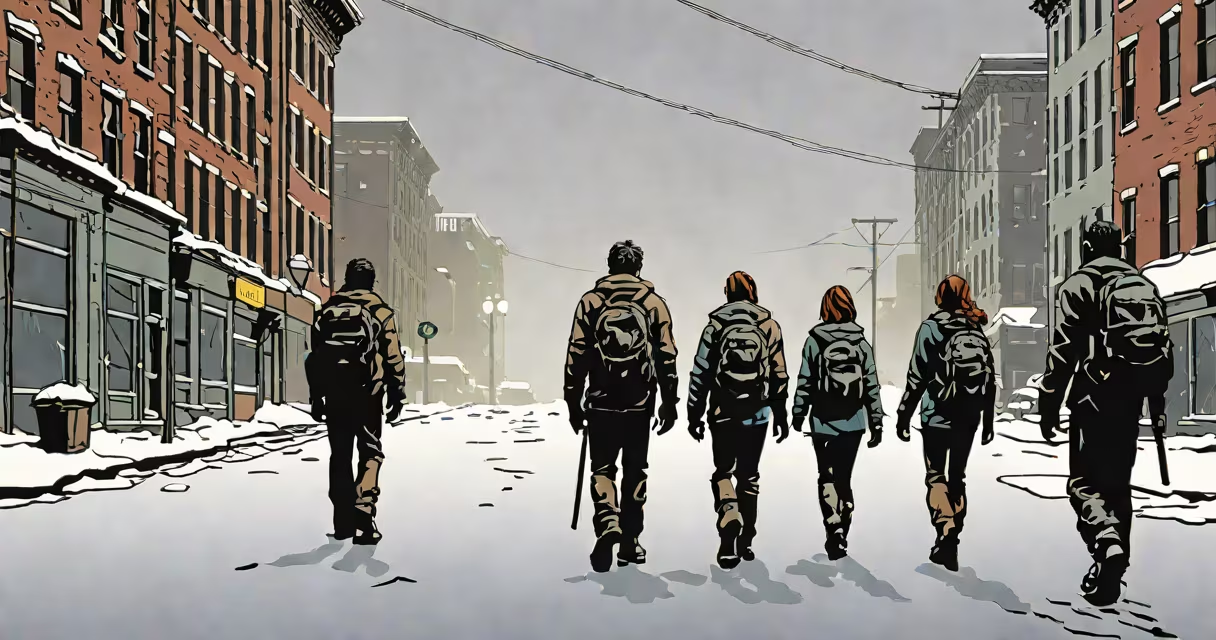
The Last of Us Part is a 2020 action-adventure game developed by Naughty Dog and published by Sony Interactive Entertainment. It is the direct sequel to The Last of Us (2013), continuing the story of Joel and Ellie as they traverse a post-apocalyptic United States ravaged by a fungal infection that turns humans into aggressive, zombie-like creatures.
The game follows Joel, a hardened survivor, and Ellie, a teenage girl immune to the infection, as they process across the American Midwest. Their mission: deliver Ellie to a resistance group called the Fireflies, who may hold the key to a cure. The narrative emphasizes emotional weight, moral ambiguity, and the cost of survival in a world where trust is rare and violence is routine.
Set in 2036, nearly 20 years after the outbreak began, the game expands on the original's themes of grief, loyalty, and fatherhood. Players control Joel and Ellie through environments ranging from abandoned urban centers to rural forests, going through both hostile human factions and infected creatures. Combat is tense and resource-limited, forcing players to rely on stealth, environmental traps, and improvised weapons.
The gameplay blends third-person exploration, stealth, and combat. Movement is deliberate-running drains stamina quickly, and crouching reduces noise. Players must manage limited supplies: ammunition, health kits, and crafting materials like shivs and molotovs. Crafting occurs at workbenches, requiring specific components gathered from scavenged locations.
Combat is asymmetric. Infected enemies-such as runners, stalkers, and clickers-require different tactics. Runners are fast and aggressive; stalkers move silently and attack from behind; clickers use echolocation and must be disoriented with noise. Human enemies, including cultists and military patrols, often fight in groups and require careful planning.
Ellie plays a central role beyond narrative. She can assist in combat, provide cover, or trigger environmental hazards. Her presence affects player choices: protecting her may slow progress, while leaving her behind risks permanent consequences. The game tracks player decisions through a "moral compass" system, influencing dialogue and outcomes.
The game's foundation lies in its storytelling, character design, and environmental detail. Narrative pacing is slow and deliberate, allowing moments of quiet reflection between action sequences. Cutscenes are rendered in cinematic quality, using motion capture and facial animation to convey subtle emotions.
Sound design reinforces immersion. Ambient noise-wind, distant screams, radio static-builds tension. Music by Gustavo Santaolalla underscores emotional beats with sparse guitar motifs. The score won a BAFTA for Best Original Score in 2021.
Environmental storytelling is pervasive. Abandoned homes contain personal items: a child's drawing, a wedding ring, a half-finished letter. These details imply lives lost and relationships fractured. A single photograph of a family in a burned-out school suggests the scale of the pandemic's impact.
The Last of Us Part is officially titled The Last of Us Part II. It is not a standalone expansion but a full sequel with new mechanics, a revised art style, and a nonlinear narrative structure. It features dual protagonists: Ellie in the first half, and Abby in the second.
| Feature | The Last of Us Part | The Last of Us Part II |
|---|---|---|
| Release Year | 2020 | 2020 |
| Protagonist | Joel | Ellie (first half), Abby (second half) |
| Setting | Jackson, Wyoming; Boston; Salt Lake City | Seattle; Portland; coastal towns |
| Gameplay Focus | Survival, stealth, linear progression | Combat variety, environmental interaction, branching paths |
| Themes | Grief, fatherhood, sacrifice | Revenge, trauma, cycle of violence |
A common misconception is that The Last of Us Part is a downloadable expansion. It is not. It is a full-length game released alongside the original's remastered version. The title "Part" refers to its position in the series' arc-not a division of content.
The game was critically acclaimed upon release. It earned a 94/100 average on Metacritic, based on 105 reviews. Critics praised its narrative depth, voice acting, and technical execution. The New York Times called it "one of the most emotionally resonant video games ever made."
Its influence extends beyond gaming. The story's exploration of trauma and moral compromise sparked academic discussion. A 2021 study from the University of Southern California analyzed player empathy toward characters, finding that 78% of participants reported feeling emotionally invested in Ellie's process.
It also inspired a live-action television adaptation by HBO, premiering in 2023. The series stars Pedro Pascal as Joel and Bella Ramsey as Ellie. The show closely follows the game's plot, with minor changes to pacing and character development. It received 19 Primetime Emmy nominations, winning five.
Many assume The Last of Us Part is a multiplayer game. It is not. It is a single-player narrative experience. The absence of online features reflects Naughty Dog's focus on emotional storytelling over competitive mechanics.
Another error is equating the game's ending with a simple victory or defeat. The finale is intentionally ambiguous. After killing a man who killed his daughter, Joel chooses to protect Ellie-even if it means lying to her about the truth. This moment is not resolved with a clear moral verdict. As game designer Neil Druckmann stated in a 2021 interview, "We wanted to show that love isn't always clean. Sometimes it's messy, selfish, and dangerous."
One non-obvious fact: the game's music was composed in reverse. Santaolalla recorded melodies first, then reversed them to create a haunting, dreamlike effect. This technique was used in the track "I'm Not Your Mother," which plays during a key scene in Seattle.
In one of the game's most memorable sequences, Joel and Ellie enter a church in Jackson, Wyoming. The building is filled with infected children-"bloaters"-who were previously sheltered by a religious cult. The environment is dimly lit, with candles flickering and stained glass casting colored shadows.
Players must go through narrow corridors, avoid detection, and use fire to distract the bloaters. A single mistake triggers a chain reaction: the sound of breaking glass alerts nearby enemies. The scene lasts 12 minutes and requires precise timing and quiet movement.
This sequence exemplifies the game's design philosophy: tension arises not from spectacle, but from consequence. A misstep isn't punished with instant death-it's punished with psychological strain. The player feels the weight of every decision.
I played The Last of Us Part during a power outage in winter. My console ran on battery. The screen flickered intermittently, and audio crackled. When Ellie whispered, "I don't want to die," the distortion made her voice sound like a memory. That moment-the isolation, the fragility-felt real. I paused, not because I needed to save, but because I didn't want to leave her alone.
That's the power of the game. It doesn't just tell a story. It makes you feel responsible for it.
The Last of Us Part is not just a video game. It is a layered narrative about loss, identity, and the choices people make when everything else is gone. Its emotional depth, technical precision, and thematic complexity have redefined what games can achieve.
For those seeking a story of survival and sacrifice, The Last of Us Part delivers. It challenges players to confront uncomfortable truths-not through combat, but through silence, choice, and connection.
If you're drawn to stories where love and violence coexist, where endings aren't tidy, and where the line between right and wrong blurs, then The Last of Us Part is essential. It's not just a game. It's a mirror.