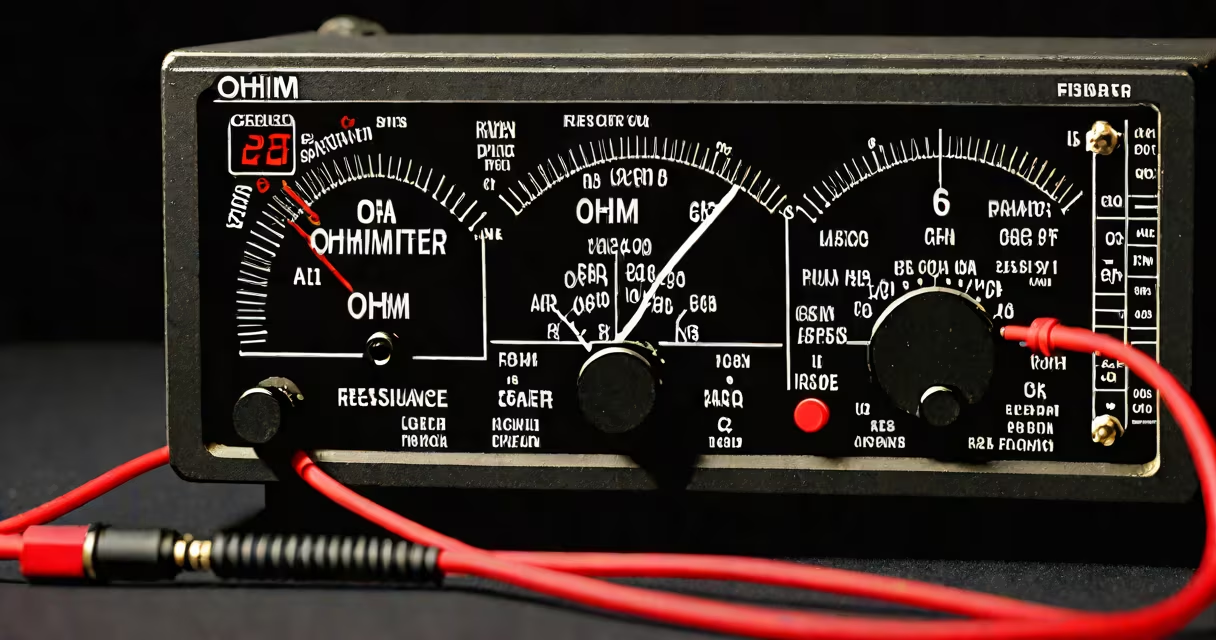
An ohmmeter measures electrical resistance in ohms, quantifying how much a material opposes the flow of electric current. It's used to test components, wires, and circuits for continuity, open connections, or degraded materials.
Resistance is a fundamental property in electrical systems. When current flows through a conductor, electrons collide with atoms, converting energy into heat. The higher the resistance, the less current passes under a given voltage. Ohmmeters apply a known voltage, measure resulting current, then calculate resistance using Ohm's Law: R = V/I.
Modern digital ohmmeters display results numerically, often with auto-ranging and overload protection. Analog models use a needle on a scale, requiring manual range selection. Both types detect open circuits (infinite resistance), short circuits (near-zero resistance), and normal resistive values.
Ohmmeters operate by injecting a small, safe test current into a circuit or component. The device measures the voltage drop across the component and calculates resistance using Ohm's Law. This process requires the circuit to be de-energized-no external power applied-because live voltage interferes with readings and risks damaging the meter.
For accurate results, connect the ohmmeter's probes to both ends of the component being tested. For example, measuring a 100-ohm resistor: set the meter to the 200-ohm range, touch the probes to each end, and read the displayed value. A stable reading near 100 indicates proper function. A reading of "OL" (overload) means the circuit is open.
Some ohmmeters include a continuity test mode. When resistance drops below 50 ohms, the device emits a beep, signaling a complete path. This feature is useful for checking wiring integrity without needing to interpret numbers.
Ohmmeters come in standalone units and integrated forms. Multimeters combine ohmmeter, voltmeter, and ammeter functions. Digital multimeters (DMMs) offer precision, auto-ranging, and data hold. Analog multimeters require visual interpretation but remain common in field work due to durability.
| Type | Range | Use Case | Accuracy |
|---|---|---|---|
| Digital ohmmeter | 0.1 Ω - 20 MΩ | PCB testing, component verification | ±0.5% |
| Analog ohmmeter | 1 Ω - 10 MΩ | Field maintenance, quick checks | ±2% |
| Four-wire Kelvin measurement | 0.001 Ω - 100 kΩ | High-precision lab work, low-resistance testing | ±0.1% |
Industrial applications include verifying motor windings, checking fuse integrity, and diagnosing faulty sensors. In electronics repair, an ohmmeter detects burned-out resistors or broken traces on circuit boards. For example, a 1 kΩ resistor showing 10 kΩ resistance likely failed due to overheating.
A non-obvious fact: ohmmeters cannot measure resistance in live circuits. Attempting to do so may cause false readings or damage the meter. Always disconnect power and discharge capacitors before testing.
Ohmmeters are often confused with multimeters, but they are distinct tools. A multimeter combines multiple measurements-voltage, current, resistance-into one device. An ohmmeter is a single-function instrument focused solely on resistance.
Another confusion arises with continuity testers. While both check for complete paths, continuity testers only indicate "open" or "closed" with a beep. Ohmmeters provide numerical resistance values, allowing detection of high-resistance faults that a beep might miss.
Some users assume ohmmeters measure current or voltage. They do not. Measuring current requires an ammeter in series; voltage requires a voltmeter in parallel. Mixing these functions leads to incorrect readings and potential equipment damage.
In a 2021 study by the National Institute of Standards and Technology (NIST), technicians used digital ohmmeters to diagnose intermittent failures in automotive wiring harnesses. A 12-volt system showed no voltage drop, but resistance tests revealed a corroded terminal with 1.8 kΩ resistance-well above acceptable limits. Replacing the connector restored functionality.
During a personal troubleshooting session, I used a Fluke 87V multimeter to test a blown 120V AC heater element. With power off, I measured across the terminals. The display read "OL," confirming an open circuit. Replacing the heating element resolved the issue. This confirmed the ohmmeter's role in isolating component failure.
Understanding what does ohmmeter measure connects to broader electrical concepts. Resistance relates directly to conductance-the inverse of resistance, measured in siemens. High resistance means low conductance; low resistance means high conductance.
For context, a copper wire has ~0.017 Ω·m resistivity. A 1-meter length of 1 mm² cross-section wire has ~17 mΩ resistance. An ohmmeter can verify such values during quality control in manufacturing.
Ohmmeters are essential in electronics, industrial maintenance, and safety testing. Their ability to detect hidden faults prevents equipment failure and ensures operational reliability. Knowing what does ohmmeter measure enables accurate diagnosis and informed decision-making.