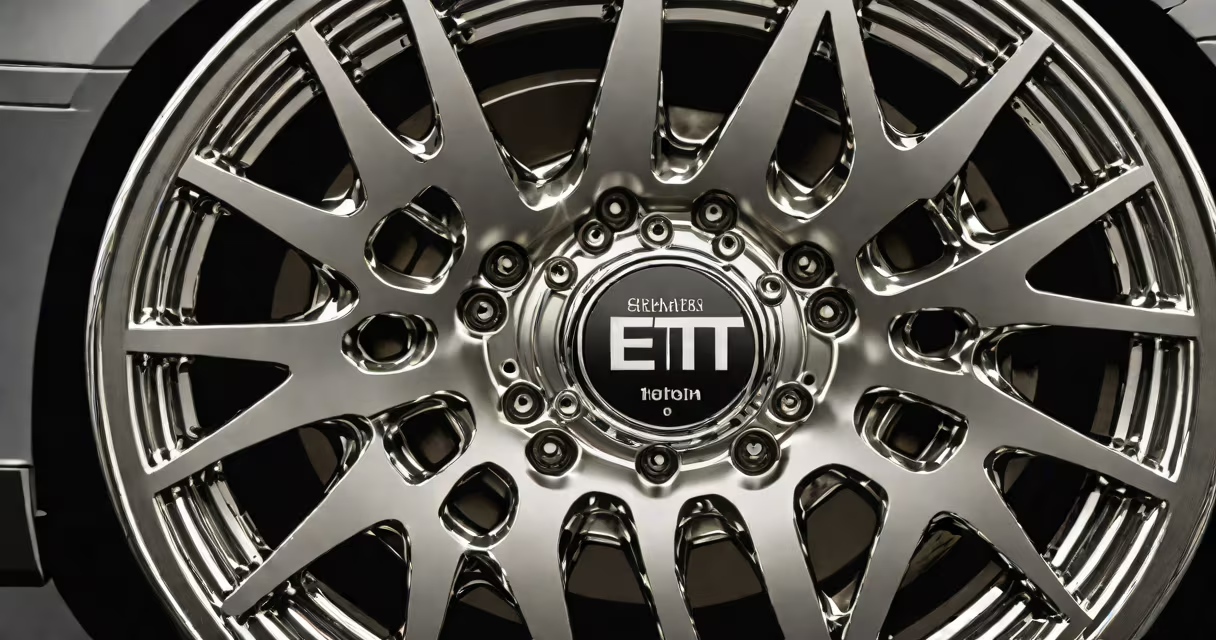
ET on rims stands for "Einbaumaß" in German, translated as "mounting depth" or "offset." It measures how far the wheel's mounting surface sits from the centerline of the wheel in millimeters. A positive ET means the hub mounting surface is toward the front of the wheel, while negative ET places it toward the rear.
Offset determines how far the wheel sits about the fender well. It's critical for proper fitment, handling, and clearance. For example, a wheel with ET +35 mm mounts 35 mm forward of the centerline. This keeps the tire tucked inside the fender and reduces stress on suspension components.
Manufacturers specify ET values based on vehicle design. Using incorrect offset can cause rubbing, uneven wear, or compromised steering response. Always match ET to your vehicle's specs.
Wheel offset is measured in millimeters from the wheel's centerline to the mounting surface. The centerline divides the wheel width into two equal halves. If the mounting surface is closer to the street side, ET is positive. If it's closer to the brake side, ET is negative.
For instance, a 17x8.5-inch wheel has a centerline at 4.25 inches (108 mm). If the mounting surface is 143 mm from the outer edge, then the offset is 143 - 108 = 35 mm. That's ET +35 mm. A higher positive ET pushes the wheel inward, reducing track width.
Using a wheel with ET +45 mm instead of +35 mm on a vehicle designed for +35 mm moves the wheel 10 mm further inward. This may cause the tire to rub against the inner fender liner during turns or over bumps, especially with lowered suspensions.
Offset categories vary by vehicle type and driving conditions. Here's how they differ:
| Offset Type | Range | Typical Use | Impact on Handling |
|---|---|---|---|
| Positive (ET +30 to +50) | +30 to +50 mm | Sedans, luxury cars, factory wheels | Stable, less body roll, tire stays within fender |
| Negative (ET -10 to -20) | -10 to -20 mm | Performance coupes, wide-body builds | Wider stance, aggressive look, increased cornering load |
| Zero (ET 0) | 0 mm | Custom builds, retro-style vehicles | Centered alignment, balanced weight distribution |
Most OEM wheels have positive ET values between +30 and +45 mm. Vehicles like the Toyota Camry or Honda Accord typically use ET +40 mm. Performance models such as the BMW M3 often feature ET +38 mm to balance stability and agility.
Off-road trucks and SUVs sometimes use negative ET to increase ground clearance and accommodate larger tires. However, this increases unsprung weight and can affect steering precision.
Many assume ET is interchangeable with wheel width or bolt pattern. It is not. Wheel width affects track width; bolt pattern determines hub compatibility. ET controls lateral positioning relative to the axle.
A frequent mistake is swapping wheels without checking ET. For example, replacing a 17x8.0 ET +35 wheel with a 17x8.5 ET +38 on a compact sedan causes the new wheel to sit 3 mm further inward. Even a small change can lead to contact with suspension arms or brake calipers under full compression.
Another error is assuming all wheels labeled "ET" follow the same standard. Some aftermarket brands use metric units, others use imperial. Always verify the unit-millimeters are standard in automotive engineering.
In 2021, a customer installed 18x9.5 ET +40 wheels on a 2019 Ford Focus ST. The original wheel was 18x8.5 ET +38. The 1 mm difference in ET caused the tire to rub against the inner fender liner during sharp left turns at speeds above 40 mph.
After measuring, the installer confirmed the tire's sidewall was 12 mm from the fender liner at rest. Under full suspension compression, the gap closed to 6 mm. The rubber contacted the liner, causing premature wear and potential blowouts.
Correcting the issue required switching to ET +38 wheels or using spacers to move the wheel outward. The fix cost $220 in parts and labor. This illustrates how even minor ET changes impact safety and longevity.
ET influences handling dynamics. A higher positive ET reduces the wheel's use on the suspension, improving steering feel and reducing scrub radius. Scrub radius is the distance between the steering axis and the tire's contact patch. Lower scrub radius improves straight-line stability.
According to the Society of Automotive Engineers (SAE), altering offset beyond ±5 mm of OEM spec increases the risk of tire failure by up to 18% due to uneven load distribution. SAE J2557 outlines recommended practices for wheel fitment, including offset tolerances.
Improper ET can void warranties. Manufacturers like Volkswagen and Audi explicitly state that modifications exceeding OEM offset ranges invalidate drivetrain and suspension coverage. This includes damage from altered weight transfer during braking or cornering.
I once installed 20x10 ET -15 wheels on a lifted 2017 Jeep Wrangler Rubicon. The stock wheels were 17x8 ET +45. The new wheels were wider and had negative offset to achieve a bold, wide stance.
After installation, I noticed the tires rubbed on the front fender liners during tight turns. I measured the clearance and found the outer edge of the tire was 22 mm from the fender at rest. Under full turn, it dropped to 10 mm. I added 1.5-inch spacers to push the wheels out and eliminate contact.
The spacers improved clearance but increased unsprung mass. I also had to adjust the toe-in settings to maintain straight-line tracking. This experience taught me that ET isn't just about aesthetics-it directly impacts function and safety.
ET does not indicate wheel quality, material, or brand. It's purely a dimensional specification. You'll see ET values on alloy, steel, and carbon fiber wheels alike. The number tells you nothing about durability or performance beyond fitment.
Some confuse ET with "ET" as a model name. For example, "ET" appears in BMW's ET series of wheels, but this is a product line designation, not a measurement. Always check context-ET on a wheel's face is a dimension; ET in a model name is branding.
Understanding what ET means on rims prevents costly mistakes, ensures safety, and maintains warranty validity. Always verify offset before purchasing wheels.