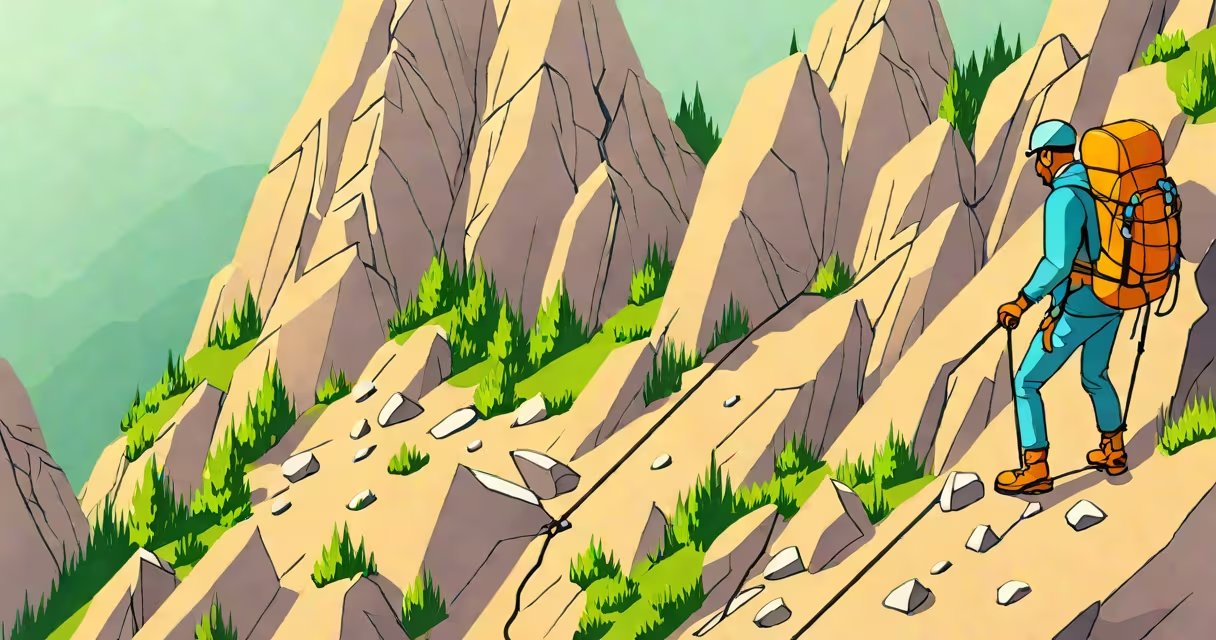
Descent means moving downward in position, rank, or condition. It describes a fall, decline, or downward motion-whether physical, social, or metaphorical.
When someone descends a staircase, they move from higher to lower steps. When a company's stock price drops sharply, it experiences a financial descent. A culture may enter a period of moral or artistic descent when standards decline. The word applies across physical space, social hierarchy, and abstract states.
Descent is not simply "going down." It implies direction, often with consequences. A descent from a peak may be dangerous. A descent in reputation can damage relationships. The term carries weight beyond mere location change-it signals change in value, stability, or control.
Descent operates through directionality. It requires a reference point: a starting height, status level, or state. Without a baseline, "down" has no meaning. A plane descending from 30,000 feet uses altitude as the frame of reference. A politician losing public favor undergoes a political descent relative to their previous standing.
In physics, descent involves gravity. Objects fall toward Earth unless counteracted. But in human contexts, descent is often intentional or symbolic. A monk may descend into a monastery to live a simpler life. A leader may step down from power to allow succession.
Descent can be gradual or sudden. A slow descent in temperature occurs over hours. A rapid descent in a stock market crash happens in minutes. The speed doesn't change the core meaning-only the impact.
Descent appears in several distinct forms:
| Type | Description | Example |
|---|---|---|
| Physical | Movement downward in space | A hiker descending a cliff path |
| Social | Decline in status or influence | A once-useful family falling into obscurity |
| Emotional | Downward shift in mood or mental state | Depression as a psychological descent |
| Abstract | Decline in quality, performance, or integrity | The descent of a nation into corruption |
Physical descent is measurable. You can track elevation loss using GPS or altimeters. Social descent is harder to quantify but documented through historical records. For example, the Roman Empire's decline in the 5th century is widely studied as a social and political descent.
Abstract descent often carries judgment. Saying "the film's quality took a descent" suggests a loss of artistic merit. This usage reflects cultural values about excellence and standards.
Descent is frequently mistaken for "descent" in other languages or similar-sounding words. In French, "descendre" means "to descend," but "descendance" refers to lineage-a different concept entirely. In English, people sometimes confuse descent with "assent," which means agreement or upward movement.
Another error: equating descent with failure. Not all descent is negative. A person may choose to descend in lifestyle-moving from city life to rural living-to reduce stress and simplify existence. This is a voluntary, positive descent.
Also, descent is not synonymous with "fall." A fall implies loss of balance or accident. Descent can be controlled. A skydiver free-falls (a form of descent), but so does a glider pilot who descends deliberately. The difference lies in intent, not just motion.
During the 2008 global financial crisis, major banks experienced a rapid descent in value. Lehman Brothers' stock dropped from $60 per share in early 2008 to under $10 by September. That was a 83% descent in less than a year.
This wasn't random. It stemmed from risky lending practices, housing market collapse, and poor oversight. The descent was systemic-linked to policy failures and market behavior. Regulators later cited this event as a case study in institutional descent due to unchecked risk.
Even after the crisis, many institutions never recovered their former status. Their descent became permanent. This illustrates how descent can be irreversible and have long-term effects.
I once descended Mount Rainier during a guided climb. We started at 14,410 feet, the summit. The descent took four hours. Our pace slowed with fatigue and snow accumulation. At 8,000 feet, we reached a ranger station. The drop wasn't just physical-it felt emotional. The high-altitude euphoria faded as we returned to normal air pressure.
That experience showed me that descent isn't just about going down. It's about adaptation. Your body adjusts to lower oxygen levels. Your mind shifts from focus on the summit to survival on the way back. The descent changed my understanding of effort, recovery, and perspective.
Descent contrasts with ascent-the upward movement. While both involve vertical change, they carry different connotations. Ascent suggests progress, achievement, or growth. Descent often signals loss, decline, or surrender.
However, this isn't always true. In some contexts, descent is necessary. Pilots descend to land safely. Athletes descend from peaks to train. Religious traditions feature descent as sacred-Jesus descending into hell in Christian doctrine, or the goddess Inanna descending to the underworld in Sumerian myth.
These examples show descent isn't inherently negative. It's contextual. The same word can describe a disaster or a ritual. Meaning depends on setting, intention, and outcome.