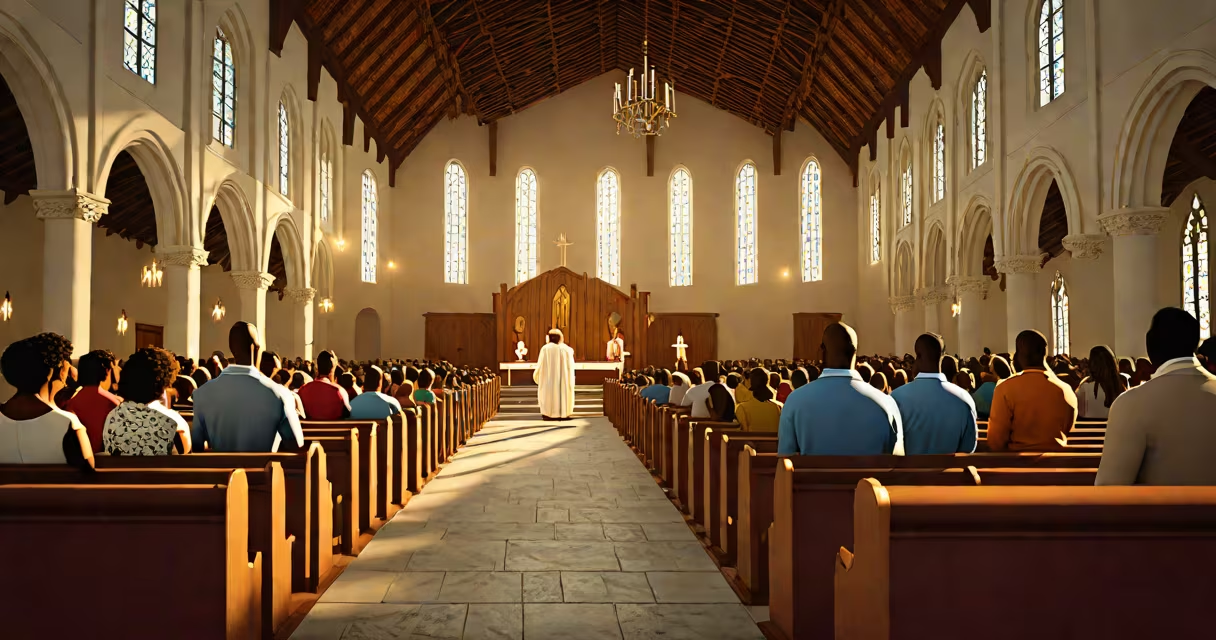
A church denomination is a distinct Christian group with shared doctrine, leadership structure, and worship practices that differentiate it from other Christian bodies. Denominations arise from theological differences, historical developments, or cultural contexts, forming organized communities with consistent beliefs and rituals.
Denominations are not optional additions to Christianity-they are formal expressions of how different communities interpret scripture, administer sacraments, and organize leadership. The term applies to groups ranging from the Roman Catholic Church and Eastern Orthodox Churches to Protestant bodies like Baptists, Methodists, and Pentecostals. Each denomination maintains its own standards for membership, ordination, and doctrinal authority.
For example, the Southern Baptist Convention operates under a congregational polity where local churches govern themselves, while the Presbyterian Church (USA) uses a representative system led by elected elders. These structural differences reflect deeper theological distinctions about authority, grace, and salvation. A person's denomination often shapes their understanding of baptism, communion, and moral teaching.
Each denomination establishes a set of official beliefs through creeds, confessions, or statements of faith. These documents define what members must accept to be considered part of the group. For instance, the Nicene Creed forms the foundation of belief for both Catholic and Orthodox Christians, while the Baptist Faith and Message outlines the doctrinal stance of Southern Baptists.
Leadership models vary widely. The Roman Catholic Church follows a hierarchical structure with the Pope as supreme authority. In contrast, Quakers practice a consensus-based decision-making process with no ordained clergy. Methodist churches use bishops to oversee regional conferences, while Anabaptist groups emphasize lay leadership and communal accountability.
Denominations also differ in how they handle membership. Some require baptism as a prerequisite for joining, others allow affiliation based on personal profession of faith. The Lutheran Church-Missouri Synod requires pastors to affirm adherence to the Book of Concord, a 16th-century doctrinal document. This ensures consistency across congregations and prevents doctrinal drift.
Christian denominations fall into broad categories based on history, theology, and governance. The following table outlines major types and their distinguishing features:
| Type | Key Features | Examples |
|---|---|---|
| Catholic | Hierarchical leadership; sacramental theology; papal authority | Roman Catholic Church, Eastern Orthodox |
| Protestant | Reformation roots; emphasis on scripture; varied governance | Baptist, Methodist, Lutheran, Presbyterian |
| Evangelical | Focus on personal conversion; Bible-centered preaching | Assemblies of God, Church of Christ |
| Non-Trinitarian | Rejects traditional Trinity doctrine | Jehovah's Witnesses, Unitarians |
Within Protestantism, further subdivisions exist. For example, the Church of Christ-a group often mistaken for a denomination-functions as a network of independent congregations rather than a centralized denomination. Its members share a commitment to restoring New Proof Christianity but lack a single governing body. This distinction matters: the Church of Christ is not a denomination in the formal sense, though many refer to it as such.
Historically, denominations emerged during periods of reform. The Protestant Reformation in the 16th century led to the creation of Lutheran, Reformed, and Anglican traditions. Later, the Great Awakenings in the 18th and 19th centuries fueled the rise of Methodism, Adventism, and Holiness movements. Each wave of revival introduced new interpretations of biblical authority and spiritual experience.
Many assume that all Christian groups are denominations. That's incorrect. While denominations have formal structures, not all Christian communities do. Independent churches, house churches, and parachurch organizations may follow similar teachings but lack a centralized doctrine or leadership hierarchy.
Another frequent error is equating denomination with size or influence. The Seventh-day Adventist Church, with over 21 million members worldwide, is a large denomination. But so is the small, rural Mennonite congregation in Lancaster County, Pennsylvania-both are denominations because they meet the criteria of consistent belief, governance, and identity, regardless of scale.
Some confuse denominational differences with doctrinal heresy. A difference in views on baptism-believer's baptism versus infant baptism-does not make either side wrong. The United Church of Christ affirms both modes, while the Church of Christ restricts baptism to believers who profess faith. Both positions are rooted in scripture, even if interpreted differently.
I once attended a wedding where the couple belonged to different denominations-one Catholic, one Methodist. The officiant was a retired minister from a non-denominational church. We discussed how the couple had chosen a service that blended elements from both traditions. Their pastor later explained that interdenominational marriages are common and often involve negotiation around liturgy, sacraments, and family religious upbringing. This experience showed me that denominational identity doesn't always dictate personal practice-it can coexist with flexibility.
Denominational affiliation affects how individuals engage with faith. It influences access to sacraments, participation in church councils, and eligibility for certain roles. A Catholic priest cannot serve in a Baptist church, nor can a Presbyterian elder lead a Methodist congregation. Each denomination sets its own qualifications for ministry.
Studies show that religious affiliation correlates strongly with social behavior. According to Pew Research Center, Protestants are more likely to attend services weekly than unaffiliated adults, and Catholics report higher rates of charitable giving than those with no religious affiliation. These patterns aren't due to individual choice alone-they're shaped by the expectations embedded in denominational culture.
Understanding what church denomination means helps clarify why people choose specific churches, how they interpret scripture, and how they relate to others in their faith community. It also prevents confusion between formal denominations and informal religious networks. When someone says "I'm Christian," they could belong to any of over 33,000 Christian groups globally, according to the World Christian Encyclopedia. Knowing the denomination provides context for belief, practice, and community.