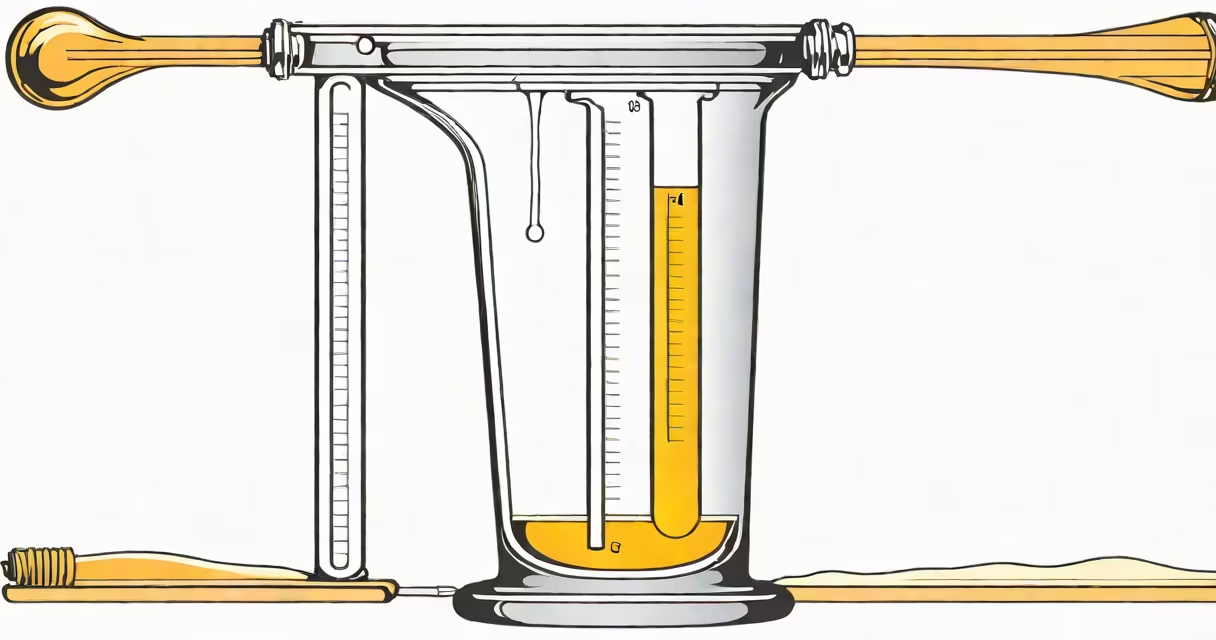
A hydrometer measures the specific gravity of a liquid-its density relative to water-to track changes during fermentation and estimate alcohol content in homebrewed beer, wine, and mead.
It operates on Archimedes' principle: a floating object displaces a volume of fluid equal to its own weight. The hydrometer sinks deeper in less dense liquids and floats higher in denser ones. In brewing, this allows you to monitor sugar conversion into alcohol over time.
For example, a typical beer wort starts with a specific gravity around 1.050. After 7 days of fermentation, the reading drops to 1.010. This change indicates that most sugars have converted to alcohol, signaling the end of active fermentation.
The hydrometer is a sealed glass tube with a weighted bulb at the bottom and a calibrated stem marked with a scale. When placed in a liquid, it floats vertically. The point where the surface meets the scale gives the specific gravity reading.
Readings are taken at standard temperature-usually 60°F (15.5°C)-because temperature affects liquid density. Most hydrometers include a temperature correction chart or feature a built-in thermometer. For accurate results, adjust readings using the formula: corrected SG = measured SG × (1 + 0.0004 × (T − 60)), where T is the actual temperature in °F.
For instance, if you measure a wort at 70°F with a reading of 1.050, the corrected gravity is 1.050 × (1 + 0.0004 × (70 − 60)) = 1.0504. This small adjustment prevents misjudging fermentation progress.
Hydrometers come in several forms based on their intended use:
| Type | Scale Range | Common Use | Example Application |
|---|---|---|---|
| Brewing hydrometer | 0.990 - 1.150 | Beer, wine, mead | Tracking fermentation from wort to final gravity |
| Alcohol hydrometer | 0.790 - 1.000 | Distilled spirits | Estimating ABV in moonshine or brandy |
| Antifreeze hydrometer | 1.000 - 1.120 | Automotive coolant | Determining freeze protection level in car radiators |
Brewing hydrometers are the most common in homebrewing. They're designed to read between 0.990 and 1.150 specific gravity, covering the range from initial wort to finished beer. The scale is often labeled in both specific gravity and potential alcohol percentage.
When measuring, always use a sample tube or test jar large enough to allow the hydrometer to float freely without touching the sides. Stir the sample gently to remove bubbles, then lower the hydrometer slowly until it stabilizes. Read the meniscus-the curved surface of the liquid-at eye level for accuracy.
Many assume a hydrometer measures alcohol content directly. It does not. Instead, it measures density. Alcohol content is calculated using the difference between original gravity (OG) and final gravity (FG).
The formula is: ABV = (OG − FG) × 131.25. For example, if OG is 1.050 and FG is 1.010, ABV = (1.050 − 1.010) × 131.25 = 5.25%. This calculation assumes all sugar was converted to ethanol, which is close but not exact-fermentation efficiency varies.
Another mistake is testing too early. Fermentation produces CO₂, which creates bubbles. If you measure while bubbling, the air pockets distort the reading. Wait until fermentation slows to avoid false low readings.
I once used a hydrometer on a batch of sour cherry mead that had been fermenting for 14 days. The reading was stable at 1.008, but the hydrometer floated unevenly due to trapped yeast cells. After filtering the sample through a coffee filter, the reading dropped to 1.004. That 0.004 difference meant the mead was drier than expected-proof that sediment can skew results.
Without a hydrometer, brewers rely on guesswork. A consistent drop in gravity confirms fermentation is complete. A stalled gravity suggests infection, nutrient deficiency, or yeast fatigue.
According to the American Society of Brewing Chemists (ASBC), specific gravity measurements are the gold standard for monitoring fermentation in commercial and craft breweries. Their official method (ASBC Method 24.01) requires hydrometer readings at multiple stages to ensure consistency.
Even in winemaking, hydrometers are critical. A red wine with an OG of 1.080 and FG of 1.000 yields about 10.5% ABV. Winemakers use this to predict final alcohol levels and adjust sugar additions accordingly.
Hydrometers are inexpensive-most cost under $15-but their impact on quality control is significant. A single inaccurate reading can lead to over-carbonation, flat beer, or off-flavors.
For homebrewers, tracking gravity is not optional. It's the only way to confirm fermentation completion and calculate alcohol content reliably.
Understanding what a hydrometer does-measuring density to infer fermentation progress and alcohol yield-is essential for anyone making fermented beverages. It's not a luxury tool. It's a necessity.