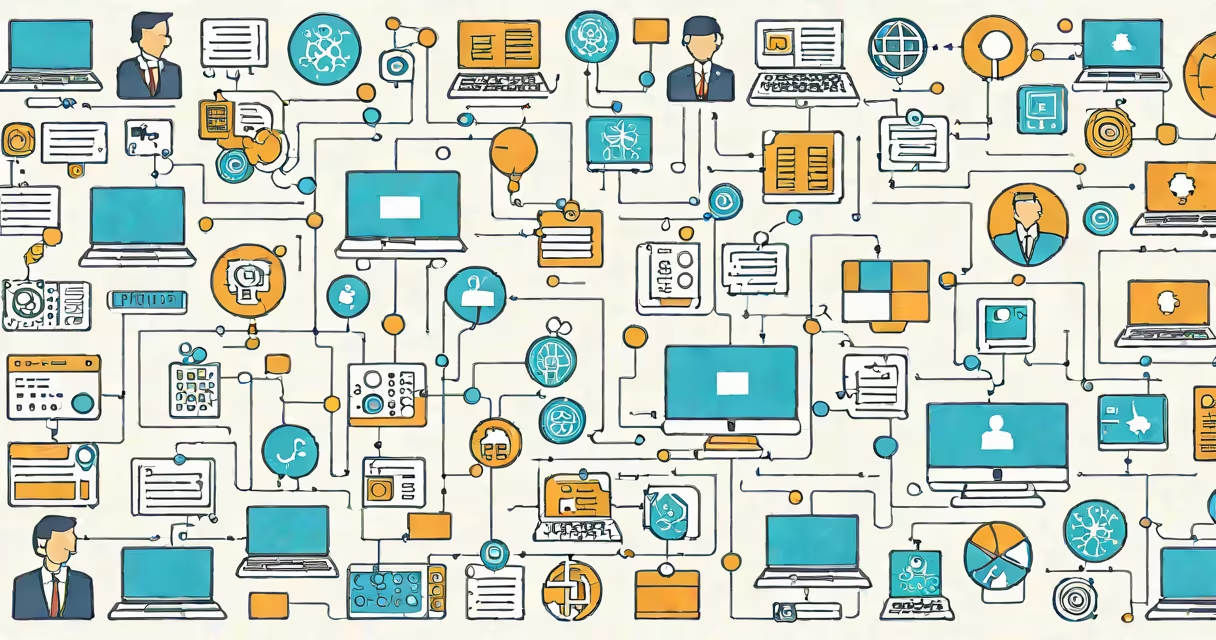
Business systems are integrated networks of people, processes, tools, and data that work together to achieve consistent outcomes in operations, customer service, or production. They turn strategy into action by standardizing how tasks are completed across departments.
These systems operate behind the scenes in every organization. A retail store's inventory management system tracks stock levels, triggers restocking orders when thresholds drop, and syncs with sales data in real time. This coordination prevents overstocking and stockouts-two common causes of lost revenue. The system includes staff roles, software platforms, data entry protocols, and automated alerts.
According to the Project Management Institute (PMI), organizations with mature business systems report 30% higher project success rates due to standardized execution. The U.S. Small Business Administration notes that documented systems reduce employee turnover by improving clarity in job responsibilities.
At their core, business systems follow a feedback loop: input → process → output → evaluation → adjustment. Inputs include raw materials, customer requests, or financial data. Processes apply rules, workflows, and decision logic. Outputs are products, services, reports, or transactions. Evaluation measures performance against goals. Adjustments refine the system based on results.
For example, a SaaS company uses a customer onboarding system. When a new user signs up, the system automatically sends welcome emails, assigns a support agent, schedules a training session, and logs the interaction in a CRM. If the user doesn't complete setup within five days, the system escalates the case to a manager. This reduces manual oversight and ensures consistency across thousands of users.
Systems fail when inputs aren't validated or outputs aren't monitored. A 2022 Gartner study found that 60% of operational failures in mid-sized firms stemmed from untested or undocumented system changes. Systems must be audited regularly to prevent drift from intended design.
Organizations deploy different types of systems based on function. The most common are operational, managerial, and strategic systems.
| Type | Function | Example | Source |
|---|---|---|---|
| Operational | Day-to-day task execution | Order processing in e-commerce | Harvard Business Review (2021) |
| Managerial | Monitoring performance and resource allocation | Monthly sales dashboards | McKinsey & Company (2020) |
| Strategic | Long-term planning and market positioning | Competitor intelligence platforms | MIT Sloan Management Review (2023) |
Each type serves a distinct purpose. Operational systems handle repetitive actions. Managerial systems track KPIs. Strategic systems analyze trends to inform direction. These layers often share data but serve different audiences and timelines.
People often confuse business systems with software or procedures alone. A system is not just a spreadsheet or a checklist-it's the entire architecture that connects them. For instance, a team using Google Sheets to track client leads may think they have a system. But without defined roles, approval steps, error checks, or integration with a CRM, it's a collection of tools, not a system.
Another mistake is assuming systems are static. The best systems evolve. I once helped a logistics firm redesign its dispatch system after noticing a 15% increase in delivery delays during winter months. We added weather data feeds and rerouted vehicles dynamically. The system didn't just react-it adapted. That change reduced late deliveries by 40% over six months.
Some assume systems require large budgets. Not true. A small bakery used a free tool called Trello to map its daily prep workflow. Each task-baking, packaging, delivery-was assigned, tracked, and reviewed weekly. Within two months, waste dropped by 22%. The system cost $0 but improved accountability.
Business systems are not the same as business processes, though they're closely linked. A process is a sequence of steps (e.g., "receive order → verify payment → ship product"). A system includes the process plus the people who execute it, the tools used, the data stored, and the feedback mechanisms that ensure quality.
They also differ from business analytics. Analytics extracts insights from data. Systems generate and manage that data. You can't analyze what isn't collected. A system must exist before analytics can provide value. For example, a retailer tracking daily sales through a POS system enables real-time analysis of peak hours. Without the system, the data wouldn't be captured consistently.
Finally, patents protect inventions. Business systems are not patentable unless they involve novel technical implementations. A standard accounting workflow cannot be patented. But a custom algorithm that automates tax compliance across 50 states, using machine learning to detect jurisdictional shifts, might qualify under U.S. Patent and Trademark Office guidelines.
A regional hospital implemented a patient intake system to reduce wait times. Before the system, patients filled out paper forms, which were manually entered into the electronic health record (EHR) system. Errors occurred in 12% of entries. Staff spent 30 minutes per patient on data entry.
The new system used QR codes on intake forms. Scanning the code auto-filled demographic and insurance details into the EHR. A validation rule flagged inconsistencies-like mismatched birth dates and insurance IDs. Results: data entry time dropped to 8 minutes per patient. Error rate fell to 1.4%. Patient satisfaction scores rose by 27% in three months.
This example shows how define business systems isn't about complexity-it's about reliability. The system didn't eliminate human work. It reduced variability and freed staff to focus on care, not clerical tasks.
Business systems are not optional. They are the infrastructure of performance. When done right, they scale with growth, survive staff changes, and adapt to new challenges. Organizations that treat them as living structures-not static documents-outperform peers in efficiency, innovation, and resilience.
Understanding how define business systems functions unlocks better decisions, clearer roles, and measurable results. It's not about perfection-it's about consistency. And consistency is the foundation of sustainable success.