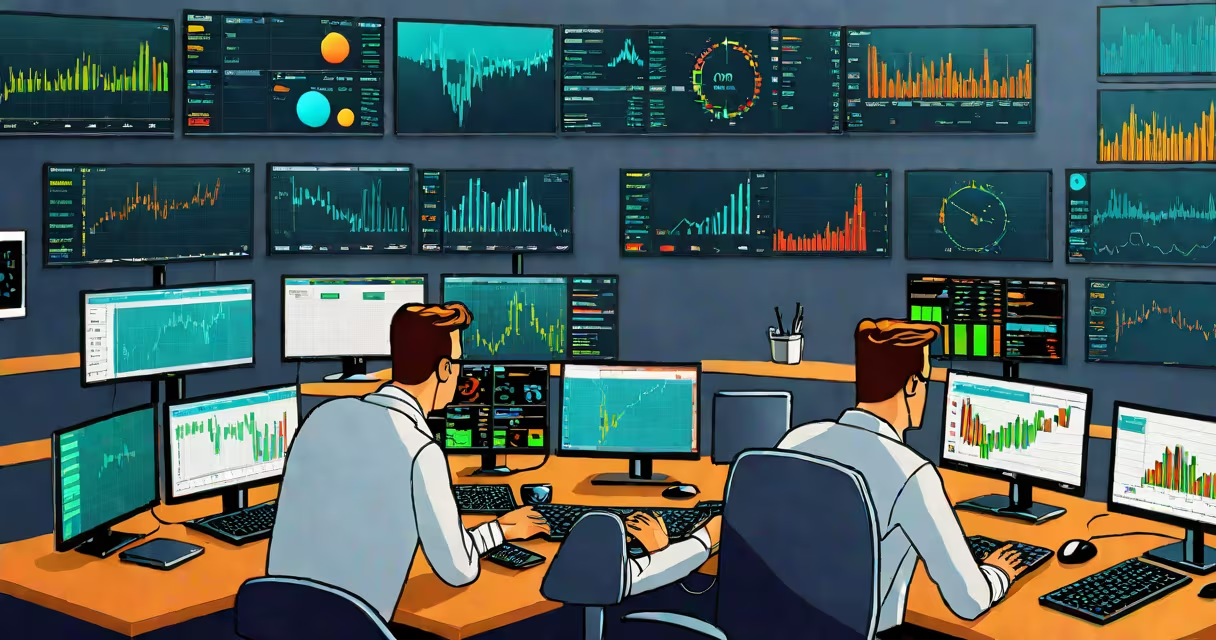
Managed futures are investment strategies that use systematic, algorithm-driven trading across global futures markets-commodities, currencies, equities, and interest rates-guided by predefined rules rather than discretionary judgment. These strategies are typically run by commodity trading advisors (CTAs) who manage client capital using quantitative models.
Unlike traditional stock or bond investing, managed futures don't rely on company fundamentals or macroeconomic forecasts. Instead, they exploit price trends in financial instruments through automated systems. A CTA may hold long positions in crude oil futures when prices rise steadily, or short positions in Treasury bonds when momentum suggests a downward move. The goal is to profit from sustained directional moves, regardless of whether the market is rising or falling.
According to the Managed Funds Association (MFA), over $160 billion was under management in U.S.-based managed futures funds as of 2023. These strategies have historically delivered low correlation to traditional asset classes, making them attractive during periods of market stress. For example, during the 2008 financial crisis, many managed futures strategies generated positive returns while equities plunged.
Managed futures operate on the principle of trend following: buying assets that are rising in price and selling those that are declining. The strategy assumes that trends-once established-tend to persist for measurable durations. Traders enter positions based on technical indicators such as moving averages, volatility thresholds, or momentum oscillators.
Each strategy uses a set of rules that define entry, exit, position sizing, and risk limits. For instance, a model might buy gold futures when the 50-day moving average crosses above the 200-day average, and close the trade if volatility spikes beyond a certain level. These rules are tested against historical data to ensure consistency and avoid emotional bias.
Trading occurs across multiple timeframes-from intraday to multi-year cycles-and spans dozens of markets. A typical managed futures fund might trade 100+ instruments across 20+ exchanges worldwide. This diversification reduces reliance on any single market's performance.
While trend following dominates the space, several distinct approaches exist, each with different risk-return profiles:
| Strategy Type | Core Mechanism | Typical Markets | Volatility Profile |
|---|---|---|---|
| Trend Following | Entry on momentum breakouts; hold until reversal signals | Crude oil, S&P 500, EUR/USD | Medium-high |
| Mean Reversion | Buys low, sells high within defined ranges | Interest rate swaps, agricultural commodities | Low-medium |
| Arbitrage | Exploits pricing inefficiencies between related instruments | Calendar spreads, cross-market arbitrage | Low |
| Seasonal/Calendar Effects | Capitalizes on recurring patterns tied to time of year | Grain futures, natural gas | Medium |
Most managed futures programs focus on trend following because it performs well across diverse market environments. Research from the Journal of Alternative Investments shows that trend-following strategies had a positive annualized return of 6.2% from 1980 to 2020, even during prolonged bear markets.
Investors use managed futures primarily for portfolio diversification. Because their returns often move independently of stocks and bonds, they act as a buffer during equity downturns. According to a 2022 study by Morningstar, portfolios including 10-15% in managed futures showed lower maximum drawdowns and improved Sharpe ratios over 10-year periods.
These strategies are especially valuable in volatile or uncertain environments. During the 2020 pandemic crash, many managed futures funds rose by 15-25%, driven by sharp moves in energy, interest rates, and currency markets. One fund tracked by the MFA posted a 22% gain in March 2020 alone.
Managed futures are accessible through various vehicles: hedge funds, exchange-traded funds (ETFs), and separately managed accounts. The ProShares Managed Futures Strategy ETF (ticker: QAI) tracks a basket of CTA-managed futures and has averaged 7.3% annual returns since inception in 2010, according to Bloomberg data.
Many people assume managed futures are synonymous with speculative gambling or high-risk trading. That's incorrect. While futures contracts carry use, managed futures strategies enforce strict risk controls. Most programs limit exposure to any single market to 5-10% of total capital and cap daily losses at 1-2%.
A common confusion is equating managed futures with "futures trading" in general. Not all futures trading is systematic or managed. Individual traders may place trades based on news, intuition, or technical patterns-but managed futures rely solely on pre-defined algorithms. The difference lies in consistency and scalability.
Another misconception is that managed futures always perform well in crises. They do not. In 2022, rising inflation and aggressive Fed rate hikes caused widespread losses in trend-following strategies. Many models were caught in whipsaw movements as markets reversed rapidly. This underscores the importance of understanding that managed futures aren't immune to market regime shifts.
For context, a real-world example: In early 2023, a major CTA firm reduced exposure to long-term interest rate futures after detecting a breakdown in the usual yield curve behavior. The model triggered a series of exits, preserving capital during a period of unexpected volatility. This decision wasn't based on sentiment-it was embedded in the system's logic.
I once reviewed the performance logs of a managed futures fund during a six-month period when global markets experienced extreme uncertainty. The fund's algorithm consistently exited positions before sharp reversals, even when human analysts expected continuation. What stood out wasn't just the accuracy-it was the discipline. The system didn't hesitate, didn't second-guess. It executed based on thresholds, not emotions.
This reinforced a key insight: managed futures aren't about predicting the future. They're about responding to it-automatically, consistently, and with clear boundaries. The strength lies in process, not prophecy.
Managed futures are not the same as direct futures trading. They are not equivalent to mutual funds or index funds. And they are not likely to outperform. Their success depends on the quality of the model, the diversity of markets traded, and the integrity of risk management.
One non-obvious fact: most managed futures strategies are not actively managed daily. Models may generate signals once per week or even less frequently. The system operates on a schedule, not constant monitoring. This reduces operational noise and prevents overtrading-a known pitfall in discretionary trading.
Also, the term "managed" doesn't imply personal oversight. The manager is the algorithm. Human oversight exists, but it's focused on system validation, not trade execution. A CTA may review performance monthly, adjust parameters quarterly, but never override a live signal unless a system failure occurs.
What are managed futures? They are disciplined, systematic trading strategies applied across global markets using quantitatively defined rules. They aim to capture persistent trends while minimizing emotional interference. Their appeal lies in diversification, not guaranteed returns.
For investors seeking alternatives to traditional assets, managed futures offer a structured way to participate in global market dynamics. They are not a magic bullet, but when integrated properly, they improve resilience. Understanding what they are-and what they are not-is essential for informed allocation.