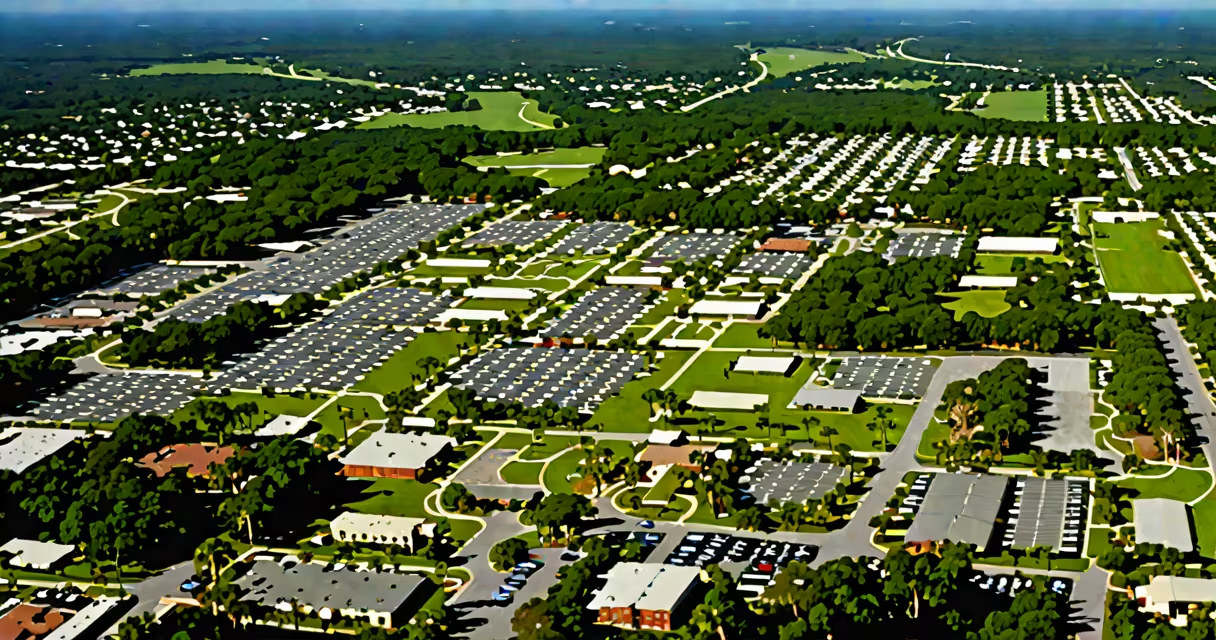
Ocala is located in Marion County, Florida. It is the largest city and county seat of Marion County, which spans 1,865 square miles-the largest county by area in the state.
Marion County lies in central Florida, bordered by Alachua County to the north, Lake County to the west, Citrus County to the southwest, and Levy County to the south. Ocala sits approximately 70 miles northwest of Orlando and 90 miles northeast of Tampa, placing it at a strategic midpoint between major metropolitan areas.
The city was founded in 1850 and incorporated in 1856. Its growth was driven by agriculture, particularly citrus and cattle, and later by the expansion of railroads. Today, Ocala is known for its horse industry, hosting the annual Ocala Breeders' Sales Company event and serving as a hub for thoroughbred training and breeding.
Marion County operates under a county commission form of government. The five-member Board of County Commissioners sets policy, approves budgets, and oversees public services such as law enforcement, emergency management, road maintenance, and environmental protection.
County services include the Marion County Sheriff's Office, which handles local law enforcement, and the Marion County Health Department, responsible for disease control, immunizations, and public health initiatives. The county also manages the Ocala Regional Airport and maintains over 1,500 miles of roads.
For residents and visitors, the county provides access to public libraries, parks, and recreational facilities. The Ocala National Forest, located just east of the city, covers over 50,000 acres and is managed by the U.S. Forest Service under federal guidelines.
Ocala is the 10th-largest city in Florida by population, with about 60,000 residents as of the 2020 U.S. Census. The city's economy is diverse, combining agriculture, tourism, education, and healthcare. The University of Florida's Institute of Food and Agricultural Sciences (IFAS) has research stations in the area focused on sustainable farming and animal science.
Marion County is home to several historic districts, including the Ocala Historic District, listed on the National Register of Historic Places. The district includes buildings from the late 19th and early 20th centuries, such as the Marion County Courthouse (built 1908) and the former Ocala City Hall.
A lesser-known fact: Ocala is part of the Suwannee River Water Management District, which regulates water use and protects aquifers. The region relies heavily on the Floridan Aquifer, a primary source of drinking water. Overuse and contamination remain concerns due to agricultural runoff and urban development.
Some people mistakenly believe Ocala is in Lake County or Levy County due to proximity. Lake County borders Marion County to the west, and parts of the Ocala metropolitan area extend into unincorporated areas of Lake County. However, the city limits of Ocala are entirely within Marion County.
Another confusion arises from the term "Central Florida." While Ocala is geographically central, the term often refers to the Orlando-Lakeland-Tampa corridor. Ocala lies outside that core region but remains a key node in the broader central Florida network.
To file a deed or obtain a marriage license in Ocala, visit the Marion County Clerk of the Circuit Court and Comptroller's office. This office handles civil and criminal records, voter registration, and property tax assessments. The main address is 100 W. College Ave., Ocala, FL 34471.
For example, if someone wants to register to vote in Ocala, they must provide proof of residency in Marion County. The process requires a valid Florida driver's license or state ID, and the applicant must have lived in the county for at least 30 days prior to registration. The county's online portal allows voters to check their status and update information.
Property owners in Ocala pay taxes based on assessed value through the Marion County Property Appraiser's Office. In 2023, the average single-family home in Ocala had a taxable value of $327,000, resulting in an annual property tax bill of about $5,200. These figures are updated annually and published in the county's budget reports.
Understanding jurisdiction helps clarify responsibilities. In Ocala, different levels of authority handle distinct functions:
| Authority | Responsible For | Example |
|---|---|---|
| Marion County Government | County-wide infrastructure, public safety, elections | County road maintenance, sheriff's patrols, voter rolls |
| Ocala City Government | Municipal services, zoning, local ordinances | Parking enforcement, building permits, city park operations |
| State of Florida | Education, state highways, criminal justice | Florida Department of Education standards, I-75 maintenance |
For instance, while the city of Ocala controls street lighting and trash collection within city limits, the county maintains rural roads and bridges. A resident calling about a pothole on a county-maintained road should contact the Marion County Public Works Department, not the city's sanitation team.
I once attended a community meeting at the Marion County Public Library in 2022 to discuss flood mitigation plans after heavy rains. The discussion included data from the National Weather Service and recommendations from the Florida Division of Emergency Management. The county's floodplain maps showed that parts of Ocala lie in high-risk zones, prompting new zoning rules for new construction.