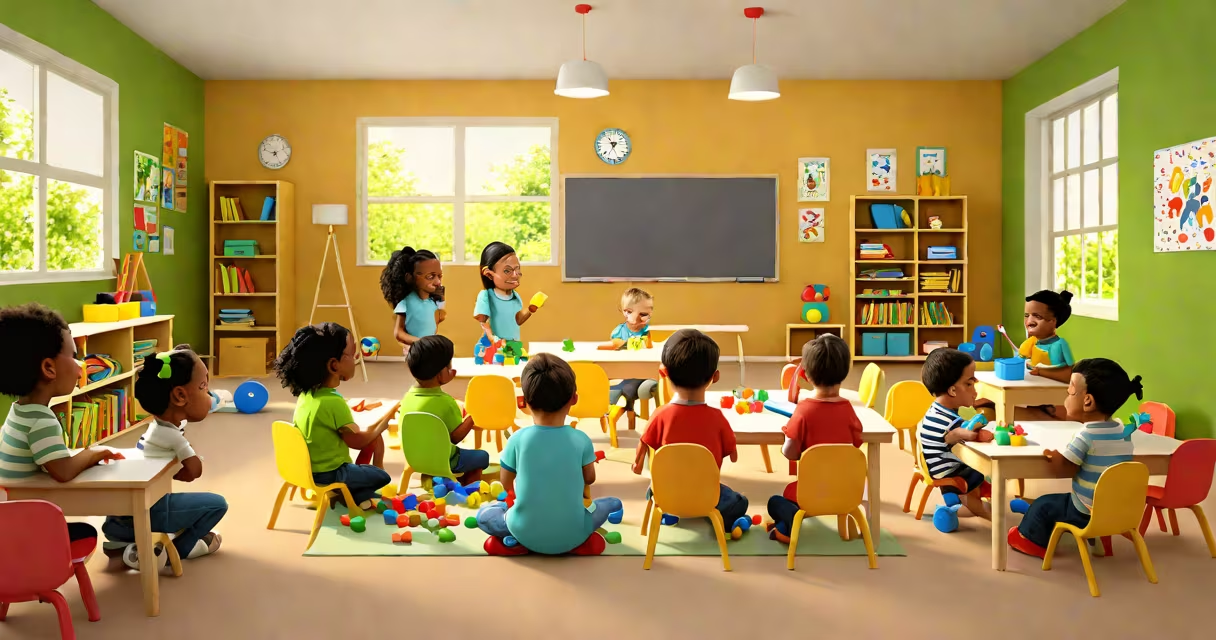
Pre-K typically precedes kindergarten in the U.S. education system. Pre-K focuses on foundational social, emotional, and cognitive skills, while kindergarten introduces formal academic instruction in reading, math, and writing.
Pre-K is designed for children aged 3 to 5, depending on state and program structure. It emphasizes play-based learning, motor skill development, and early literacy exposure. Kindergarten, usually for 5-year-olds, shifts toward structured curricula aligned with state standards, including letter recognition, counting to 20, and following multi-step directions.
The sequence is consistent across most public school districts. For example, the National Association for the Education of Young Children (NAEYC) states that pre-K programs serve children before they enter kindergarten, often as part of early childhood education initiatives. The U.S. Department of Education confirms that kindergarten is the first year of formal schooling, following preschool or pre-K.
Pre-K builds readiness for kindergarten through activities like circle time, storytelling, and guided play. These experiences develop attention span, turn-taking, and basic problem-solving. A 2021 study by the National Bureau of Economic Research found that children who attended high-quality pre-K were 15% more likely to be on grade level in reading by third grade.
Kindergarten then expands on those foundations. Students learn to write their names, identify letters and sounds, count objects, and participate in group discussions. Teachers assess progress using benchmarks such as the Early Childhood Longitudinal Study (ECLS), which tracks child development from pre-K through elementary school.
For example, a child entering kindergarten in September must have turned 5 by December 1 in most states. This age cutoff ensures consistency in classroom grouping. Pre-K admissions often require children to be 4 by September 1, aligning with the typical birthdate window for entry into early education programs.
Programs vary by location and funding model. The table below outlines common differences:
| Feature | Pre-K | Kindergarten |
|---|---|---|
| Typical Age Range | 3-5 years | 5-6 years |
| Instruction Focus | Social-emotional growth, sensory play, language basics | Reading fluency, phonics, addition/subtraction, writing |
| Structure | Flexible schedules, less formal assessments | Fixed daily routines, standardized testing |
| Funding Source | State-funded, Head Start, private tuition | Public school district budget |
Some schools offer transitional kindergarten (TK), a bridge between pre-K and traditional kindergarten. TK is available in California and several other states. It targets children born between September and December, allowing them to mature before entering full kindergarten.
High-quality pre-K programs follow the NAEYC structure, emphasizing intentional teaching and individualized support. For instance, a pre-K class might spend 30 minutes on sorting shapes by color and size, then transition to a story about sharing. In contrast, kindergarten includes timed lessons, such as 15-minute phonics drills and 20-minute math centers.
Many parents assume pre-K is optional or purely childcare. That's incorrect. Pre-K is a critical stage in early development. According to the American Psychological Association, children who attend pre-K show improved executive function-skills like planning, focus, and impulse control-compared to peers who do not.
Another misconception is that kindergarten is just "school for five-year-olds." While age is a factor, kindergarten is academically rigorous. The Common Core State Standards define kindergarten expectations: students must understand that numbers represent quantities, compose and decompose numbers up to 10, and read and write numbers 0-20.
A key distinction: pre-K is not the same as daycare. Daycare primarily provides supervision and basic care. Pre-K is educational, with trained teachers, curriculum goals, and developmental objectives. A 2022 report from the Center for American Progress found that only 38% of U.S. children under age 5 attend a pre-K program with measurable learning outcomes, underscoring the gap between informal care and structured early education.
Consider Maya, born on October 15, 2018. She entered pre-K in August 2022, at age 4. Her classroom focused on naming colors, identifying animals, and practicing fine motor skills with scissors and playdough. She participated in weekly story circles and practiced lining up quietly during transitions.
In August 2023, Maya started kindergarten. Her teacher introduced a daily calendar routine, taught letter sounds using flashcards, and assigned short writing tasks like "I like to draw." By May, she could write her name, recognize 20 sight words, and solve simple addition problems using counters.
This progression reflects national norms. The National Institute for Early Education Research (NIEER) reports that 92% of U.S. public school districts require children to be 5 by September 1 to enroll in kindergarten. Pre-K programs typically admit children who are 4 by the same date.
I observed this pattern firsthand while volunteering at a public pre-K center in Portland, Oregon. One child struggled with staying seated during group time. Over six weeks, the teacher used visual cues and positive reinforcement. By the end of the semester, the child could sit for 12 minutes and participate in shared reading. This improvement prepared him for kindergarten's expectations.