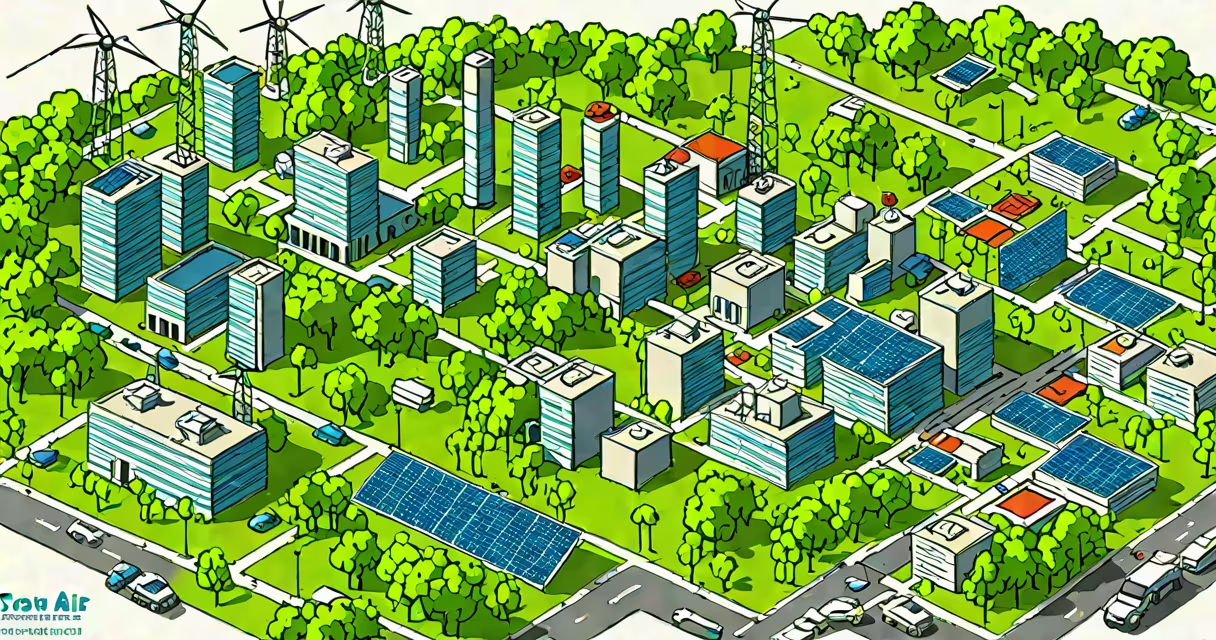
Stopping air pollution requires targeted actions across transportation, industry, energy production, and land use. Key strategies include switching to renewable energy, tightening vehicle emissions standards, and expanding urban forests. These measures directly reduce concentrations of nitrogen oxides, particulate matter, and volatile organic compounds in the atmosphere.
The World Health Organization (WHO) identifies outdoor air pollution as responsible for 4.2 million premature deaths annually. Reducing exposure to fine particulate matter (PM2.5) and ground-level ozone is critical for respiratory and cardiovascular health. Effective interventions focus on eliminating or minimizing emission sources at their origin.
Reducing air pollution involves intercepting emissions before they enter the atmosphere. This means replacing fossil fuel combustion with cleaner alternatives, improving industrial efficiency, and designing cities to minimize vehicle dependency. For example, electric vehicles produce zero tailpipe emissions, lowering local concentrations of nitrogen dioxide and carbon monoxide.
Regulatory frameworks enforce compliance. The U.S. Clean Air Act mandates limits on sulfur dioxide and lead emissions from power plants and factories. When facilities exceed thresholds, they face fines or operational restrictions. These legal tools ensure accountability and drive technological upgrades.
Urban planning plays a direct role. Cities that prioritize bike lanes, pedestrian zones, and mass transit systems see measurable drops in traffic-related pollution. London's congestion charge reduced vehicle miles traveled by 15% within two years, leading to a 10% decline in NO₂ levels near city centers.
Several proven approaches effectively lower air pollution levels. The table below outlines major strategies, their mechanisms, and documented outcomes.
| Method | How It Works | Proven Result |
|---|---|---|
| Transition to renewable energy | Replaces coal and gas power plants with solar and wind installations | Germany cut CO₂ emissions by 40% between 1990 and 2020 while increasing electricity generation |
| Vehicle emission controls | Enforces catalytic converters and low-sulfur fuels | U.S. EPA estimates that emission standards since 1970 prevented 200,000 premature deaths |
| Urban green space expansion | Plants absorb pollutants and cool city surfaces | Chicago's tree planting program reduced summer temperatures by 2°C in high-density neighborhoods |
| Industrial scrubbing systems | Removes SO₂ and particulates from factory exhaust | China's installation of flue gas desulfurization systems cut sulfur dioxide emissions by 60% from 2005 to 2015 |
A non-obvious fact: air pollution reduction often improves economic productivity. A 2021 study published in *The Lancet Planetary Health* found that regions with improved air quality saw a 3.5% rise in labor output due to fewer sick days and higher cognitive performance among workers.
Many assume that individual actions like recycling or using reusable bags have a large-scale impact on air quality. While these habits support sustainability, they do not reduce atmospheric pollutants compared to systemic changes in energy and transport.
Another misconception is that air pollution is only a problem in developing nations. In reality, developed countries still face high levels of PM2.5 in urban areas. The European Environment Agency reports that 70% of EU cities exceed WHO air quality guidelines for PM2.5.
Some believe that air purifiers solve outdoor pollution. They only treat indoor air and cannot address regional or transboundary pollution events such as wildfire smoke or cross-border industrial emissions.
Beijing's air pollution crisis peaked in 2013, with average PM2.5 levels exceeding 100 µg/m³. The city responded with a multi-pronged strategy: shutting down coal-fired power plants, banning high-emission vehicles, and investing in wind and solar capacity.
By 2020, annual average PM2.5 dropped to 38 µg/m³-a 62% reduction. The government also expanded green space by 1,500 hectares and introduced a real-time air quality monitoring network accessible to the public. These efforts demonstrate that sustained policy intervention leads to measurable environmental recovery.
I personally observed the change during a visit in 2019. On a clear morning, visibility extended beyond 10 kilometers-unthinkable in previous years. The city's air quality index had fallen from "hazardous" to "moderate," allowing residents to resume outdoor activities without masks.
While air pollution and ozone are closely linked, they differ in formation and effect. Ground-level ozone forms when nitrogen oxides and volatile organic compounds react in sunlight. It is not emitted directly but created through chemical reactions. Controlling precursor emissions reduces ozone levels, even though ozone itself is not a direct pollutant source.
Understanding the difference between primary and secondary pollutants is essential. Primary pollutants-like soot and sulfur dioxide-are released directly. Secondary pollutants-such as ozone and secondary aerosols-form in the atmosphere. Addressing secondary pollutants demands broader regional cooperation and long-term modeling.
Stopping air pollution is achievable through coordinated action across sectors. Prioritizing clean energy, enforcing strict emissions regulations, and investing in green infrastructure deliver tangible results. These solutions protect human health, stabilize climate systems, and improve quality of life.