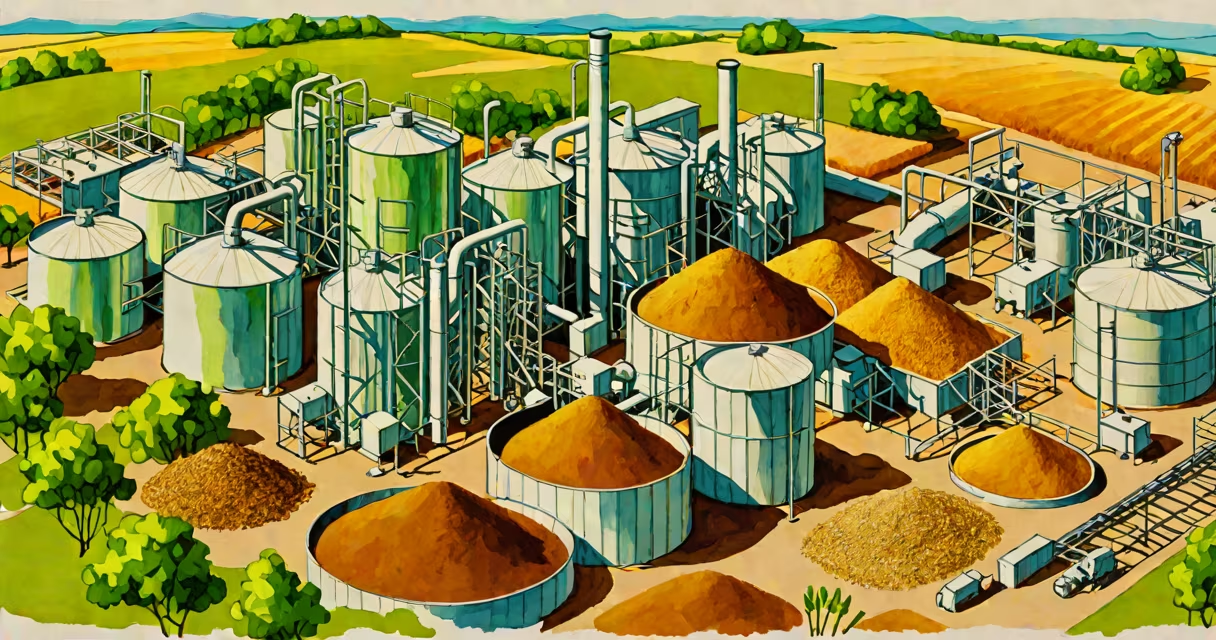
Biomass refers to organic materials derived from living or recently living organisms that can be used as fuel or raw material. These include plant matter, animal waste, and organic byproducts from agriculture, forestry, and food processing.
Biomass is a renewable resource because it comes from biological sources that can regrow or be replenished within human timescales. When burned or processed, biomass releases stored solar energy as heat, electricity, or liquid fuels. The key requirement is that the material must be organic and capable of being converted through thermal, biochemical, or chemical processes.
Common examples include wood chips, crop residues like corn stover and wheat straw, sugarcane bagasse, animal manure, and municipal solid waste. These materials serve as feedstock for bioenergy systems ranging from small-scale home heating to large industrial power plants.
Biomass energy generation relies on three primary conversion methods: combustion, gasification, and anaerobic digestion. Combustion burns biomass directly to produce steam, which drives turbines to generate electricity. Gasification heats biomass in low-oxygen environments to create syngas-a mixture of hydrogen, carbon monoxide, and methane-used for power or synthetic fuel production.
Anaerobic digestion uses microorganisms to break down wet organic matter in oxygen-free conditions. This process produces biogas, primarily methane and carbon dioxide, which can be burned for heat or upgraded to biomethane for injection into natural gas networks. Landfill gas recovery is a form of anaerobic digestion applied to decomposing waste in landfills.
A 2021 report by the International Energy Agency (IEA) notes that biomass accounts for about 55% of global renewable energy consumption, with solid biomass (like wood and pellets) making up 60% of that share. The IEA emphasizes that biomass is essential for decarbonizing sectors where electrification is difficult, such as heavy industry and long-haul transport.
The following table outlines major categories of biomass, their typical sources, and common applications:
| Type | Source Material | Conversion Method | End Use |
|---|---|---|---|
| Forest residues | Wood chips, sawdust, logging debris | Combustion, gasification | Electricity, district heating |
| Crop residues | Corn stover, rice husks, sugarcane bagasse | Gasification, fermentation | Biogas, bioethanol |
| Animal waste | Cattle manure, poultry litter | Anaerobic digestion | Biogas, fertilizer |
| Municipal waste | Food scraps, yard trimmings, paper | Combustion, landfill gas capture | Electricity, heat |
| Dedicated energy crops | Switchgrass, miscanthus, algae | Fermentation, pyrolysis | Second-generation biofuels |
Each category varies in energy density, moisture content, and logistics. For example, switchgrass grown on marginal farmland has lower water and nutrient demands than corn, making it a more sustainable option for biofuel feedstock. Algae-based biomass shows promise due to high lipid content and rapid growth rates, though commercial scaling remains limited.
Biomass is often conflated with fossil fuels or assumed to be inherently carbon-neutral. While biomass is renewable, its carbon neutrality depends on lifecycle management. If forests are clear-cut for wood pellets, the carbon released during combustion may take decades to reabsorb through regrowth-making short-term emissions problematic.
The U.S. Environmental Protection Agency (EPA) clarifies that biomass energy is only carbon-neutral when sustainably sourced and managed. Overharvesting forest biomass can lead to soil degradation, biodiversity loss, and increased net emissions. A 2020 study published in *Nature Climate Change* found that burning whole trees for energy results in higher carbon debt than coal in the first 40 years, even if regrowth eventually offsets emissions.
Another misconception is that all biomass is suitable for direct combustion. Wet materials like fresh manure or green grass have high moisture content, reducing efficiency and increasing emissions. Pre-treatment-such as drying or pelletizing-is required to improve energy density and handling.
In Sweden, over 30% of residential heating comes from biomass. The city of Malmö operates a district heating system powered by wood chips and waste from local sawmills. The system supplies heat to over 10,000 homes and reduces CO₂ emissions by 120,000 tons annually compared to oil-based heating.
In India, rural households use cow dung cakes as cooking fuel. Though inefficient and polluting, they remain widespread due to low cost and availability. Modern alternatives include biogas digesters installed in villages, converting dung into clean-burning methane. A pilot project in Uttar Pradesh installed 5,000 household digesters, providing 1.5 million meals daily without smoke inhalation risks.
On a larger scale, the Drax Power Station in the UK switched from coal to biomass in 2016. It now burns wood pellets imported from the southeastern U.S., generating 3.6 gigawatts of electricity-enough for 4 million homes. The facility claims to reduce emissions by 80% compared to coal, though critics argue that the environmental cost of sourcing and transporting pellets undermines the climate benefit.
I once visited a community biogas plant in northern California that processes dairy waste from nearby farms. The digester runs continuously, producing enough biogas to power 200 homes and generate 150 tons of organic fertilizer annually. The system reduced methane emissions from lagoons by 90%, demonstrating how localized biomass solutions can deliver multiple environmental benefits.
Understanding what are examples of biomass requires distinguishing between feedstock, conversion method, and sustainability outcome. Not all organic matter qualifies-only those that are efficiently converted and responsibly sourced. The most effective biomass systems integrate waste streams, avoid competition with food crops, and minimize land-use change.