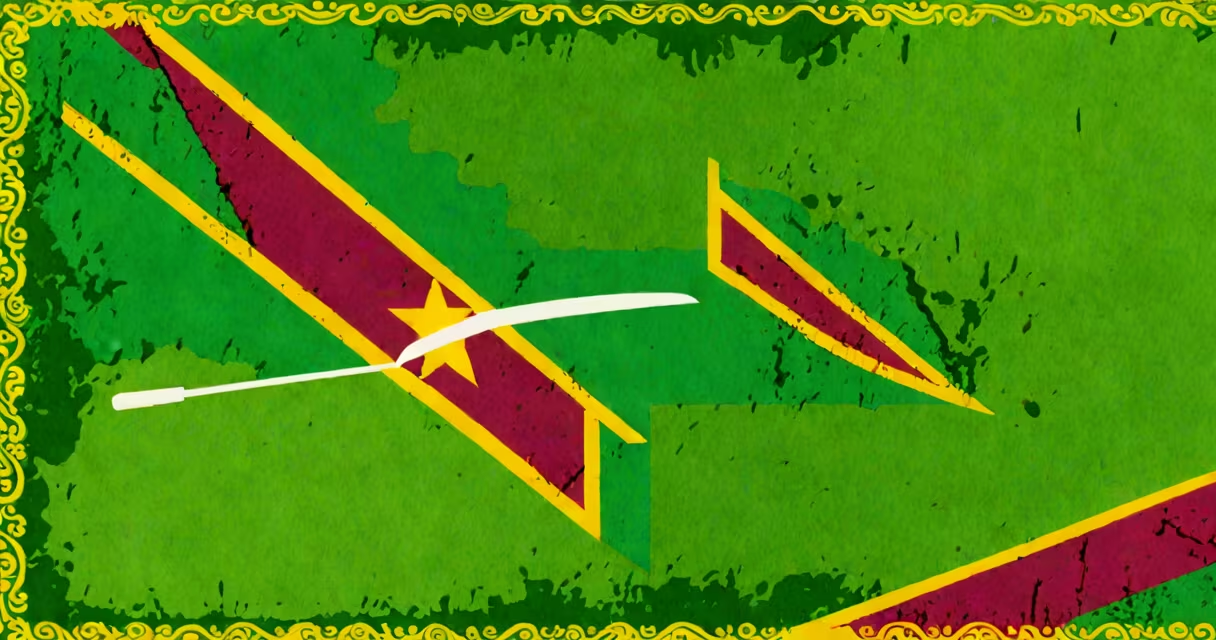
The west indies cricket team flag is a green field with a white cricket bat and ball centered, encircled by a gold border and a ring of 15 stars representing the region's member nations. It is not a national flag but a regional sports emblem used in international competitions.
Unlike national flags, which represent sovereign states, the west indies cricket team flag identifies a multi-national sporting entity. It was adopted in 1999 by Cricket West Indies (CWI), the governing body for cricket in the Caribbean. The flag serves as a unifying symbol for players from 15 different countries and territories, including Jamaica, Barbados, Trinidad and Tobago, and the Leeward and Windward Islands.
The design reflects both sport and geography. Green represents the lush Caribbean field and the game's natural setting. White signifies purity and fairness in play. The central bat and ball are standard cricket iconography. The 15 stars denote the 15 full-member nations within the West Indies cricket structure. A gold border adds visual prominence and honors excellence in competition.
The west indies cricket team flag appears on uniforms, official match programs, stadium signage, and digital broadcasts during international tournaments such as the ICC Cricket World Cup and the T20 World Cup. It is flown alongside the host nation's flag during home games, acknowledging both the team's regional identity and the venue's sovereignty.
During the 2023 ICC Men's T20 World Cup, the flag was prominently displayed at the Narendra Modi Stadium in Ahmedabad, India. It hung above the team's dugout and was featured in promotional material. Players wore jerseys with the emblem on the chest, and fans waved flags during matches against Australia and England.
For home series, the flag is often paired with the host nation's flag. When the West Indies hosted Sri Lanka in Kingston, Jamaica, the team's flag flew beside Jamaica's national flag at Sabina Park. This dual display reinforces the team's regional status while respecting local jurisdiction.
The flag's composition follows a standardized ratio of 3:2, matching international sports flag guidelines set by the International Olympic Committee (IOC) and the International Cricket Council (ICC). The green background uses Pantone 3425 C, a shade associated with tropical vegetation and resilience.
The cricket bat and ball are rendered in a stylized, minimalist form. The bat is 1.5 times longer than the ball, following traditional proportions. The white color is Pantone 100 C, chosen for high visibility under stadium lighting. The gold border is 10% of the flag's width, using metallic foil in official prints.
The 15 stars are evenly spaced around the inner circle. Each star represents a member of the West Indies cricket board: Antigua and Barbuda, Bahamas, Barbados, Belize, Cayman Islands, Dominica, Grenada, Guyana, Jamaica, Montserrat, Saint Lucia, Saint Vincent and the Grenadines, Suriname, Trinidad and Tobago, and the United States Virgin Islands., the Virgin Islands are included despite being a U.S. territory, reflecting their participation in regional cricket structures.
Many assume the west indies cricket team flag is a national flag. It is not. National flags belong to individual countries. The West Indies flag is a sports emblem, similar to the Olympic flag or the UEFA Euro emblem. It does not grant political recognition or citizenship rights.
Another misconception is that the flag represents a single country. The team includes athletes from 15 distinct nations. Players may qualify through birth, ancestry, or residency. For example, Shai Hope, born in St. Lucia, plays for the West Indies despite never living in other member nations. His eligibility stems from the regional selection policy, not nationality.
A third error is confusing the flag with the logo. The flag is a physical textile or digital graphic. The logo is a simplified version used in branding. The logo omits the gold border and reduces the star count to five, symbolizing the core Caribbean nations. The logo appears on merchandise, social media, and broadcast graphics.
Use the table below to distinguish the west indies cricket team flag from actual national flags.
| Feature | West Indies cricket team flag | Caribbean national flag (e.g., Jamaica) |
|---|---|---|
| Primary purpose | Regional sports representation | National sovereignty and identity |
| Adopted | 1999 | 1967 (Jamaica) |
| Colors | Green (Pantone 3425 C), white, gold | Black, yellow, green (Jamaica) |
| Central symbol | White cricket bat and ball | Diagonal cross (Jamaica) |
| Number of stars | 15 (member nations) | None (Jamaica) |
| Legal status | Regulated by ICC and CWI | Enshrined in national constitution |
One non-obvious fact: the west indies cricket team flag is not flown at UN headquarters or embassies. National flags are permitted in diplomatic settings. Sports emblems are not recognized as state symbols under international law. The flag remains strictly a sporting identifier.
In 2022, I attended a West Indies versus South Africa match at Kensington Oval in Bridgetown, Barbados. The team's flag was raised before the game on a pole adjacent to the national flag of Barbados. The crowd sang both national anthems, then chanted "West Indies!" as the team entered. The flag remained visible throughout the match, displayed on banners and player gear. It was not a replacement for national identity-it coexisted with it.
The official west indies cricket team flag is available through Cricket West Indies' merchandise portal. It is sold in sizes ranging from 30cm x 45cm (for personal use) to 3m x 5m (for stadiums). Authentic versions carry a certification label indicating compliance with ICC standards.
Reproductions exist online, but some lack proper color codes or star counts. For example, a 2021 eBay listing offered a "West Indies cricket flag" with only 12 stars and a blue bat. This version misrepresents the original design and violates ICC trademark policies.
When purchasing, verify the source. The official flag is licensed by the ICC and produced by Sportswear International Ltd. It meets the specifications outlined in the ICC Flag and Logo Usage Guide (2021 edition).