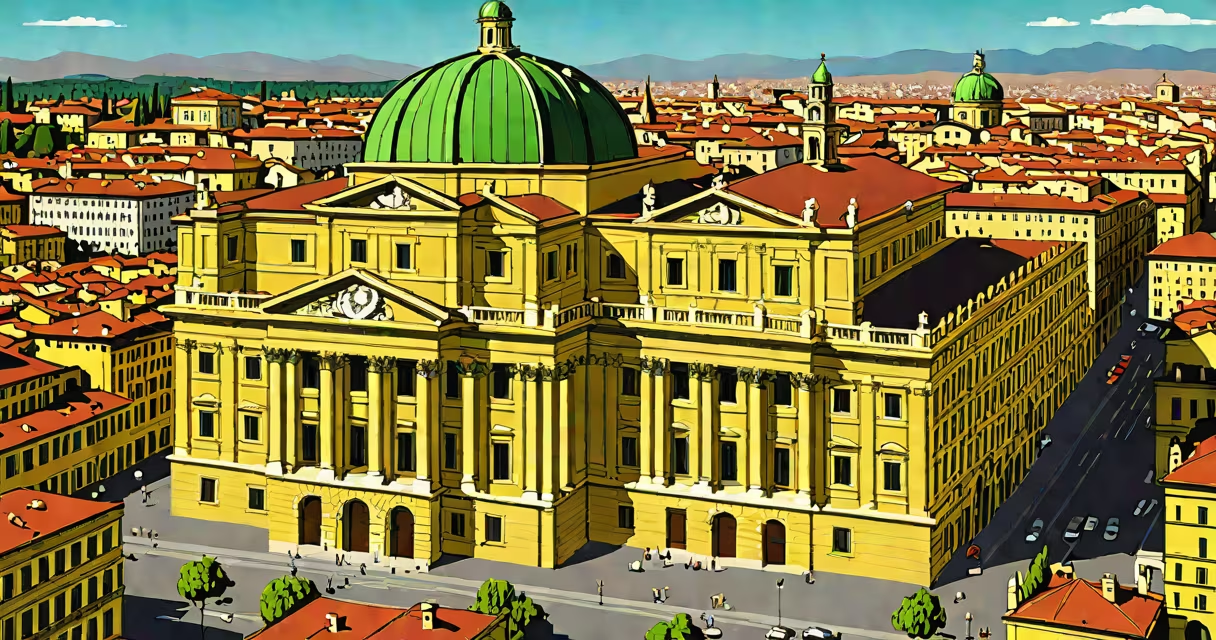
Teatro Verdi Firenze is a 19th-century theater located in central Florence, Italy, dedicated primarily to opera, ballet, and orchestral concerts. It serves as a cultural hub for the city's performing arts scene and hosts productions by the Maggio Musicale Fiorentino, one of Italy's oldest and most respected music festivals.
The venue opened in 1854 as Teatro della Pergola, replacing an earlier structure destroyed by fire. It was renamed Teatro Verdi in 1893 in honor of Giuseppe Verdi, whose operas were frequently performed there. The building's design reflects Neoclassical principles, with a symmetrical façade, arched windows, and a prominent dome. Inside, the auditorium seats 1,600 people and features a proscenium stage with a deep orchestra pit.
Performance schedules at Teatro Verdi Firenze typically run from September through June. Major events include full-scale operas such as *La Traviata*, *Rigoletto*, and *Tosca*, often staged with international casts and conductors. The theater also hosts the annual Maggio Musicale Fiorentino festival, which began in 1933 and features performances by the Orchestra del Teatro Comunale di Firenze and guest ensembles from Europe and North America.
Teatro Verdi Firenze operates under the management of the Fondazione Teatro della Pergola, a public institution responsible for programming, maintenance, and artistic direction. The theater uses a traditional proscenium stage layout, meaning the audience faces a framed stage with a curtain that opens and closes during acts. This setup allows for complex scene changes, elaborate sets, and precise lighting cues.
Behind the scenes, the theater maintains a technical infrastructure including fly systems for moving scenery, automated lighting grids, and sound reinforcement systems. The acoustics are carefully tuned to support both large orchestras and solo vocalists. According to the Accademia Nazionale di Santa Cecilia, the average reverberation time in the auditorium measures 1.8 seconds-ideal for live classical music performance.
For accessibility, the theater provides wheelchair spaces in the front rows of the stalls and balcony, audio description services for visually impaired attendees, and sign language interpretation upon request. These accommodations are mandated under Italian law (Legge 104/1992) and enforced by the Ministry of Culture.
Teatro Verdi Firenze categorizes performances into three primary tiers based on scale and production cost:
| Type | Scope | Examples | Duration |
|---|---|---|---|
| Full Opera | Large cast, full orchestra, elaborate staging | *Aida*, *Don Giovanni* | 3-4 hours (including intermission) |
| Ballet | Choreographed narrative with costumes and sets | *Swan Lake*, *Giselle* | 2-2.5 hours |
| Concert Series | Orchestral or chamber music without staging | Verdi's *Requiem*, Beethoven symphonies | 1.5-2 hours |
Each tier requires different technical staffing. Full operas involve over 100 crew members during rehearsals and performances, including set builders, costume technicians, and stage managers. Ballet productions require specialized floor systems to absorb impact from dancers' jumps. Concert series rely heavily on acoustic engineers to balance sound levels across the hall.
Many visitors assume Teatro Verdi Firenze is a modern multipurpose venue. It is not. The building retains its original 19th-century structural integrity, including load-bearing masonry walls and wooden beams. Renovations since 2000 have focused on seismic retrofitting and HVAC upgrades, not architectural overhaul.
A frequent error is confusing Teatro Verdi with Teatro Goldoni, a smaller 18th-century theater in Florence's Oltrarno district. While both host performances, Goldoni specializes in contemporary drama and experimental works. Teatro Verdi remains committed to classical repertoire and historical staging traditions.
Another misconception is that tickets are sold exclusively online. In reality, the box office at Via de' Tornabuoni 16 handles walk-up sales, especially for last-minute availability. During peak season, up to 40% of tickets are purchased in person, according to data from the Teatro della Pergola's 2023 annual report.
In the 2022-2023 season, Teatro Verdi Firenze mounted a full production of *La Traviata* directed by Luca Ronconi. The staging featured a 19th-century Parisian setting with period costumes designed by Maria Grazia Chiuri for Dior. The orchestra consisted of 85 musicians from the Orchestra del Teatro Comunale di Firenze, conducted by Daniele Gatti.
Rehearsals spanned eight weeks. The set included a rotating stage platform, allowing for smooth transitions between Violetta's salon, her country villa, and the final act's cemetery. Lighting cues were programmed using a grandMA3 console, with 224 channels mapped to control intensity, color, and movement.
Opening night drew 1,580 attendees. Ticket prices ranged from €25 to €150, with 35% of seats sold at reduced rates for students and seniors. Post-show surveys indicated a 92% satisfaction rate among audience members, citing the emotional delivery of soprano Anna Netrebko in the title role.
I attended a performance of *Il Trovatore* at Teatro Verdi Firenze in November 2021. The hall was nearly full, with a mix of local residents and tourists. The acoustics were striking-the low notes from the baritone resonated through the stone walls with clarity. After the final curtain, applause lasted over five minutes. I noticed that the stagehands exited through a side door behind the proscenium, a detail I'd never seen in modern theaters with automated stage lifts.
teatro verdi firenze remains a important center for classical performance in Italy. Its enduring legacy stems from consistent programming, adherence to historical standards, and integration with national cultural institutions. For audiences seeking authentic opera and ballet experiences, it offers a rare combination of architectural heritage and artistic excellence.