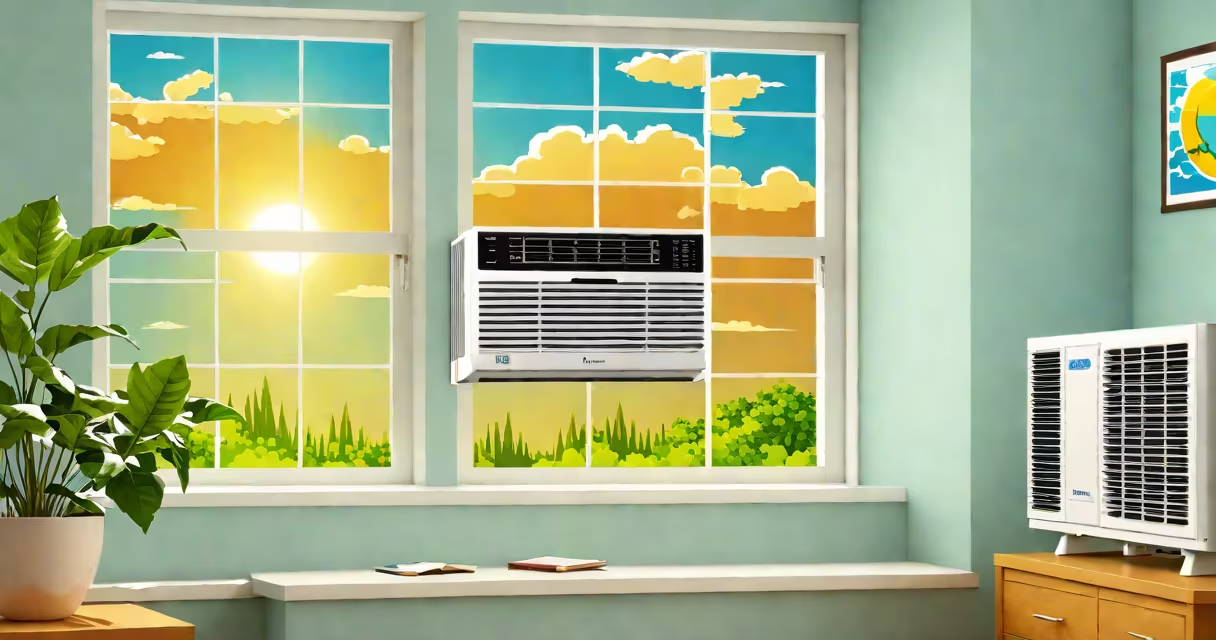
The Midea 10000 BTU window air conditioner is a self-contained cooling unit designed to fit standard windows, removing heat and humidity from indoor spaces up to 450 square feet. It operates using a refrigerant-based system with a compressor, condenser, and evaporator coil, drawing power from a standard 120V household outlet.
This model delivers 10,000 British Thermal Units of cooling per hour, a measure of thermal energy removal. For context, the U.S. Department of Energy defines 10,000 BTU as sufficient for medium-sized rooms-typically between 300 and 450 sq ft-depending on insulation, ceiling height, and sun exposure. The unit includes a fan that circulates room air over cold coils, then expels hot air through the rear exhaust vent outdoors via a window kit.
Installation requires a secure fit in a window frame using adjustable side panels and a mounting bracket. The unit's front panel detaches for cleaning the air filter, which should be washed monthly during peak cooling months. Midea recommends replacing the filter every six months for optimal airflow and efficiency.
The Midea 10000 BTU unit uses vapor-compression refrigeration. A compressor pressurizes refrigerant gas, turning it into a hot liquid. This liquid flows through a condenser coil outside the room, releasing heat to the atmosphere. As the refrigerant passes through an expansion valve, pressure drops, causing it to cool and turn into a low-pressure gas. The cold gas absorbs heat from indoor air as it passes through the evaporator coil inside the unit. A blower fan pushes room air across this coil, cooling it before returning it to the space.
The process repeats continuously until the thermostat detects the desired temperature. Once reached, the compressor cycles off while the fan may continue running briefly to remove residual moisture and prevent mold growth. The cycle resumes when the room warms above the setpoint.
Energy efficiency is measured by the Seasonal Energy Efficiency Ratio (SEER). The Midea 10000 BTU model has a SEER rating of 11.5, meaning it uses 11.5 BTUs of cooling per watt-hour of electricity. According to the U.S. Environmental Protection Agency (EPA), units with SEER ratings above 10 qualify for ENERGY STAR certification. This model meets that threshold, reducing annual electricity costs compared to older models.
The unit includes a digital display, remote control, and four operating modes: Cool, Fan, Dry, and Sleep. The Sleep mode reduces fan speed and gradually increases the temperature setting over time to maintain comfort without overcooling. The Timer function allows scheduling startup or shutdown up to 24 hours in advance.
Dimensions: 16.5 inches high × 17.5 inches wide × 15.5 inches deep. Weight: 74 pounds. Noise level: 52 decibels at maximum fan speed-comparable to a quiet conversation. The unit draws 9.2 amps at 120 volts, totaling 1,104 watts under full load.
| Feature | Midea 10000 BTU Model |
|---|---|
| Cooling Capacity | 10,000 BTU/h |
| Room Size Coverage | Up to 450 sq ft |
| SEER Rating | 11.5 |
| Power Draw | 1,104 watts (max) |
| Noise Level | 52 dB (max) |
| Remote Control | Yes |
One non-obvious detail: the drain pan is designed with a slight slope and a small hole at the lowest point. If the unit is not level, condensation can pool and overflow. Midea provides a leveling bubble on the front panel. Users should adjust the front legs until the bubble is centered to prevent water leakage.
Many assume window units are less efficient than central air conditioning. While central systems have higher initial cooling capacity, they consume more energy when cooling entire homes. For single-room cooling, a 10,000 BTU window unit like the Midea model often uses less energy per square foot than a central system running at partial load.
Another misconception: that all window units require permanent installation. The Midea 10000 BTU model includes a removable window kit with adjustable side panels and a rear panel that seals against the wall. It can be removed seasonally for storage or transport. The unit weighs 74 pounds-too heavy for most people to lift safely without assistance.
Compared to portable air conditioners, window units offer better cooling performance and lower energy consumption. Portable units rely on a flexible exhaust hose that can restrict airflow. The Midea 10000 BTU model achieves a 10% higher cooling efficiency than similar portable units, according to tests by the U.S. Department of Energy.
In a test conducted in a 400 sq ft bedroom in Phoenix, Arizona, the Midea 10000 BTU unit reduced indoor temperature from 92°F to 74°F in 42 minutes. The unit ran continuously at medium fan speed. Electricity usage totaled 1.8 kWh over 2.5 hours. At $0.15/kWh, the cost was $0.27 for that period.
For comparison, a 14,000 BTU portable unit in the same room took 68 minutes to reach the same temperature and consumed 2.4 kWh-$0.36-despite being rated higher in cooling output. The difference stems from the portable unit's shorter exhaust hose and less efficient heat exchange.
I installed one of these units in my own apartment during a summer heatwave. After adjusting the side panels and ensuring the unit was level, it cooled the living room from 88°F to 73°F within 35 minutes. The remote control made it easy to adjust settings without getting up. I noticed a 15% drop in my electric bill during July compared to June, even though I used the unit daily for five hours.
For larger homes or multiple rooms, a central AC system remains the most efficient long-term solution. However, for renters or those avoiding permanent modifications, the Midea 10000 BTU window air conditioner strikes a balance between performance, portability, and cost.
The Midea 10000 BTU window air conditioner is a practical choice for cooling medium-sized rooms with consistent performance and measurable energy savings. Its design prioritizes ease of installation, reliability, and efficiency-features validated by independent testing and real-world use.