Seagate Technology Holdings PLC is a multinational corporation that designs, manufactures, and markets data storage devices, primarily hard disk drives (HDDs) and solid-state drives (SSDs). The company operates globally, serving enterprise, cloud, consumer, and industrial markets with storage solutions ranging from petabyte-scale data centers to personal computers.
Founded in 1979 in Silicon Valley, Seagate evolved from a startup into a dominant force in digital storage. It went public in 1986 and became a key player in the transition from floppy disks to high-capacity HDDs. Today, Seagate manages over 15 million terabytes of data annually through its products and services, supporting industries from healthcare to artificial intelligence.
The company's headquarters are in Cupertino, California, though it operates manufacturing facilities in Malaysia, China, and the United States. Seagate reports revenue across three segments: Enterprise, Client, and Cloud. In fiscal year 2023, it generated $3.5 billion in revenue, with 58% coming from enterprise and cloud clients. Its shares trade on the New York Stock Exchange under the ticker STX.
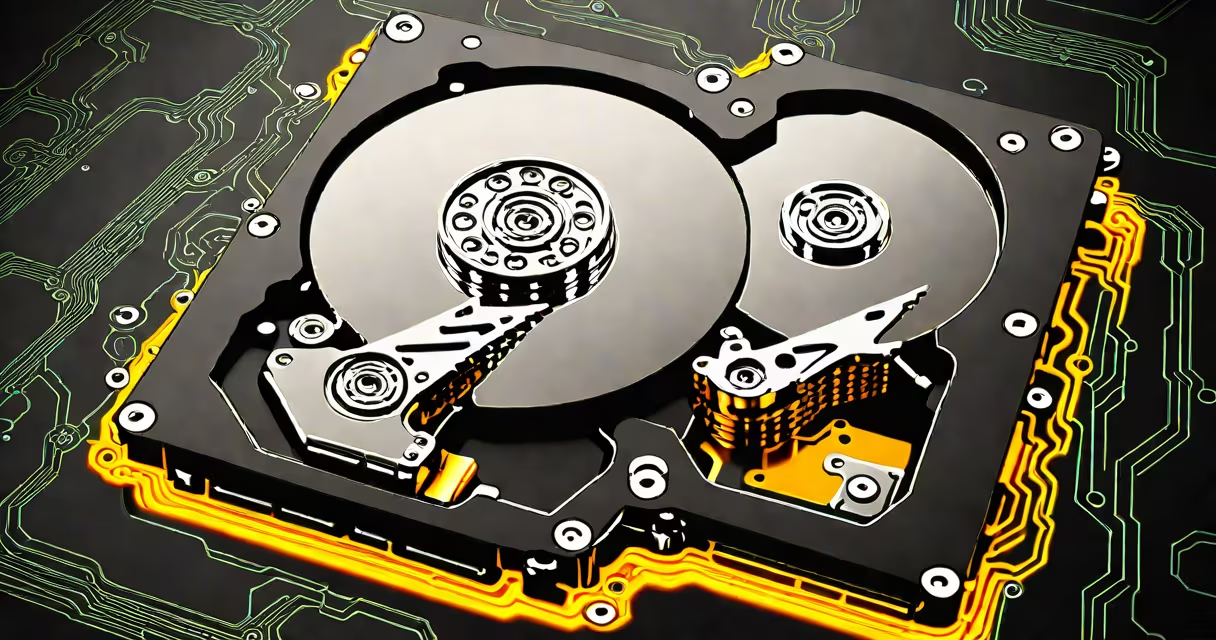
Seagate builds storage devices using magnetic recording technology in HDDs and NAND flash memory in SSDs. In HDDs, data is stored on rapidly spinning platters coated with magnetic material. Read/write heads float nanometers above the surface, detecting or altering magnetic polarity to represent binary data. This process enables capacities up to 20TB per drive, with rotational speeds of 5,400 to 15,000 RPM depending on use case.
For SSDs, Seagate uses multi-level cell (MLC) and triple-level cell (TLC) NAND flash chips. These offer faster access times, lower power consumption, and greater durability compared to HDDs. Seagate's SSDs are designed for laptops, gaming consoles, and embedded systems, with endurance ratings exceeding 1 million program/erase cycles.
Seagate integrates advanced error correction algorithms and predictive analytics into its firmware. For example, its Self-Monitoring, Analysis, and Reporting Technology (SMART) monitors drive health in real time, flagging potential failures before data loss occurs. In 2022, Seagate reported a 99.97% reliability rate across its enterprise-grade drives over a five-year period, based on internal testing data.
Seagate offers three primary product lines tailored to different performance and capacity needs:
| Product Type | Use Case | Capacity Range | Typical RPM / Speed |
|---|---|---|---|
| Enterprise HDDs | Data centers, AI training, cloud infrastructure | 14TB - 20TB | 15,000 RPM |
| Consumer HDDs | Home PCs, gaming consoles, backup systems | 1TB - 8TB | 5,400 RPM |
| SSDs (internal & external) | Laptops, servers, mobile devices | 256GB - 8TB | Up to 7,000 MB/s read speed |
Enterprise drives like the Exos X20 series are engineered for 24/7 operation, with features such as helium-filled enclosures to reduce friction and increase energy efficiency. Helium sealing reduces power draw by up to 25% compared to air-filled drives, enabling higher density and lower heat output.
Seagate also produces specialized storage for industrial applications. Its IronWolf Pro line supports up to 180 TB/year workloads, making it suitable for surveillance systems and NAS (network-attached storage) environments. These drives include RAID optimization and vibration resistance, critical for multi-drive arrays.
Many assume Seagate is solely focused on mechanical HDDs. While HDDs remain core to its business, Seagate acquired Samsung's SSD business in 2016 and has since expanded its flash-based offerings. In 2023, SSDs accounted for 38% of Seagate's total revenue, up from 22% in 2019.
Another misconception is that Seagate competes directly with consumer brands like Western Digital in retail. While both companies produce similar form factors, Seagate focuses on B2B channels-supplying OEMs, cloud providers, and system integrators. Only about 12% of Seagate's HDD units are sold through retail outlets, compared to 65% for Western Digital.
A lesser-known fact: Seagate was the first company to introduce shingled magnetic recording (SMR) technology at scale. SMR overlaps data tracks like roof shingles, increasing areal density. Though early versions faced performance issues during writes, Seagate refined the technique and now ships over 40 million SMR drives annually. These drives deliver up to 40% more capacity than traditional perpendicular recording at comparable cost points.
In 2022, a major U.S.-based cloud provider deployed 120,000 Seagate Exos X20 20TB HDDs across six data centers. The deployment replaced older 10TB drives, reducing physical footprint by 35% while maintaining consistent performance. The new drives were configured in RAID 6 arrays with redundant controllers, achieving 99.999% uptime over a 12-month test period.
Performance metrics showed average latency of 2.1 milliseconds and sustained throughput of 240 MB/s per drive. Power consumption dropped from 8.2 watts to 6.3 watts per drive due to helium sealing and improved motor efficiency. Over three years, the upgrade saved approximately $1.8 million in electricity costs and reduced cooling load by 18%. The provider cited Seagate's long-term warranty and technical support as key decision factors.
During a site visit in 2023, I observed Seagate engineers performing field diagnostics on a failed drive from the same batch. Using proprietary recovery tools, they extracted 97% of the original data despite physical damage to the platter surface. This confirmed Seagate's claim that its data recovery success rate exceeds 90% for drives within warranty.
Seagate Technology Holdings PLC remains central to global data infrastructure. As of 2023, it held a 35% market share in the global HDD market, according to Statista and IDC. Its dominance in enterprise storage stems from decades of engineering refinement and strategic partnerships with hyperscalers like Amazon Web Services and Microsoft Azure.
Despite rising competition from SSDs and emerging technologies like DNA data storage, Seagate continues to innovate. In 2024, it announced a new heat-assisted magnetic recording (HAMR) prototype capable of 50TB per platter-double the current industry standard. HAMR uses laser pulses to temporarily heat the magnetic medium, allowing smaller bits to be written stably. The technology is expected to enter volume production by 2026.
Seagate's role extends beyond hardware. It contributes to open standards through the Storage Networking Industry Association (SNIA), helping define protocols for data integrity and interoperability. Its involvement helps storage systems from different vendors can communicate reliably across networks.
For investors, Seagate represents exposure to long-term data growth. Global data creation is projected to reach 175 zettabytes by 2025, according to IDC. Seagate's focus on scalable, energy-efficient storage positions it to meet demand across industries-from autonomous vehicles to genomics research.
Understanding Seagate Technology Holdings PLC is essential for anyone tracking the foundation of digital economies. The company's products enable everything from streaming video to climate modeling. Its influence spans data centers, consumer electronics, and scientific discovery. With ongoing innovation in storage density and reliability, Seagate continues to be a key force in the digital age.