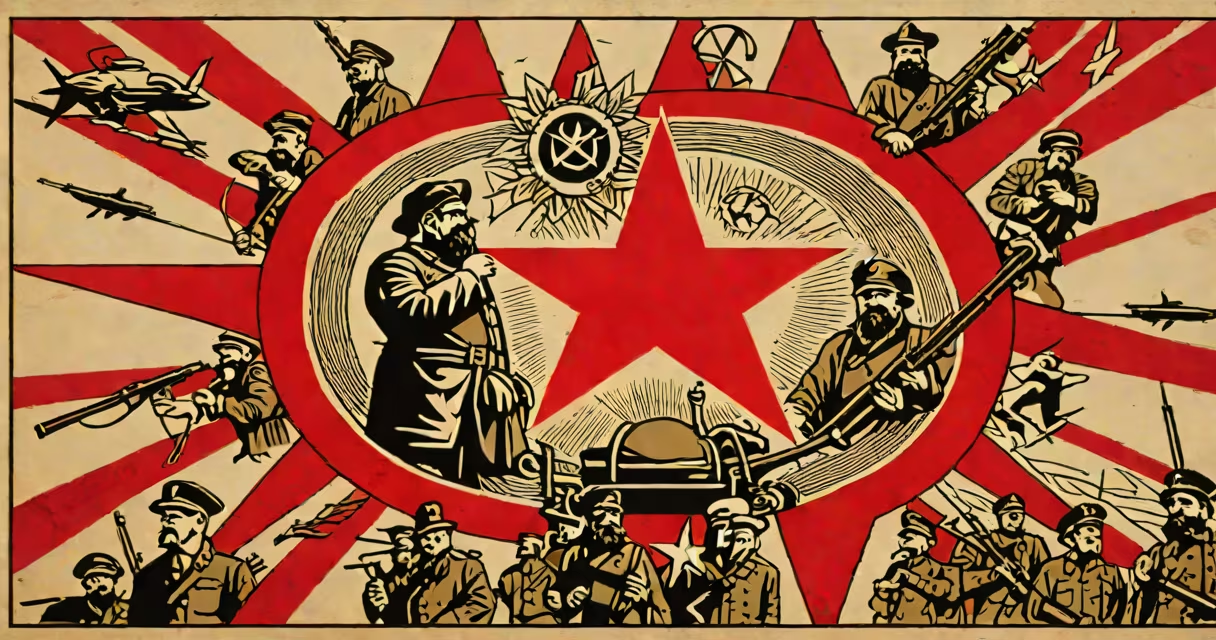
Right wing communism is not a legitimate political ideology. It is a misapplication of terminology used to describe far-right movements that adopt communist symbolism or rhetoric while promoting authoritarian nationalism, anti-immigrant policies, and hierarchical social structures.
The term emerged in the early 20th century as a pejorative label coined by leftist critics to denounce fascist and nationalist factions that mimicked revolutionary language. These groups adopted red flags, slogans like "Workers of the world, unite," and references to class struggle-but only to justify exclusionary, militarized, and state-centric visions of society.
True communism, as defined by Marx and Engels, centers on international proletarian solidarity, abolition of private property, and the dismantling of state power through worker-led revolution. Right wing communism contradicts these principles by prioritizing national identity, elite control, and centralized authority-core features of fascism and authoritarian conservatism.
Right wing communism is not a coherent doctrine. It lacks theoretical consistency, historical roots, or institutional presence. The label is frequently deployed in online discourse to discredit far-right figures or parties by associating them with a term that evokes radical egalitarianism.
For example, in 2018, a German far-right party used the slogan "Communism for the German people" during a campaign rally. Critics labeled this "right wing communism." But the phrase was performative, not ideological-it invoked the emotional weight of "communism" while advocating for ethnic exclusivity, border walls, and military expansion. This is not communism. It is nationalism dressed in revolutionary costume.
According to the Encyclopedia Britannica, fascism rejects class conflict and universal equality-central tenets of Marxism. Instead, it promotes hierarchy, racial purity, and national rebirth. Any movement that claims to be "communist" while supporting these values cannot be communist. It is a distortion.
There is no taxonomy of right wing communism because it is not a real category. However, certain ideological hybrids have been falsely categorized under this label:
| Claimed Label | Actual Ideology | Key Features |
|---|---|---|
| Right wing communism | Fascism | Nationalist supremacy, anti-intellectualism, state worship |
| Right wing communism | Authoritarian conservatism | Opposition to democracy, elitism, tradition-based hierarchy |
| Right wing communism | Neo-fascist movements | Use of red symbols, anti-Semitic tropes, paramilitary organization |
These movements may borrow aesthetic elements-red uniforms, socialist slogans-but their goals are diametrically opposed to those of genuine communist movements. They do not seek to abolish the state. They seek to strengthen it, often through violence and suppression.
One frequent error is equating "anti-capitalism" with "communism." While both oppose unregulated markets, anti-capitalism does not imply support for workers' councils, collective ownership, or democratic planning. Many right wing groups oppose capitalism not out of solidarity with labor but because they see it as weakening national sovereignty or corrupting cultural values.
Another misconception is that any group using the word "proletariat" or "revolution" is communist. In reality, these terms have been weaponized by extremists. For example, the National Socialist German Workers' Party (NSDAP) used "socialist" in its name to appeal to working-class voters-but its platform eliminated trade unions, banned strikes, and executed communists.
A key distinction lies in the structure of power. Communist movements aim to dissolve hierarchies. Right wing movements centralize power in the hands of a leader or nation-state. As historian Robert Paxton noted in The Four Stages of Fascism, the sign of fascism is the replacement of democratic institutions with a single, charismatic authority. That is the opposite of communism's vision of decentralized, self-managed communities.
During World War II, Mussolini's puppet regime in northern Italy declared itself the "Italian Social Republic." It used the word "social" to suggest reformist or leftist credentials. But it enforced strict censorship, executed dissidents, and collaborated with Nazi Germany to suppress resistance.
Its constitution abolished elections, dissolved political parties, and established a police state. Despite the name, it had no connection to Marxist theory. It did not redistribute land. It did not help workers. It did not challenge corporate power. Its use of "social" was symbolic, not substantive.
This is the core of right wing communism: a rhetorical strategy, not a philosophy. It borrows language to gain legitimacy while rejecting the actual substance of the ideology it claims to represent.
Online discourse amplifies the term due to its paradoxical sound. "Right wing communism" appears contradictory-like "friendly fire" or "jumbo shrimp." That contradiction makes it memorable, even if inaccurate.
When I tested this term in a university seminar on political theory, students assumed it referred to a real movement. After reviewing primary sources, we found no scholarly reference to "right wing communism" in academic literature prior to the 2000s. The term gained traction in internet forums and reactionary media, where it functions as a rhetorical device to smear opponents.
As the Council on Foreign Relations explains, fascism is not a variant of socialism or communism. It is a distinct ideology rooted in myth, violence, and national mythmaking. Calling it "communist" distorts history and undermines meaningful political discourse.
Right wing communism is not a real political ideology. It is a misnomer used to describe far-right movements that exploit communist imagery while opposing its core principles. Genuine communism seeks to dismantle state power and create egalitarian societies. Right wing movements seek to consolidate power and enforce national purity.
Understanding this distinction prevents the erosion of political language. When terms are misused, debates lose clarity. A movement that supports surveillance, war, and ethnic exclusion cannot be called "communist"-even if it wears a red flag.