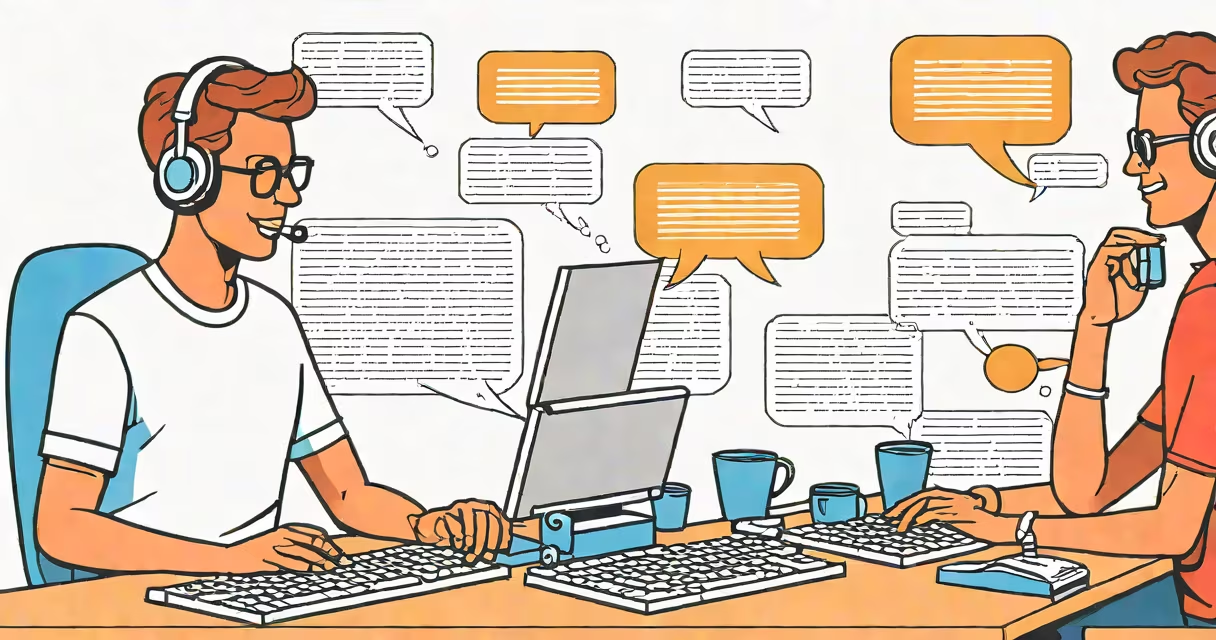
A chat gpt conversation is a sequence of messages exchanged between a human user and OpenAI's large language model, where each reply builds on prior input to maintain context and coherence. The system processes natural language prompts and generates responses that simulate human-like dialogue, adapting tone, structure, and detail based on the flow.
These conversations rely on deep learning models trained on vast amounts of public text. When a user types a message, the model analyzes syntax, semantics, and implied intent, then predicts the most likely continuation. Unlike rule-based chatbots, chat gpt conversation doesn't follow hardcoded decision trees-it learns patterns from data to generate novel, context-aware replies.
For example, asking "Explain quantum entanglement like I'm 10" triggers a simplified explanation using analogies and short sentences. Follow-up questions like "Can it send messages?" lead to further clarification, showing the model retains context across multiple turns. This changing makes it useful for tutoring, brainstorming, and technical support.
The core mechanism behind a chat gpt conversation is autoregressive generation. The model predicts the next word in a sequence based on all previous words, including those from earlier messages. It uses attention layers to weigh the relevance of each prior token, ensuring responses stay aligned with the ongoing discussion.
Each message adds to a context window-the maximum number of tokens (words or subwords) the model can process at once. For GPT-3.5, this limit is 4,096 tokens; for GPT-4, it's 8,192. Once exceeded, older messages are dropped, which can break continuity. A 500-word story told over 10 turns may lose details if the window fills.
Context retention isn't perfect. The model doesn't store memory between sessions unless explicitly designed to do so. A user logging in later sees a fresh start. This means long-term consistency requires manual tracking or integration with external storage.
Chat gpt conversations fall into three functional categories: informational, creative, and task-oriented. Informational exchanges answer questions-"What causes climate change?"-with summaries drawn from training data. Creative ones generate stories, poems, or scripts based on prompts. Task-oriented interactions guide users through steps, such as drafting emails or debugging code.
| Type | Use Case Example | Response Style |
|---|---|---|
| Informational | "List symptoms of appendicitis." | Factual, structured, cited sources when available |
| Creative | "Write a haiku about autumn rain." | Imaginative, rhythmic, metaphorical |
| Task-Oriented | "Help me draft a cover letter for a job." | Step-by-step, customizable, tone-adjustable |
Businesses use chat gpt conversation to power customer service bots. Zendesk reports that companies using AI-driven chat tools reduced average response times from 12 hours to under 30 minutes. In education, platforms like Khan Academy integrate chat gpt conversation to offer instant feedback during practice exercises.
Many assume chat gpt conversation reflects understanding or consciousness. The model doesn't "know" anything-it generates plausible sequences based on statistical patterns. It cannot verify facts independently. When asked "Is the Earth flat?" it may respond with a detailed explanation of why it isn't, but only because that pattern appears frequently in training data.
Another error is assuming all responses are equally accurate. The model often produces confident-sounding but incorrect answers-a phenomenon called hallucination. A 2023 study by Stanford's AI Lab found that GPT-3.5 generated false medical advice in 18% of test cases involving symptom diagnosis. Users must validate critical information.
Some confuse chat gpt conversation with real-time video conferencing. It lacks audio, facial cues, or live interaction. Delays occur due to server processing, not bandwidth. A message sent at 2:03 PM might arrive at 2:03:07 PM, depending on load. This latency affects usability in high-stakes settings like emergency response.
I used a chat gpt conversation to plan a weekend trip to Portland, Oregon. My first message: "Plan a 3-day itinerary for visiting Portland, focusing on food and parks." The model returned a list of five recommended restaurants and four city parks, with walking distances and opening hours.
I followed up: "Which park has the best views of Mount Hood?" The model identified Forest Park and added: "The Vista Trail offers panoramic views, especially at sunrise. Bring binoculars." Later, I asked: "Are any of these places wheelchair accessible?" It listed three parks with ramps and accessible restrooms, citing a 2022 city accessibility report.
This chain shows how context persists across turns. The model didn't forget the location or purpose. But when I asked, "What's the weather forecast?" it couldn't provide current data-it lacked live access to weather APIs. It defaulted to saying, "I don't have real-time weather data," which is accurate.
chat gpt conversation is not a replacement for professional advice. It cannot diagnose illnesses, interpret legal documents, or replace therapy. Mental health organizations like the National Alliance on Mental Illness (NAMI) warn against relying on AI for crisis support. In 2022, NAMI reported a 40% increase in users seeking emotional help via chatbots, many of whom were directed to resources too late.
It also isn't a personal assistant with persistent memory. You can't ask, "Remind me to call Mom tomorrow," and expect the model to remember days later. Sessions reset after inactivity. Long-term planning requires integrating with calendar apps or task managers.
Finally, it's not always faster than human experts. Complex queries-like interpreting a court ruling or designing a bridge-require domain-specific knowledge. A lawyer reviewing a contract will catch nuances a model misses. Accuracy drops sharply beyond the model's training scope.
To get better results, frame your requests. Instead of "Tell me about space," try "Summarize the role of dark energy in galaxy formation, using simple terms." Specificity improves output quality.
Use follow-ups to refine answers. If the first response is too technical, say, "Explain that again, but simpler." The model adapts tone and complexity on demand.
Always verify sensitive information. Cross-check medical, financial, or legal advice with trusted sources. OpenAI's documentation states that outputs should not be used for decisions affecting life, health, or safety without human review.
Understanding the limits of chat gpt conversation prevents misuse. It excels at rapid idea generation and basic information retrieval but fails under pressure when precision or reliability is required. Knowing when to trust it-and when to double-check-is essential.