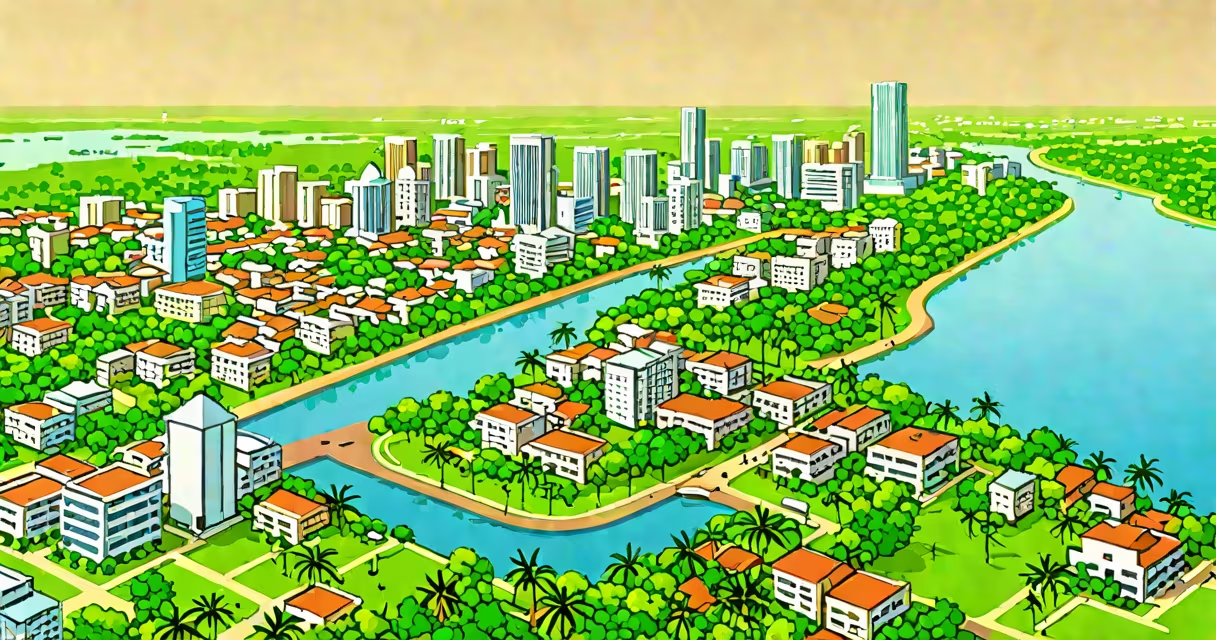
The Republique du Congo is a sovereign state in Central Africa, bordered by Gabon, the Democratic Republic of the Congo, Cameroon, and the Atlantic Ocean. It lies entirely within the Congo Basin and shares its name with the neighboring Democratic Republic of the Congo, though the two are distinct nations with different capitals, governments, and histories.
Established in 1960 after independence from France, the Republique du Congo adopted a presidential system with a constitution ratified in 2015. The country's capital is Brazzaville, located on the banks of the Congo River opposite Kinshasa, the capital of the DRC. With a population of approximately 6 million people, it is one of the smaller nations in sub-Saharan Africa.
French is the official language, and the country operates under a unitary semi-presidential system. The president holds significant executive power, and the current leader, Denis Sassou Nguesso, has governed since 1979 with brief interruptions. His rule has been marked by political stability, economic reliance on oil exports, and periodic constitutional changes that extend presidential tenure.
The Republique du Congo functions under a centralized government model. The president appoints the prime minister and cabinet, who oversee ministries responsible for education, health, defense, and finance. The National Assembly, composed of 151 members elected through proportional representation, serves as the legislative body.
Political opposition exists but faces challenges. The 2015 constitution introduced term limits and a two-round voting system, yet critics argue that electoral processes lack transparency. International observers, including Human Rights Watch, have documented irregularities in past elections, particularly in voter registration and ballot counting.
A notable feature is the country's dual capital structure: Brazzaville hosts the national government, while Pointe-Noire, the largest city and port, serves as the economic hub. This division reflects historical colonial planning and continues to influence infrastructure investment and regional development policies.
The Republique du Congo spans 342,000 square kilometers, roughly the size of the U.S. state of Montana. Over 80% of its land is covered by tropical rainforest, part of the Congo Basin-the world's second-largest tropical forest after the Amazon. These forests store vast carbon reserves and support biodiversity, including endangered species like western lowland gorillas and forest elephants.
Oil accounts for nearly 90% of export earnings and over half of government revenue. Production peaked in the early 2000s at around 400,000 barrels per day but declined due to aging fields and reduced exploration. In 2022, output averaged 220,000 barrels daily, according to the U.S. Energy Information Administration (EIA).
Other natural resources include uranium, timber, and minerals such as gold and diamonds. However, mining remains underdeveloped due to limited infrastructure and regulatory hurdles. The government promotes foreign investment through special economic zones, especially near Pointe-Noire.
| Resource | Export Value (2022 est.) | Share of Total Exports |
|---|---|---|
| Crude Oil | $3.8 billion | 89% |
| Timber | $140 million | 3% |
| Uranium | $45 million | 1% |
| Gold & Diamonds | $30 million | 1% |
Despite resource wealth, poverty persists. The World Bank reports that 30% of the population lives below the national poverty line, with higher rates in rural areas. Access to clean water and electricity remains uneven, especially outside major cities.
The Republique du Congo plays a moderate role in regional diplomacy. It is a member of the African Union, the United Nations, and the Economic Community of Central African States (CEEAC). It also participates in the Central African Forest Initiative (CAFI), a multilateral effort to reduce deforestation and promote sustainable land use.
France maintains strong ties due to historical colonial links. French companies operate in energy and construction sectors. The country also receives development aid from the European Union and bilateral partners like China and India. In 2021, China signed a $1.2 billion loan agreement for infrastructure projects in Brazzaville and Pointe-Noire.
Security cooperation includes joint military exercises with the U.S. and France. The U.S. Defense Department lists the Republique du Congo as a partner in counterterrorism efforts in the Sahel region, despite its distance from the conflict zone.
Many confuse the Republique du Congo with the Democratic Republic of the Congo (DRC). They share a border and the same river, but differ in language, governance, and history. The DRC uses Lingala and Swahili widely; the Republique du Congo uses French and local languages like Kikongo and Mbochi.
Another misconception is that the country is politically unstable. While there have been protests and opposition crackdowns, the government has maintained control since 1997. The 2016 and 2021 elections were marred by allegations of fraud, but violence remained low compared to other African states.
A lesser-known fact: the Republique du Congo is one of the few African nations to host a permanent UN peacekeeping mission. Since 2005, the UN Mission in the Republic of the Congo (MONUC) has supported disarmament and humanitarian operations in the Pool region, where armed groups previously operated.
In 2019, I spent two weeks in Brazzaville documenting urban development. The city center features wide boulevards lined with colonial-era buildings, many restored after decades of neglect. The Palais de la Nation, home to the presidency, sits at the heart of the city, surrounded by gardens and security checkpoints.
I visited the Marché des Fleurs, a bustling market selling fresh produce, textiles, and handmade crafts. Prices were low-local eggs cost $0.15 per dozen-but quality varied. In the evening, I walked along the Congo River promenade, where families gathered under streetlights. The air smelled of wood smoke and distant cooking fires.
One detail stood out: public signage in both French and Kikongo. This bilingual policy reflects national efforts to promote linguistic diversity. It's rare among African nations with French as the sole official language.
For context, the Republique du Congo ranks 142nd globally in HDI, behind nations like Senegal and Ghana. Its GDP per capita is $4,200 (World Bank, 2022), placing it in the lower-middle-income group.
Understanding the Republique du Congo requires distinguishing it from its larger neighbor. The country's identity is shaped by French colonialism, post-independence consolidation, and ongoing reliance on hydrocarbon revenues. Despite challenges, it remains a stable actor in Central Africa with growing engagement in climate and regional security initiatives.