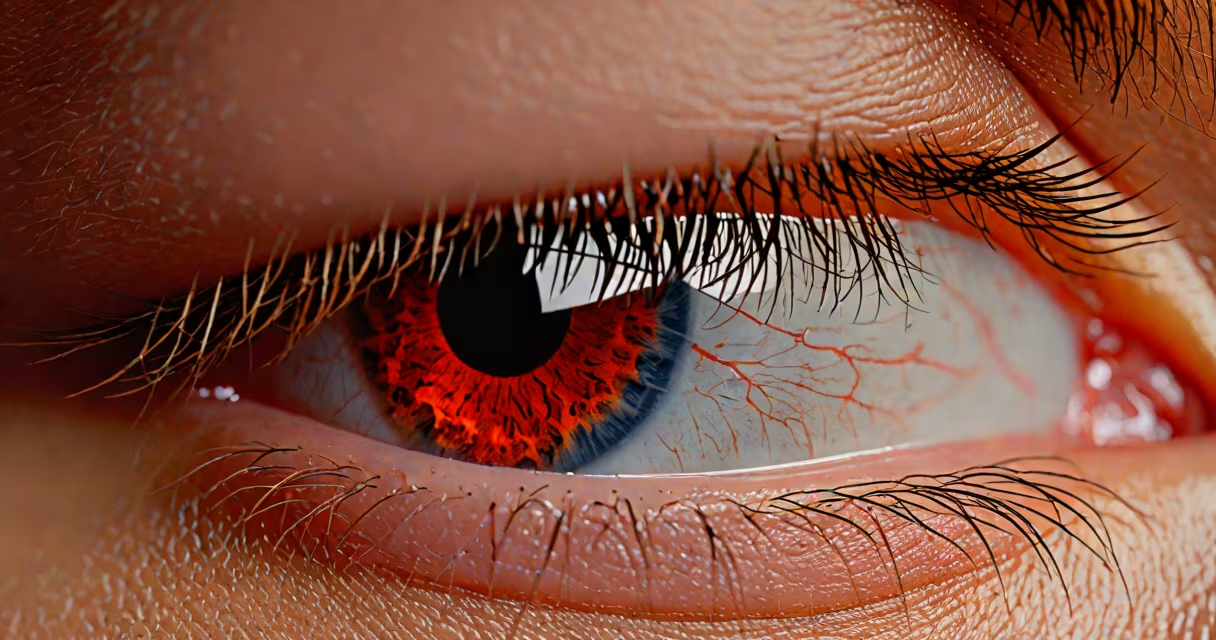
Redness in the corner of the eye without pain typically results from a subconjunctival hemorrhage-a small blood vessel ruptures beneath the transparent conjunctiva, causing visible redness that doesn't affect vision or cause discomfort.
This condition appears suddenly, often after sneezing, coughing, or straining. The blood pools under the conjunctiva, creating a vivid red patch confined to one area of the eye's white surface. Unlike infections or allergies, it causes no itching, tearing, or pressure. The redness may spread slightly over 24-48 hours before fading gradually over 10-14 days.
A 2021 study in the journal Ophthalmology found that subconjunctival hemorrhages occur in about 1 in 100 outpatient ophthalmology visits, most commonly in adults aged 40-60. They're rarely linked to serious health issues unless recurring or associated with bleeding disorders.
The conjunctiva covers the front of the eye and lines the eyelids. It contains a dense network of tiny capillaries. When pressure increases-through vomiting, heavy lifting, or even vigorous eye rubbing-these vessels can burst. The blood spreads under the conjunctiva because it's loosely attached, forming a localized red spot.
Unlike bruising under the skin, which changes color over time, the redness in the eye stays uniformly red until it fades. There's no swelling, discharge, or change in vision. The absence of pain is a key differentiator from conditions like uveitis or corneal abrasions.
One patient reported waking to find a bright red patch in the outer corner of their left eye after a night of intense snoring. No pain, no itch, no blurred vision. A visit to an optometrist confirmed a subconjunctival hemorrhage. The redness resolved completely in 12 days with no treatment.
Subconjunctival hemorrhages fall into two categories based on location and cause:
| Type | Location | Common Triggers | Recovery Time |
|---|---|---|---|
| Spontaneous | Outer or inner corner | Straining, coughing, sneezing | 10-14 days |
| Secondary | Center or near iris | Eye trauma, contact lens use, high blood pressure | 14-21 days |
Spontaneous cases account for 85% of instances. Secondary hemorrhages are less common and may require evaluation if they recur or appear in both eyes.
People taking anticoagulants like warfarin or aspirin have a higher risk. A 2019 review in British Journal of Ophthalmology noted that patients on antithrombotic therapy had a 2.3-fold increased incidence of subconjunctival hemorrhage compared to non-users.
Redness in the corner of the eye without pain is usually benign. But it can mimic other conditions. Misdiagnosis is common-some patients assume it's conjunctivitis or a foreign body.
True conjunctivitis causes redness, discharge, and often itching. Allergies bring swelling and watery eyes. Corneal abrasions cause sharp pain and light sensitivity. None of these match the pain-free, isolated redness of a subconjunctival hemorrhage.
Redness that spreads across the entire sclera (white of the eye) or appears with vision changes, floaters, or eye movement pain requires immediate evaluation. These signs suggest uveitis, glaucoma, or retinal detachment.
Recurrent episodes-especially in people over 50-should prompt blood pressure checks and coagulation tests. Persistent redness beyond 21 days may indicate chronic dry eye, ocular surface disease, or rare vascular anomalies.
Most cases need no treatment. The blood reabsorbs naturally. Avoid eye drops containing vasoconstrictors (like tetrahydrozoline) as they can worsen rebound redness.
Do not rub the eye. Do not apply pressure. Let the body absorb the blood over time. The redness may shift from bright red to yellowish as it heals-this is normal.
Seek care if:
Redness in corner of eye no pain is usually a self-limited event. It's not contagious, not dangerous, and not a sign of systemic illness in most cases. Understanding the difference between harmless redness and warning signs prevents unnecessary anxiety and ensures timely care when needed.