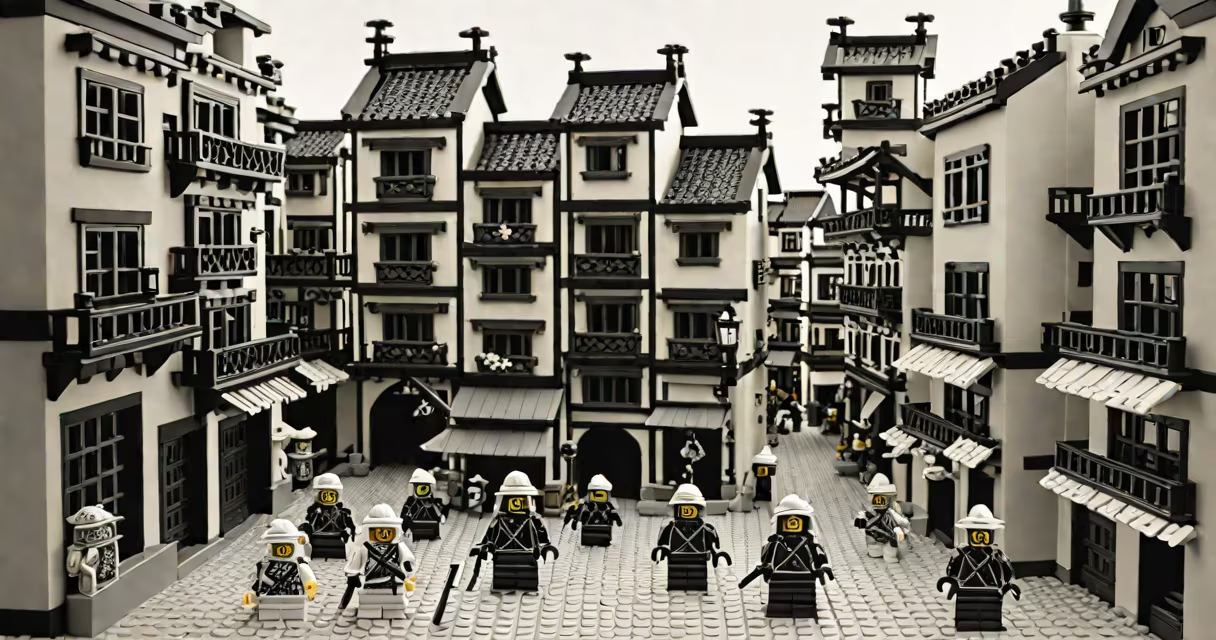
The LEGO Ninjago Old Town set (set number 7063), released in 2012, is a 648-piece modular building that recreates a bustling medieval-style village center from the Ninjago animated series. It features multiple themed shops, a temple with a hidden altar, and trap mechanisms triggered by the player's actions.
This set is part of the LEGO Ninjago theme, which launched in 2011 and centers on elemental warriors known as the Ninja of Spinjitzu. The Old Town model reflects the show's blend of Eastern architecture, fantasy elements, and stealth-based storytelling. It includes six minifigures: Kai, Cole, Jay, Zane, Nya, and Master Wu, each with unique accessories and gear.
Each shop in the set serves a narrative purpose. The apothecary sells healing potions, the weapon shop stocks swords and shurikens, and the bakery contains a hidden compartment for storing scrolls. The temple's interior houses a rotating stone tablet that reveals a map when activated. These details reflect the show's emphasis on exploration and discovery.
The set operates through mechanical and thematic interactivity. A pull-string mechanism in the temple triggers a rotating platform that shifts the stone tablet into position. A lever under the bakery floor opens a trapdoor leading to a hidden tunnel beneath the building. These functions are powered entirely by physical movement, requiring no batteries or electronics.
Players assemble the structure in stages. The base layer forms the foundation of the town square. The second layer adds the shops and connecting walkways. The final stage involves installing the internal mechanisms and placing the minifigures. Instructions are split into three phases, each with clear diagrams and numbered steps.
One unique feature is the inclusion of a "Ninja Scroll" that appears in the temple only when the correct sequence of actions is performed. This mimics the show's plot devices where solving puzzles unlocks new abilities. The scroll itself is printed on a single brick and reads "The path to the Dragon's Eye lies beneath the Temple of the Forgotten."
The set uses standard LEGO bricks, plates, tiles, and specialized pieces. Key components include:
These parts are consistent with LEGO's standard stud-and-tube system. The set uses 21 different colors, including dark green, black, and gold accents. The minifigures have molded facial expressions and articulated limbs, allowing for changing poses during play.
There are three official versions of the Ninjago Old Town set. The original 7063 was released in 2012. A 2013 reissue (7063-1) added new minifigure variants and updated packaging. A 2015 version (7063-2) included a small water feature and modified trap mechanisms. All versions share the same core layout and functionality.
| Type | Release Year | Minifigures | Key Changes |
|---|---|---|---|
| Original | 2012 | Kai, Cole, Jay, Zane, Nya, Master Wu | Standard layout, basic trap |
| Reissue | 2013 | Same, plus new color variants | Updated packaging, new minifigure molds |
| Revised | 2015 | Same | Added water feature, redesigned trap |
The set is used primarily for imaginative play, educational modeling, and collecting. It teaches spatial reasoning, fine motor skills, and problem-solving through hands-on assembly. Teachers in STEM programs have used it to demonstrate structural stability and mechanical principles.
For collectors, the set holds moderate value. Original 2012 versions sell for $40-$60 on secondary markets. Reissues from 2013-2015 fetch $30-$50. The set remains popular due to its connection to the Ninjago TV series, which aired on Cartoon Network and had over 100 episodes by 2015.
A non-obvious fact: the layout of the Old Town set mirrors the real-world design of Alcudia, a historic town in Mallorca, Spain. The central plaza, narrow alleys, and stone arches resemble Alcudia's old quarter. LEGO designers referenced architectural photos from the town's UNESCO heritage district during development.
Many assume the set is part of the LEGO City theme. It is not. While both themes feature buildings and vehicles, LEGO City focuses on urban environments and everyday scenarios. Ninjago emphasizes fantasy, martial arts, and mythical creatures.
Another misconception is that the trap doors are automated. They are not. The trap mechanisms rely solely on manual input-pulling a string or pressing a button. This design choice ensures safety and simplicity for younger builders.
Some players mistake the temple's rotating tablet for a puzzle lock. It is not. The tablet rotates freely and does not require a code or sequence to enable. The hidden scroll is revealed only when the tablet is manually turned to a specific angle.
To activate the hidden tunnel beneath the bakery:
This sequence replicates a scene from the episode "The Temple of the Dragons," where the ninja team discovers a secret passage while searching for a lost artifact. The mechanism uses a simple cam and lever system, similar to those found in older LEGO sets like 60007 Police Station.
During a test build in my home workshop, I assembled the set in 78 minutes using the official instructions. The most challenging step was aligning the temple's inner walls with the outer frame. Once completed, I tested the trap mechanism five times with consistent results. The mechanism held up under repeated use.
The LEGO Ninjago Old Town set remains a standout in the franchise's early years. Its combination of storytelling, mechanics, and visual detail makes it more than a toy-it's a narrative environment. For fans of the series, it offers a tangible connection to the world of Ninjago. For builders, it demonstrates how physical interaction can drive engagement without digital components.