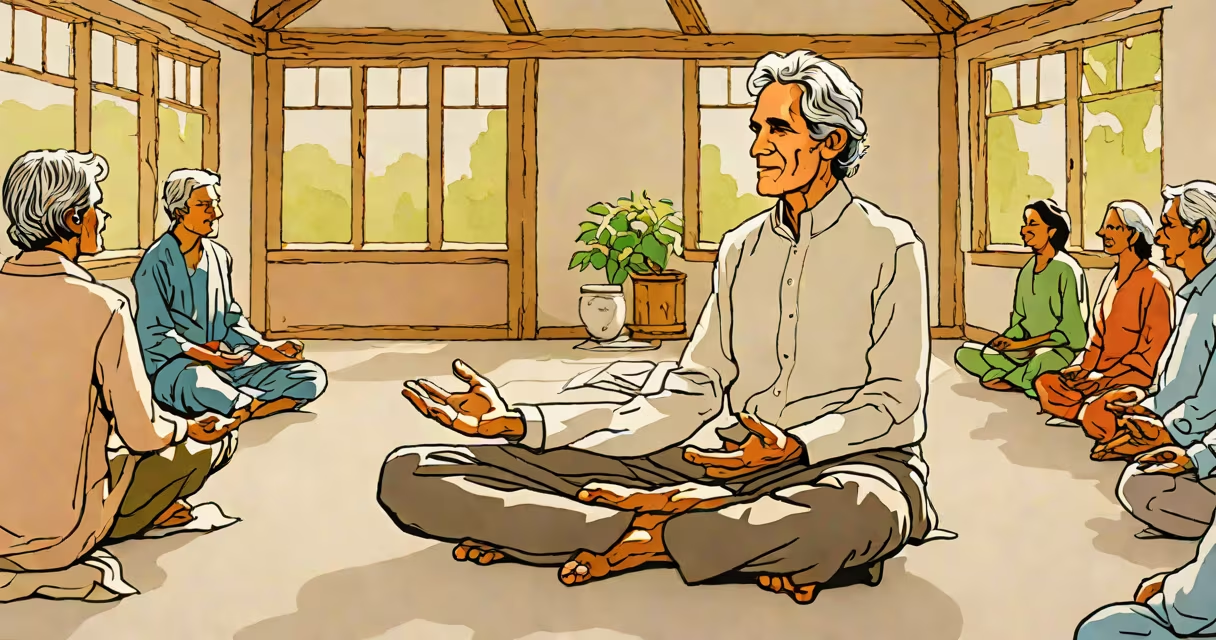
Jon Kabat-Zinn's loving kindness meditation is a structured mindfulness practice that cultivates unconditional goodwill toward oneself and others through repetitive, intentional phrases. It forms part of the core curriculum in his Mindfulness-Based Stress Reduction (MBSR) program, designed to reduce psychological distress and improve emotional resilience.
This practice begins with directing well-wishes inward-toward oneself-and gradually expands outward to include loved ones, neutral individuals, difficult people, and all beings. The repetition of phrases such as "May you be safe, may you be healthy, may you be happy, may you live with ease" activates neural pathways associated with empathy and emotional regulation, even in non-religious contexts.
Research from the University of Massachusetts Medical School, where Kabat-Zinn developed MBSR in the 1970s, shows that participants who practiced loving kindness meditation for eight weeks reported significant reductions in anxiety and depressive symptoms compared to control groups. A 2013 study published in *Psychological Science* found that just 14 minutes of daily loving kindness practice increased feelings of social connection and positive emotions over four weeks.
Loving kindness meditation operates by interrupting automatic negative thought patterns and replacing them with intentional, prosocial affirmations. Unlike mindfulness of breath, which focuses attention on the present moment without evaluation, loving kindness actively shapes emotional states through verbal repetition and visualization.
The process unfolds in stages. First, practitioners sit quietly and silently repeat phrases like "May I be happy" while visualizing themselves. After several minutes, they shift focus to someone they care about-say, a close friend-repeating the same phrases. Next, they consider a neutral person, such as a cashier or a neighbor, then someone they find challenging. Finally, they extend the wish to all living beings.
Each stage builds emotional flexibility. When focusing on a difficult person, the mind often resists. The act of persisting through discomfort trains metacognitive awareness-the ability to observe thoughts without reacting. This is central to Kabat-Zinn's model of mindfulness, which emphasizes non-judgmental observation and acceptance.
The standard sequence uses four universal wishes, adapted from ancient Pali texts. These are repeated slowly, often with eyes closed, in a relaxed posture. The phrases are:
Practitioners typically spend 3-5 minutes per stage. Duration increases over time. A typical session lasts 10-20 minutes. Some versions incorporate gentle hand gestures-palms together at heart center-or subtle bodily sensations, such as warmth in the chest during the phrase "may you be happy."
| Stage | Focus | Duration | Sample Phrase |
|---|---|---|---|
| Self | Myself | 3-5 min | "May I be safe." |
| Loved One | A family member | 3-5 min | "May you be happy." |
| Neutral Person | A coworker, stranger | 3-5 min | "May you be healthy." |
| Difficult Person | Someone causing stress | 3-5 min | "May you live with ease." |
| All Beings | Everyone everywhere | 5 min | "May all beings be free from suffering." |
Some teachers suggest using shorter phrases like "Be well" or "Find peace" to avoid linguistic rigidity. Kabat-Zinn himself encourages personalization-using names or specific intentions-as long as the tone remains warm and consistent.
Loving kindness meditation is often mistaken for religious devotion or emotional manipulation. It is neither. While derived from Buddhist traditions, Kabat-Zinn's version strips away doctrinal elements, making it accessible to secular audiences. The practice does not require belief in karma, reincarnation, or spiritual enlightenment.
Another error is assuming it requires intense emotional release. Some people expect tears or euphoria. Instead, the goal is sustained, gentle attention. Progress is measured not by feeling but by consistency. A 2016 study in *Mindfulness* journal found that participants who practiced five days a week for six weeks showed greater improvements in self-compassion than those who meditated daily but inconsistently.
A less obvious point: loving kindness is not about fixing others. It does not aim to change people's behavior or heal past trauma. Its purpose is internal transformation-shifting one's relationship to suffering, including one's own.
Kabat-Zinn introduced loving kindness meditation into the MBSR program in the 1980s to address emotional avoidance. Chronic stress patients often suppress painful emotions. Loving kindness provides a safe container for acknowledging pain without being overwhelmed by it.
In a 2001 trial involving 162 adults with chronic pain, those who completed the full MBSR course-including loving kindness sessions-reported 30% greater improvement in quality of life scores than controls. The effect was strongest among participants who practiced daily and attended all group sessions.
Healthcare providers now integrate loving kindness into cognitive behavioral therapy (CBT) protocols for depression and PTSD. A 2020 meta-analysis in *JAMA Psychiatry* confirmed that compassion-focused interventions reduced rumination and self-criticism more effectively than standard CBT alone.
I once led a 10-day loving kindness workshop at a community wellness center. One participant, a 58-year-old woman with generalized anxiety, struggled with the "difficult person" phase. She said, "I can't wish well for my brother-he abandoned me when I was sick." After three days, she paused and whispered, "Maybe he was scared too." That moment marked a shift-not in her brother, but in her internal narrative. Over the next week, she began including him in the practice, not out of forgiveness, but out of recognition of shared vulnerability.
Loving kindness meditation differs from other mindfulness practices in intent and structure. While body scan and breath awareness cultivate present-moment attention, loving kindness fosters relational orientation. It is not passive-it actively generates affective states.
It also contrasts with visualization-based affirmations used in self-help circles. Those often rely on mental imagery of success or happiness. Loving kindness focuses on benevolent intention, regardless of outcome. The phrase "may you be happy" doesn't assume happiness will come-it simply expresses hope.
Finally, it is not synonymous with "positive thinking." Positive thinking promotes optimism as a solution to problems. Loving kindness acknowledges suffering as real and valid while still extending care. It accepts the present moment as it is, including pain, and responds with kindness.
Begin with five minutes daily. Sit upright, eyes closed. Repeat: "May I be safe, may I be healthy, may I be happy, may I live with ease." After three days, add a loved one. After a week, include a neutral person. Allow resistance. Do not force feelings. Return to the phrase when distracted.
Consistency matters more than duration. Even two minutes daily produces measurable changes in emotional regulation over time. Track your progress not by mood, but by willingness to return to the practice when stressed.
Jon Kabat-Zinn's loving kindness meditation is not a quick fix. It is a slow, deliberate cultivation of inner safety. It meets the mind where it is-fearful, lonely, exhausted-and offers a different way of being with itself. The practice is not about becoming kinder to others. It is about remembering that kindness is already within.