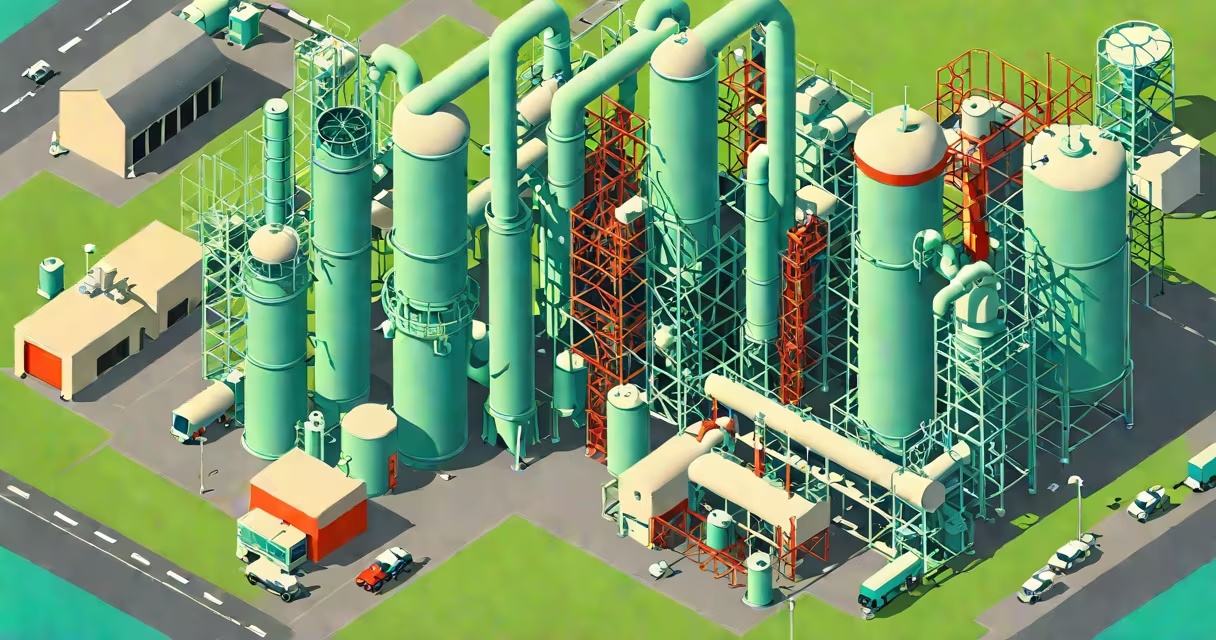
Industrial air pollution control systems are engineered solutions that capture, neutralize, or remove harmful pollutants-such as particulate matter, sulfur dioxide, nitrogen oxides, and volatile organic compounds-from exhaust gases before they enter the atmosphere. These systems are mandated by environmental regulations and deployed in manufacturing facilities, refineries, power plants, and chemical processing sites.
They function by treating flue gas streams using physical, chemical, or thermal processes. A typical system includes inlet ductwork, pollutant capture devices (like scrubbers or filters), energy recovery units, and stack emissions monitoring. The goal is to meet or exceed national standards such as those set by the U.S. Environmental Protection Agency (EPA).
For example, a coal-fired power plant may install a wet flue gas desulfurization (FGD) system to reduce sulfur dioxide emissions by over 90%. This process sprays limestone slurry into the exhaust stream, chemically reacting with SO₂ to form gypsum-a byproduct that can be sold for construction materials.
These systems operate on principles of separation, absorption, adsorption, or combustion. Particulate matter is removed through electrostatic precipitators (ESPs), which charge particles and collect them on oppositely charged plates. The collected dust is then scraped off and disposed of safely.
Gaseous pollutants require different approaches. Acid gases like SO₂ and HCl are often treated with wet scrubbers, where alkaline solutions neutralize acidic components. For nitrogen oxides (NOx), selective catalytic reduction (SCR) injects ammonia into hot exhaust gases, converting NOx into nitrogen and water vapor over a catalyst bed.
Volatile organic compounds (VOCs) are managed via thermal oxidizers or regenerative thermal oxidizers (RTOs). These burn VOCs at temperatures above 1,400°F, breaking them down into CO₂ and water. An RTO recovers heat from the exhaust to preheat incoming air, reducing fuel consumption by up to 60% compared to standard oxidizers.
The choice of system depends on the type and concentration of pollutants, flow rate, temperature, and operating costs. Below is a comparison of common technologies:
| Pollutant Type | Common Control Technology | Removal Efficiency | Typical Application |
|---|---|---|---|
| Particulates (PM10, PM2.5) | Electrostatic precipitator (ESP) | 99%+ | Cement kilns, steel mills |
| Sulfur dioxide (SO₂) | Wet scrubber (limestone slurry) | 90-95% | Coal-fired power plants |
| Nitrogen oxides (NOx) | Selective catalytic reduction (SCR) | 85-95% | Boilers, incinerators |
| Volatile organic compounds (VOCs) | Regenerative thermal oxidizer (RTO) | 99%+ | Paint booths, chemical plants |
Each system requires maintenance and monitoring. For instance, ESPs need regular rapping of collection plates to prevent buildup. Scrubber systems require pH monitoring and sludge disposal planning. RTOs depend on ceramic beds to store and reuse heat, which degrade over time and must be replaced every 5-7 years.
Industrial air pollution control systems are required under the Clean Air Act in the United States. Facilities emitting more than 100 tons per year of certain pollutants must install continuous emissions monitoring systems (CEMS) and report data to the EPA.
A facility producing aluminum ingots in Tennessee installed a combination of baghouses and SCR systems after exceeding NOx limits. After retrofitting, annual NOx emissions dropped from 1,200 tons to 320 tons-meeting compliance thresholds and avoiding $450,000 in potential fines.
Outside the U.S., similar mandates exist in the EU under the Industrial Emissions Directive (IED), which sets binding limits on emissions from large combustion plants and metal production facilities. Non-compliance results in operational shutdowns or heavy penalties.
Many assume that "scrubbers" only remove acid gases. In reality, wet scrubbers can also capture fine particulates and heavy metals like mercury. A study published in Environmental Science & Technology found that dual-stage wet scrubbers reduced mercury emissions by 88% in a waste-to-energy plant in Germany.
Another myth is that all control systems are equally effective across industries. This is false. A baghouse works well for dry, coarse particulates but fails with sticky or high-moisture emissions. In a paper mill in Wisconsin, a baghouse clogged within weeks due to moisture-laden fibers. Switching to a wet scrubber improved uptime by 70%.
Also, some believe that installing a control system eliminates all risk. That's incorrect. Systems degrade, and improper maintenance leads to bypass events. In 2019, a petrochemical plant in Texas reported a 30-minute spike in benzene emissions after a filter bypass was left unsecured during routine cleaning. The incident led to a $2.1 million penalty and mandatory operator training.
I once observed a commissioning test at a cement plant in Nevada. Engineers ran a tracer gas injection through the ESP system while measuring particle capture efficiency. Initial readings showed only 85% removal. After adjusting the voltage to the discharge electrodes, efficiency rose to 99.6%. The difference was measurable in real time-proof that small tuning adjustments dramatically improve performance.
Industrial air pollution control systems differ from residential air purifiers in scale, complexity, and purpose. Purifiers treat indoor air for allergens and odors. Industrial systems handle thousands of cubic feet per minute of exhaust and must manage toxic, corrosive, or explosive substances.
They also differ from passive controls like stack height increases. Raising a chimney disperses pollutants but doesn't reduce total emissions. Regulatory agencies now require actual abatement, not just dilution. The EPA's New Source Performance Standards (NSPS) mandate that new facilities must reduce emissions at the source, not just spread them out.
Finally, these systems are not one-size-fits-all. A refinery handling crude oil distillation faces different challenges than a food processor burning natural gas. The former deals with complex hydrocarbons and high-temperature gases; the latter focuses on low-level VOCs and odors. Matching the right technology to the specific process is critical.
Understanding industrial air pollution control systems reveals their role not just in compliance, but in public health protection. According to the World Health Organization, ambient air pollution contributes to 7 million premature deaths annually. Reducing emissions at the source prevents respiratory illness, cardiovascular disease, and long-term environmental damage.