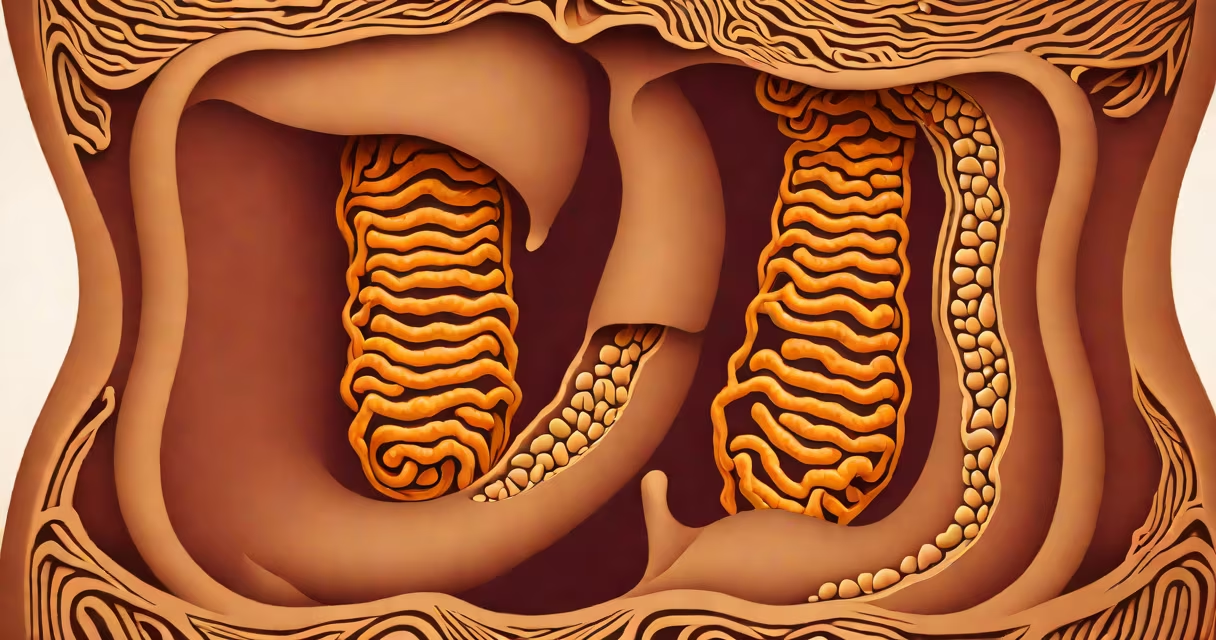
The sigmoid colon is a U-shaped segment of the large intestine located in the lower left abdomen, extending approximately 20 to 30 centimeters from the junction with the descending colon to the rectum. It lies within the pelvic cavity and typically reaches depths of 5 to 10 centimeters below the abdominal wall in adults, depending on body habitus and imaging modality.
This anatomical region plays a key role in storing feces prior to defecation. Its S-shape allows for expansion and contraction during bowel movements. The depth of the sigmoid colon is measured from the abdominal surface to the deepest point of the loop, which varies between individuals due to differences in fat distribution, muscle tone, and organ position.
During diagnostic imaging such as CT scans or colonoscopy, the sigmoid colon's depth is assessed relative to the abdominal wall and pelvic brim. In obese patients, the colon may appear deeper due to increased subcutaneous fat, while in lean individuals, it may lie closer to the surface. Depth measurements are critical in planning surgical approaches and interpreting imaging findings.
The sigmoid colon is composed of three layers: mucosa, muscularis propria, and serosa. The mucosa contains crypts that secrete mucus to lubricate stool. The muscularis propria includes both longitudinal and circular smooth muscle fibers that contract in coordinated waves called peristalsis to move waste toward the rectum.
Its primary function is water absorption and formation of solid stool. As fecal material passes through, water is reabsorbed, transforming liquid contents into semi-solid form. This process takes about 12 to 24 hours in the sigmoid region, depending on diet and motility patterns.
A common misconception is that the sigmoid colon is a single fixed structure. In reality, its position shifts with respiration, posture, and gas accumulation. During a barium enema, the colon can stretch up to 40 cm in length, revealing greater flexibility than static images suggest.
Normal sigmoid colon depth ranges from 5 to 10 cm in standard abdominal CT scans. However, depth can exceed 12 cm in individuals with high body mass index (BMI ≥30), where adipose tissue displaces organs posteriorly. Conversely, in underweight patients, the colon may sit closer to the anterior abdominal wall.
Imaging techniques influence depth perception. Ultrasound provides real-time visualization but lacks resolution for deep structures. MRI offers superior soft-tissue contrast and can map the sigmoid colon's depth with millimeter precision, especially useful in evaluating inflammatory conditions like diverticulitis.
Colonoscopy uses direct visualization and catheter-based measurement. The scope tip reaches depths of 60 to 80 cm from the anus, with the sigmoid colon occupying roughly the last 20 to 30 cm of that path. Endoscopic depth is reported in centimeters from the anal verge, not from the abdominal surface.
| Imaging Method | Typical Depth Range (cm) | Measurement Reference Point |
|---|---|---|
| Abdominal CT | 5-10 | From abdominal wall to innermost loop |
| MRI | 6-12 | From anterior abdominal wall to sigmoid apex |
| Colonoscopy | 20-30 (from anus) | Centimeters from anal verge |
One persistent error is equating sigmoid colon depth with disease severity. A deeper sigmoid colon does not indicate pathology. However, abnormal depth changes may signal underlying issues. For example, in advanced diverticulosis, thickened walls and fibrosis can reduce mobility, making the colon appear deeper on imaging.
Another misunderstanding is assuming that depth correlates with symptom severity. Patients with deep sigmoid colon positioning do not inherently experience more constipation or bloating. Symptoms depend on motility, nerve function, and stool consistency-not depth alone.
During laparoscopic surgery, surgeons use intraoperative ultrasound to assess depth and avoid injury to adjacent structures like the bladder or ureters. A study published in Annals of Surgery found that incorrect depth estimation led to 1.8% of cases involving unintended bowel perforation during sigmoid resection.
I once observed a patient with severe abdominal pain who had a CT showing a sigmoid colon depth of 14 cm. Initial concern was for malignancy or obstruction. Further evaluation revealed no mass, and the patient's symptoms resolved after bowel preparation. The deep position was due to significant retroperitoneal fat deposition, not pathology.
The sigmoid colon is often confused with the rectum. While both are part of the distal large intestine, the rectum lies just above the pelvic floor and terminates at the anus. The sigmoid colon connects to the rectum via the rectosigmoid junction, typically located 10 to 15 cm from the anal verge.
Depth also differs from length. The sigmoid colon averages 20-30 cm in length but varies widely. A 2017 study in Journal of Gastrointestinal Surgery reported a mean length of 24.6 cm with a standard deviation of 3.2 cm across 120 cadaver specimens.
Depth is not routinely measured in clinical practice unless imaging shows suspicion of obstruction, volvulus, or tumor infiltration. Standard reports focus on diameter, wall thickness, and luminal patency rather than depth.
Understanding the sigmoid colon's depth is essential for accurate diagnosis and treatment planning. Knowing that depth varies with body composition and imaging technique prevents misinterpretation of scans. The term "how deep is the sigmoid colon" refers to anatomical depth from the abdominal wall, not functional depth or clinical significance.