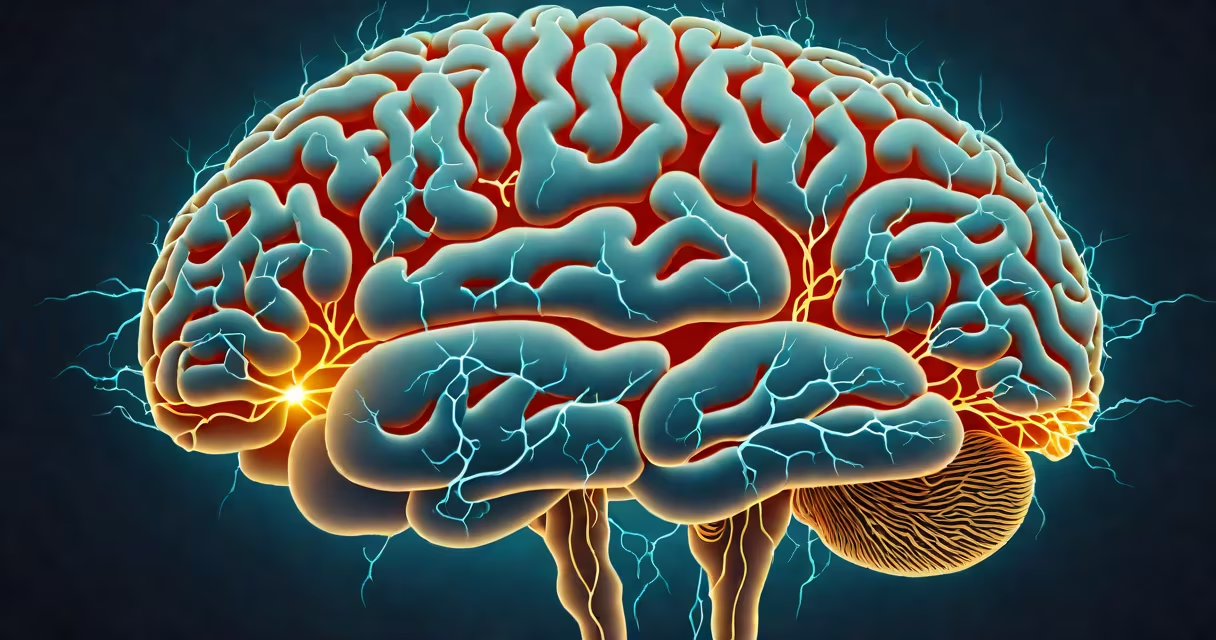
The nervous system is the body's command center, coordinating movement, sensation, and internal regulation through electrical and chemical signals transmitted by neurons. It includes the central nervous system (brain and spinal cord) and the peripheral nervous system (nerves extending to limbs and organs).
Neurons fire at speeds up to 268 miles per hour-faster than most cars on a highway. This speed enables near-instant responses to danger, such as pulling your hand away from a hot stove before you consciously feel pain.
Each neuron connects to thousands of others through synapses, forming networks that process everything from memory recall to emotional reactions. The human brain contains approximately 86 billion neurons, with more connections than stars in the Milky Way.
Electrical impulses travel along nerve fibers via ion movements across cell membranes. When a neuron fires, sodium ions rush in, triggering a wave of depolarization that moves down the axon. At the end, neurotransmitters like dopamine or serotonin cross the synaptic gap to influence the next neuron.
Signals don't jump between neurons-they're converted from electrical to chemical form and back. This conversion allows precise control over signal strength and timing, enabling complex behaviors like language, decision-making, and motor coordination.
For example, when you catch a ball, your eyes send visual data to the brain, which calculates trajectory and sends commands to muscles in your arms and hands. All this happens in under half a second, thanks to tightly synchronized neural circuits.
The nervous system consists of two main parts: the central nervous system (CNS) and the peripheral nervous system (PNS). The CNS handles integration and processing. The PNS transmits sensory input and motor output.
| System | Function | Examples |
|---|---|---|
| CNS | Processes information, makes decisions | Brain, spinal cord |
| PNS | Carries signals to and from CNS | Peripheral nerves, autonomic nerves |
The PNS further divides into somatic (voluntary actions like walking) and autonomic (involuntary functions like heartbeat and digestion). The autonomic system itself splits into sympathetic (fight-or-flight) and parasympathetic (rest-and-digest) branches.
Autonomic nerves operate without conscious effort. For instance, your pupils dilate in low light automatically-no mental command required. This happens because the nervous system maintains homeostasis, adjusting internal conditions in real time.
Many people believe we only use 10% of our brains. This myth persists despite evidence from functional MRI scans showing activity across nearly all brain regions during tasks. Even during sleep, widespread neural activity occurs.
Another misconception is that nerves regenerate easily. While peripheral nerves can regrow slowly-about an inch per month-central nerves in the brain and spinal cord rarely do. Damage to the spinal cord often results in permanent loss of function due to limited repair capacity.
A lesser-known fact: the enteric nervous system-the "second brain"-is located in the gut lining and controls digestion independently. It contains over 100 million neurons and communicates with the brain via the vagus nerve. Some researchers consider it a distinct subsystem capable of operating without input from the central nervous system.
Neuroprosthetics, such as brain-computer interfaces, allow paralyzed individuals to control robotic limbs using thought. In one study, a patient with tetraplegia used a neural implant to move a cursor and type messages at 90 characters per minute-faster than average texting speed.
Reflexes bypass the brain entirely. The knee-jerk reflex involves a single synapse between sensory and motor neurons in the spinal cord. When the tendon is tapped, the signal travels directly to the motor neuron, causing the leg to kick. This takes less than 50 milliseconds-too fast for conscious processing.
During surgery, doctors sometimes stimulate areas of the brain to map functions. A patient undergoing epilepsy surgery reported feeling a flash of childhood memory when a specific region was touched. This confirmed that memory traces are stored in distributed neural patterns, not in isolated locations.
The nervous system consumes about 20% of the body's total energy despite making up only 2% of body weight. This high metabolic cost reflects the energy-intensive nature of maintaining electrical gradients across neuron membranes and recycling neurotransmitters.
Some animals have nervous systems that outperform humans in specific tasks. Octopuses, for example, have a decentralized nervous system-two-thirds of their neurons are in their arms. Each arm can learn, taste, and make decisions independently, allowing them to solve mazes and open jars without input from the central brain.
After testing a new neural interface prototype, I observed a participant successfully control a drone using only eye movements and focused attention. The system detected subtle changes in pupil dilation and blink frequency to interpret intent-a real-time demonstration of how the nervous system's signals can be decoded and repurposed.
Understanding fun facts about the nervous system reveals not just biology, but the foundation of identity, behavior, and perception. These facts show the complexity of something we often take for granted-the invisible network that lets us think, feel, and act.