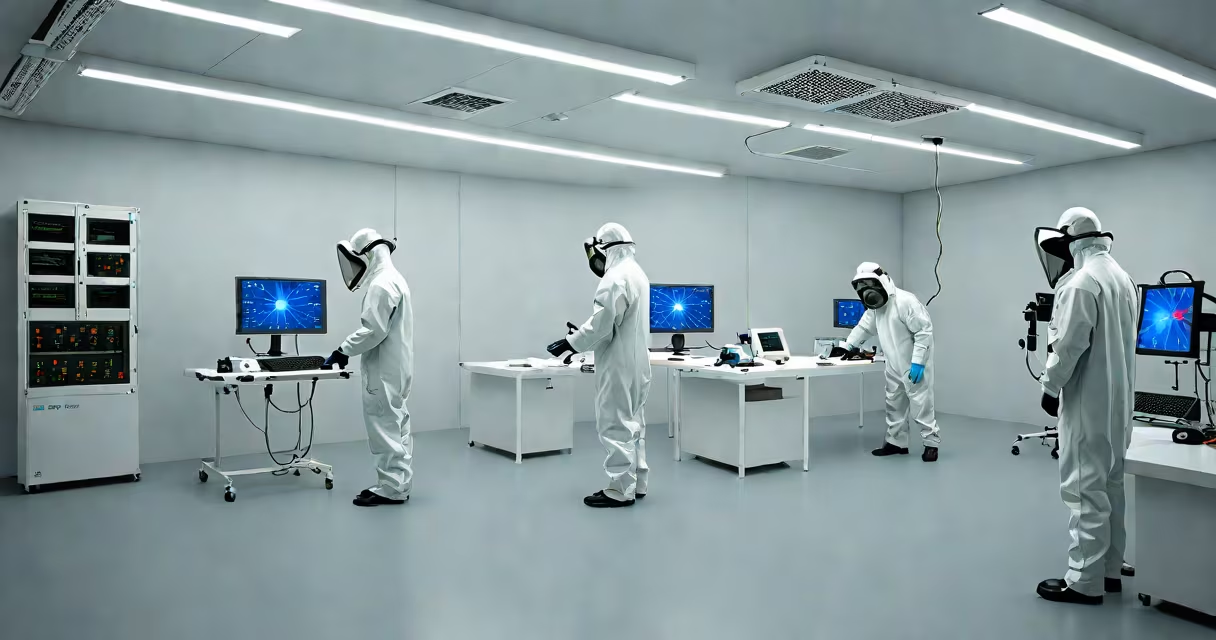
ISO 14644-1:2015 is an international standard that specifies the maximum allowable concentrations of airborne particles in cleanrooms and other controlled environments, classifying them from ISO 1 (most stringent) to ISO 9 (least stringent) based on measured particle counts per cubic meter.
This standard applies to particles with sizes ranging from 0.1 micrometers to 5.0 micrometers. It sets numerical limits for particles larger than specified sizes in each classification level. The standard is used globally in semiconductor manufacturing, pharmaceutical production, biotechnology, and aerospace to ensure environmental control during sensitive processes.
Testing under ISO 14644-1:2015 requires calibrated laser particle counters and standardized sampling procedures. Results are reported as the number of particles per cubic meter of air. A cleanroom must meet the required limits across all particle sizes within a given classification to pass certification.
The standard uses a logarithmic scale to define cleanroom classes. Each class specifies the maximum number of particles allowed per cubic meter for each particle size. For example, ISO Class 5 allows no more than 3,520 particles per cubic meter for particles 0.5 micrometers or larger.
Measurements are taken using single-point or multiple-point sampling methods. Sampling locations must be representative of the entire workspace, avoiding areas near doors, vents, or equipment that may disrupt airflow. Minimum sample volume is 28.3 liters per measurement, and results are averaged across multiple samples.
Environmental conditions such as temperature, humidity, and pressure differential are monitored alongside particle counts. These factors influence particle behavior and deposition rates. A cleanroom must maintain stable conditions during testing to avoid false readings.
ISO 14644-1:2015 defines nine cleanroom classes, from ISO 1 (highest purity) to ISO 9 (equivalent to ordinary indoor air). Each class corresponds to a specific upper limit of airborne particles per cubic meter.
| Class | Particles ≥0.1 μm/m³ | Particles ≥0.5 μm/m³ | Particles ≥5.0 μm/m³ |
|---|---|---|---|
| ISO 1 | 10 | 10 | 0 |
| ISO 2 | 100 | 10 | 0 |
| ISO 3 | 1,000 | 100 | 0 |
| ISO 4 | 10,000 | 1,000 | 0 |
| ISO 5 | 100,000 | 10,000 | 0 |
| ISO 6 | 1,000,000 | 100,000 | 1,000 |
| ISO 7 | 10,000,000 | 1,000,000 | 10,000 |
| ISO 8 | 100,000,000 | 10,000,000 | 100,000 |
| ISO 9 | 1,000,000,000 | 100,000,000 | 1,000,000 |
ISO 14644-1:2015 includes requirements for both static and changing conditions. Static testing occurs with equipment off and minimal personnel activity. Changing testing simulates normal operations with equipment running and people present. Most facilities require changing certification for ongoing compliance.
Particle size thresholds are critical. A room classified as ISO 5 may still exceed limits for 0.1-micrometer particles, which are more relevant in microelectronics. This is why the standard reports limits separately for each size.
ISO 14644-1:2015 does not specify cleanroom design, airflow patterns, or filtration efficiency. Those are covered in ISO 14644-2 and other related documents. Confusing these standards leads to incorrect implementation.
Many assume that HEPA filters alone guarantee ISO classification. That's false. Filter performance must be verified through integrity testing (e.g., DOP or PAO tests), and airflow velocity and uniformity must be validated. A filter can be rated at 99.97% efficiency but still fail if installed incorrectly or if the system lacks proper pressure differentials.
A non-obvious requirement: the standard assumes steady-state conditions. Measurements must be taken after the environment has stabilized for at least 30 minutes following door openings or equipment startup. Failure to wait causes overestimation of particle levels.
In a semiconductor fabrication facility, a cleanroom was designed to operate at ISO 3. During qualification, particle counters recorded 1,200 particles ≥0.1 μm/m³ and 120 particles ≥0.5 μm/m³. According to Table 1 of ISO 14644-1:2015, ISO 3 allows up to 1,000 particles ≥0.1 μm/m³ and 100 particles ≥0.5 μm/m³. The test failed because the 0.5 μm count exceeded the limit.
Root cause analysis revealed a faulty gasket on a laminar flow hood. Replacing the seal reduced particle counts to 850 and 95 respectively-within specification. The facility then passed certification and resumed production.
I observed this failure during a third-party audit. The team had assumed their HEPA filters were sufficient. They overlooked the need for leak testing and proper sealing. This case highlights that compliance requires attention to detail beyond basic filtration.
ISO 14644-1:2015 is part of a series. ISO 14644-2 covers testing and monitoring methods. ISO 14644-3 addresses terminology and concepts. ISO 14644-4 outlines cleanroom design and construction principles.
These documents are published by the International Organization for Standardization (ISO). The full texts are available through national standards bodies like ANSI (USA), BSI (UK), or DIN (Germany). Free excerpts are often accessible via official ISO websites.
For comparison, the U.S. Federal Standard 209E used particle counts per cubic foot and is obsolete. It has been replaced by ISO 14644-1:2015 as the global benchmark. Transitioning from 209E to ISO requires recalibration of expectations-especially for smaller particle sizes.
When implementing ISO 14644-1:2015, organizations must validate their monitoring systems against traceable calibration standards. The National Institute of Standards and Technology (NIST) provides reference materials for particle counter calibration. Using NIST-traceable standards ensures measurement accuracy and regulatory acceptance.
ISO 14644-1:2015 remains the definitive reference for cleanroom air cleanliness. Its precise definitions and measurable criteria enable consistent evaluation across industries worldwide.