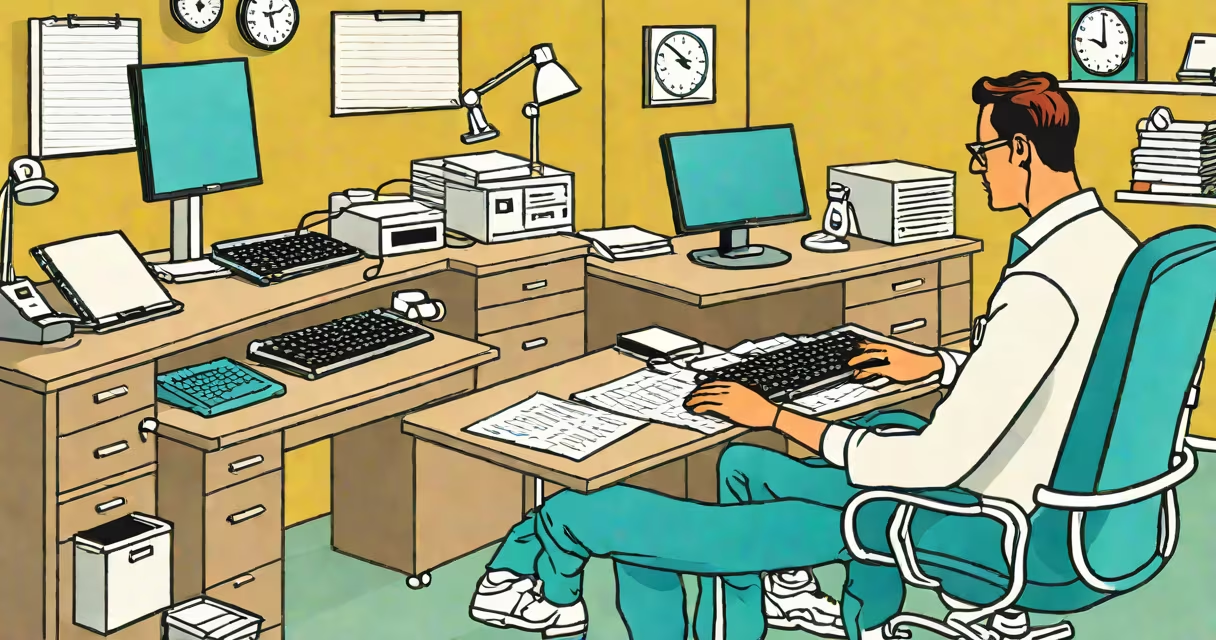
A medical scribe is a trained professional who documents patient encounters in real time within electronic health records (EHRs), supporting clinicians by capturing clinical details during visits. This role reduces administrative workload, improves documentation accuracy, and allows physicians to focus on patient care rather than charting.
Medical scribes work directly alongside clinicians in outpatient clinics, emergency departments, and inpatient settings. They observe patient interactions, enter findings, medications, and procedures into the EHR, and update care plans as the visit progresses. Their presence helps clinical notes reflect the actual encounter without delay, minimizing post-visit documentation errors.
The role emerged in response to rising documentation demands under U.S. healthcare regulations like Meaningful Use and MIPS, which require detailed, structured EHR entries. A 2021 study published in JAMA Internal Medicine found that physician burnout decreased by 36% in practices using scribes, highlighting their impact on workflow sustainability.
During a patient visit, the scribe sits near the provider, observes the interaction, and inputs data into the EHR simultaneously. They record symptoms, important signs, physical exam findings, diagnostic decisions, and treatment plans. The scribe does not make clinical judgments or alter medical decisions-they only document what is said and done.
For example, in a primary care clinic, a patient presents with chest pain. The physician asks about onset, radiation, and associated symptoms. The scribe types: "Patient reports sharp, left-sided chest pain lasting 2 hours, radiates to left arm, associated with diaphoresis. No history of CAD. ECG ordered." This entry appears in real time, eliminating the need for the physician to recall details later.
Scribes follow strict protocols to maintain HIPAA compliance. They do not access patient records outside the current visit unless authorized. All data entered is subject to audit trails and oversight by supervising providers. Scribes are not licensed healthcare professionals and cannot perform clinical tasks such as taking vitals or diagnosing conditions.
There are two main categories: in-person scribes and remote scribes. In-person scribes work on-site at clinics or hospitals, often in the same room as the provider. Remote scribes operate from centralized locations, viewing live video feeds of patient encounters via secure platforms.
| Type | Work Location | Response Time | Best For |
|---|---|---|---|
| In-person | On-site | Immediate | High-complexity visits, emergency rooms |
| Remote | Off-site, centralized | 1-2 seconds delay | Primary care, routine follow-ups |
Training programs for medical scribes typically last 4-8 weeks and cover medical terminology, anatomy, EHR navigation, and privacy laws. The American Medical Association (AMA) recognizes scribe training as part of a growing workforce pipeline for healthcare support roles. Certification is available through organizations like the National Association of Medical Scribes (NAMS).
One non-obvious distinction: scribes are not medical transcriptionists. Transcriptionists listen to recorded audio and convert it into written notes after the visit. Scribes document in real time, often correcting errors as they occur. This difference reduces turnaround time by up to 90%, according to a 2020 report from the Healthcare Information and Management Systems Society (HIMSS).
Medical scribes are most common in high-volume specialties such as emergency medicine, internal medicine, and urgent care. A 2022 survey by the American College of Emergency Physicians (ACEP) found that 68% of emergency departments using scribes reported faster patient throughput and reduced door-to-doctor times.
For example, at a Level 1 trauma center in Chicago, scribes were introduced in the ED's resuscitation bay. Over six months, average patient stay dropped from 4.7 hours to 3.2 hours. Clinicians reported spending 42% less time on documentation and 28% more time on direct patient care.
Some institutions use scribes to improve billing accuracy. By documenting procedures and diagnoses in real time, scribes reduce the risk of missed charges or coding errors. A 2021 analysis in Health Affairs showed that practices using scribes had a 15% higher rate of correct CPT code assignment compared to those without.
Many assume scribes replace nurses or medical assistants. They do not. Scribes have no patient contact, no physical tasks, and no decision-making authority. Their sole responsibility is documentation. A nurse may assess a wound; a scribe records the assessment if the provider describes it.
Another misconception is that scribes are always college graduates. While many have bachelor's degrees, the median education level among scribes is associate degree or certification. Entry-level positions often require only a high school diploma and completion of a training program.
I once observed a scribe in a rural family practice clinic in Montana. The provider was seeing 30 patients a day. Without the scribe, the doctor spent nearly 30 minutes after each visit updating charts. With the scribe, the doctor walked out of the room with a completed note and moved to the next patient within five minutes. The clinic's patient satisfaction scores rose 22% over the next quarter.
Scribes are not a substitute for EHR optimization. Poorly designed systems still lead to inefficiencies even with scribes. A 2023 study in Annals of Family Medicine found that scribes improved productivity only when paired with streamlined EHR templates and consistent clinical workflows.
Defining medical scribe clarifies a role that enhances clinical efficiency without altering patient care. Scribes are not clinicians, not transcribers, and not replacements for staff. They are real-time documentation partners who allow providers to focus on diagnosis and treatment.
When implemented correctly, medical scribes reduce clinician burnout, improve note quality, and increase patient throughput. Their effectiveness depends on proper training, clear boundaries, and integration into existing workflows-not on technology alone.