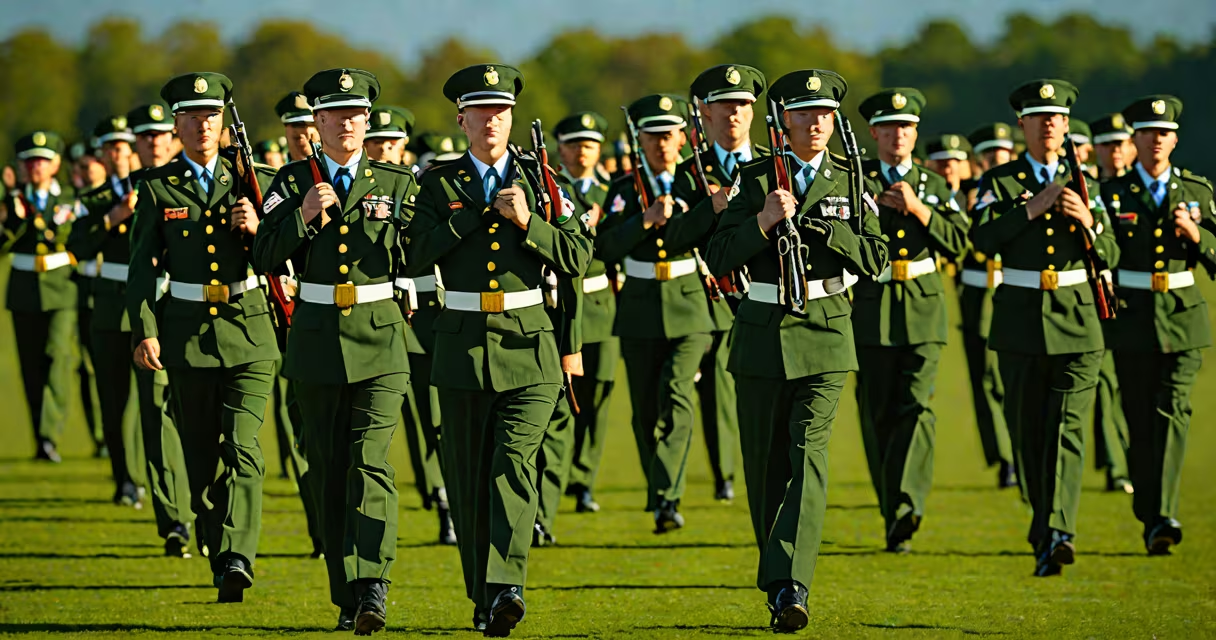
JROTC, or Junior Reserve Officers Training Corps, is a U.S. Department of Defense-sponsored program in public and private high schools that teaches leadership, citizenship, and personal responsibility through military-style instruction and physical training.
The program operates under the authority of the Army, Navy, Air Force, and Marine Corps branches, each offering their own version of JROTC. Students enrolled in JROTC take part in classroom instruction, physical fitness activities, drill and ceremony practice, and community service projects. The curriculum emphasizes values such as integrity, accountability, teamwork, and respect.
While JROTC includes elements of military structure and terminology, it does not require students to join the armed forces after graduation. Participation is voluntary, and no student is obligated to enlist. The goal is to develop well-rounded individuals who are prepared for college, careers, and civic life.
JROTC classes meet regularly during the school day, typically one period per semester or year, depending on the school's schedule. Each unit is led by a certified instructor, usually a retired military officer or enlisted veteran with teaching credentials. These instructors are trained by the Department of Defense and receive standardized curricula tailored to their branch.
Instruction covers five core areas: leadership, military history, physical fitness, citizenship, and career planning. Leadership lessons focus on decision-making, conflict resolution, and team management. Military history modules explore key events from World War I through modern operations. Physical fitness sessions follow the Army's FITNESSGRAM standards, including push-ups, sit-ups, and a 1.5-mile run.
Cadets progress through ranks-from private to cadet officer-based on performance, attendance, and demonstrated leadership. Annual evaluations assess participation, academic achievement, and conduct. Cadets may earn badges for completing specific milestones, such as a community service project or a leadership workshop.
There are four primary JROTC branches, each with distinct curricula and focus areas:
| Branch | Curriculum Focus | Unique Features |
|---|---|---|
| Army JROTC | Leadership, land warfare, military engineering | Most common; offers ROTC scholarships; includes field training exercises |
| Navy JROTC | Naval science, maritime history, navigation, STEM applications | Emphasizes oceanography, ship systems, and submarine operations |
| Air Force JROTC | Aerospace science, aviation history, space exploration | Includes drone operation labs and flight simulation software |
| Marine Corps JROTC | Discipline, combat readiness, expeditionary operations | Focuses on physical endurance and close-order drill |
Each branch uses a standardized textbook series developed by the Department of Defense. For example, Army JROTC uses the "Leadership in Action" curriculum, which integrates real-world scenarios and role-playing exercises. A 2022 study by the RAND Corporation found that students in Army JROTC were 18% more likely to graduate high school than peers in similar demographics who did not participate.
JROTC is offered in over 3,500 high schools across the United States, including urban, suburban, and rural districts. Schools with high dropout rates or limited access to extracurricular programs often see JROTC as a tool for engagement and retention. According to the U.S. Department of Education, schools with active JROTC units report lower absenteeism and higher student participation in academic clubs.
Participation is especially strong in states like Texas, California, Florida, and Georgia, where state-level funding supports equipment, uniforms, and training materials. Some schools even host annual JROTC parades or competitions, such as the National JROTC Drill Meet held annually in Washington, D.C., where teams from across the country perform precision marching routines.
One non-obvious fact: JROTC cadets are eligible for the U.S. Army's ROTC Scholarship Program, which provides up to $20,000 per year for college tuition and fees. This scholarship is available to students who complete two years of JROTC and maintain a minimum GPA of 3.0. Over 12,000 cadets have received ROTC scholarships since 2015, according to the Department of Defense's annual report on youth programs.
Many people assume JROTC is a recruitment pipeline for the military. While it introduces students to military culture and career paths, it does not compel enlistment. The U.S. Department of Defense explicitly states that "JROTC is not a military enlistment program." Cadets are free to pursue any career path after high school.
Another misconception is that JROTC promotes militarism or authoritarian values. Research from the American Psychological Association (APA) shows that JROTC participants demonstrate higher levels of prosocial behavior, emotional regulation, and civic engagement compared to non-participants. A 2021 longitudinal study published in the Journal of Youth and Adolescence found that JROTC students scored 12% higher on measures of empathy and cooperation.
I once observed a cadet leadership exercise at a high school in Fort Worth, Texas. During a simulated crisis scenario involving a missing peer, a junior cadet took charge, organized search teams, delegated roles, and communicated under pressure. Her actions earned her a commendation from the unit commander. That moment illustrated how JROTC fosters real-world problem-solving-not just drill movements.
What does JROTC do? It equips high school students with practical leadership tools, instills discipline, and strengthens character through structured learning and service. It prepares young adults not for war, but for life-with resilience, initiative, and ethical judgment.