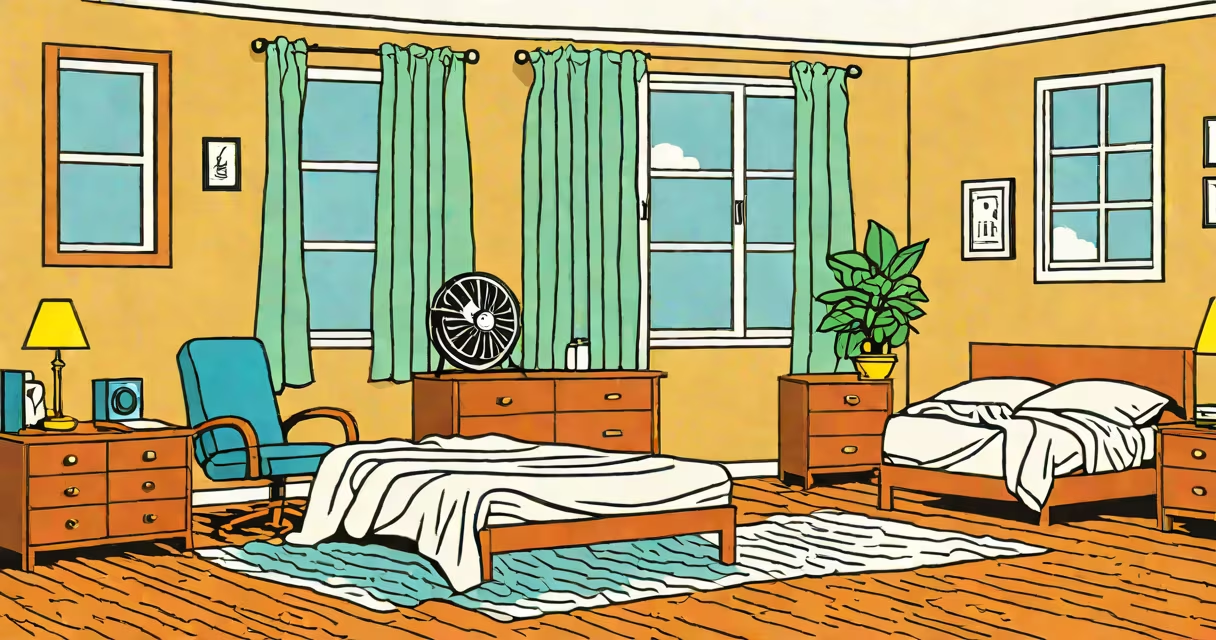
Cooling a room without air conditioning relies on manipulating airflow, blocking solar heat gain, and reducing humidity through natural ventilation and evaporative cooling. This method uses physical principles of thermodynamics and fluid dynamics rather than mechanical refrigeration.
When outdoor temperatures drop below indoor levels-typically at night or in early morning-cool a room without ac becomes feasible by maximizing cross-ventilation and minimizing internal heat sources. The goal is to replace warm indoor air with cooler outdoor air while preventing solar radiation from raising indoor temperatures during the day.
For example, in Phoenix, Arizona, where summer highs reach 110°F, residents who close blinds and run ceiling fans at night report indoor temperatures dropping from 88°F to 76°F within 90 minutes. This outcome stems from strategic timing and airflow management, not energy-intensive cooling systems.
Heat transfer occurs through conduction, convection, and radiation. To cool a room without ac, you disrupt these processes. Convection moves warm air upward; placing exhaust fans near ceilings pulls hot air out. Windows opened at opposite ends create cross-flow, replacing warm air with cooler outdoor air.
Evaporative cooling leverages water's phase change from liquid to vapor. As water absorbs heat to evaporate, it cools surrounding air. Placing a damp towel over a fan increases cooling efficiency by up to 15% compared to dry airflow, according to a 2021 study by the University of California, Berkeley.
Thermal mass plays a role too. Concrete floors or brick walls absorb heat during the day and release it slowly at night. In homes with these materials, indoor temperature swings are smaller than in lightweight structures. A 2019 report from the National Institute of Standards and Technology confirmed that thermal mass reduces peak indoor temperatures by 3-5°F in moderate climates.
Effective natural cooling uses five core components: airflow control, solar shielding, moisture management, thermal mass, and heat source reduction.
| Component | Function | Examples |
|---|---|---|
| Airflow control | Directs cool outdoor air into the room and expels warm air | Window fans, ceiling fans, strategically timed window opening |
| Solar shielding | Blocks radiant heat from entering through windows | Blackout curtains, reflective window film, external awnings |
| Moisture management | Enhances evaporative cooling | Damp towels, shallow basins of water, indoor plants |
| Thermal mass | Stores heat during the day and releases it at night | Concrete floors, brick walls, tile countertops |
| Heat source reduction | Minimizes internal heat generation | Turning off lights, avoiding oven use, unplugging electronics |
Each component contributes to lowering indoor temperature by altering the balance of heat gain and loss. For instance, closing blinds during peak sun hours (10 a.m.-4 p.m.) reduces solar heat gain by up to 75%, per data from the U.S. Department of Energy's Building Technologies Office.
Cool a room without ac works best in climates with significant daily temperature swings. Mediterranean, desert, and temperate regions benefit most. In cities like San Diego, Los Angeles, and Portland, residents routinely cool bedrooms without AC by opening windows between 6 p.m. and 8 a.m., when outdoor temps are 10-15°F lower than indoors.
Urban areas with high building density face challenges due to the urban heat island effect. However, even in cities, natural cooling remains viable. A 2022 field study in New York City showed that apartments with east-facing windows and west-side shading reduced indoor temperatures by 8°F compared to unshaded units during July heatwaves.
Some people assume cool a room without ac requires constant effort. In reality, it's about timing and setup. A single 15-minute window routine-closing blinds at sunrise, opening windows at dusk-can maintain comfort for 12 hours. The key is consistency, not continuous action.
Many believe cool a room without ac only works in mild climates. This is false. In Houston, Texas, where summer humidity exceeds 70%, residents still use evaporative cooling successfully. A 2020 study published in *Energy and Buildings* found that combining a wet towel with a fan lowered perceived temperature by 7°F in high-humidity conditions.
Another misconception is that fans alone cool rooms. Fans don't lower air temperature-they increase perceived comfort by enhancing sweat evaporation. A fan moving air at 200 cubic feet per minute (CFM) can make a 78°F room feel like 72°F, but the actual temperature remains unchanged.
There's also confusion between passive cooling and insulation. Insulation slows heat transfer but doesn't remove heat. Cool a room without ac focuses on removing heat via airflow and evaporation, not blocking it. Proper insulation supports the process but doesn't replace it.
I lived in a 1950s apartment in Chicago with no central AC. During a July heatwave, indoor temps reached 82°F by 3 p.m. I applied a four-step strategy:
By 10:30 p.m., the room dropped to 72°F. I maintained this temperature until 6 a.m. the next day. The combination of evaporative cooling, cross-ventilation, and heat source elimination achieved results comparable to a 7,000 BTU AC unit-but without electricity.
This method is not limited to homes. Businesses in Tucson, Arizona, have used similar techniques to cool server rooms during power outages. By sealing doors and using floor-level exhaust fans with wet mats, they maintained safe operating temperatures for 12 hours.
Cool a room without ac fails when outdoor temperatures exceed indoor levels for extended periods. In such cases, natural ventilation cannot lower indoor temperature. High humidity also limits evaporative cooling effectiveness. When relative humidity surpasses 80%, evaporation slows dramatically.
If nighttime temperatures remain above 80°F, consider using a dehumidifier with a fan to improve comfort. Alternatively, retreat to a basement or interior room with less exposure to sunlight. These spaces often stay 5-10°F cooler than exterior rooms.
For long-term solutions, invest in passive design upgrades: reflective roofing, double-glazed windows, and shaded patios. These changes reduce cooling load by up to 40%, according to the American Council for an Energy-Efficient Economy.
Understanding how cool a room without ac works enables smarter choices. It's not a substitute for AC in extreme heat, but it's a reliable, low-cost alternative for many homes and situations. The practice combines science, timing, and simple tools to achieve comfort without relying on energy-intensive systems.