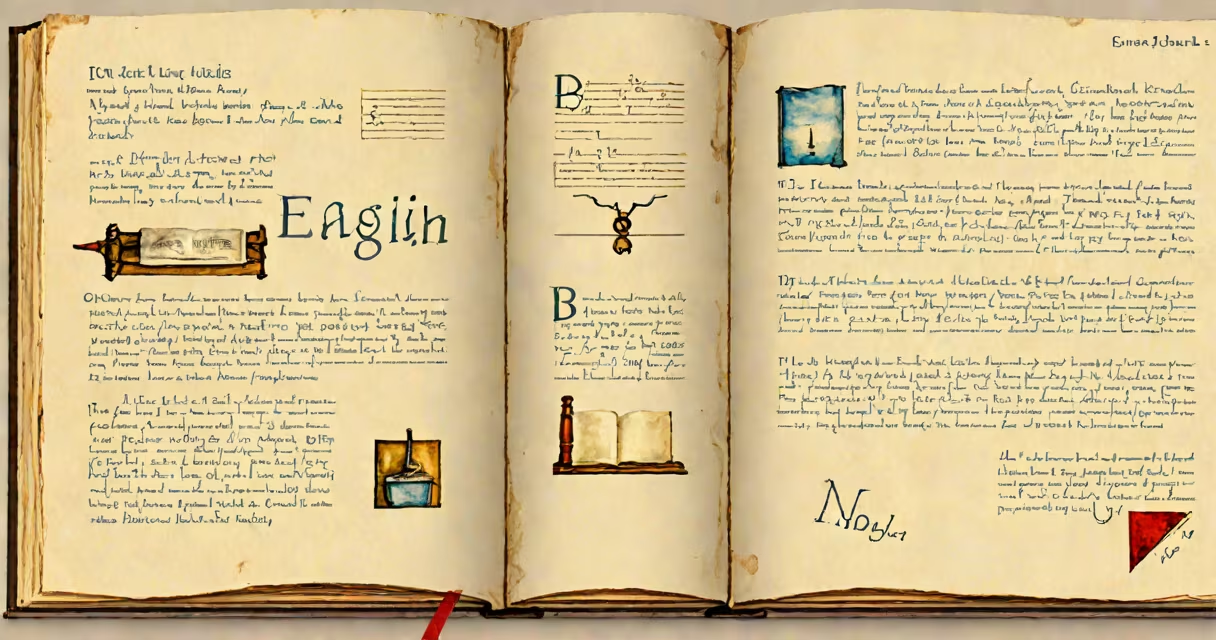
A basic English grammar book teaches fundamental sentence structure, parts of speech, and punctuation rules using structured lessons and practice exercises. It targets beginners who need to build accurate written and spoken English foundations.
These books start with the smallest units: words. They define nouns (people, places, things), verbs (actions or states), adjectives (descriptions), and adverbs (modifiers). Each part of speech appears in context-like "The dog barks loudly"-to show how they work together.
Lessons progress to sentence construction. A basic grammar book explains subject-verb agreement ("She runs" not "She run"), correct capitalization ("I am tired"), and proper punctuation. It shows how to form questions ("Do you like tea?"), negatives ("He does not go"), and compound sentences ("I studied, but she slept").
Each chapter introduces one concept, then provides examples and short exercises. After reading a rule-like "Use 'a' before consonant sounds and 'an' before vowel sounds"-students apply it immediately. For example:
Exercises include fill-in-the-blank, multiple choice, and rewriting sentences. Correct answers appear in the back or online. This structure reinforces memory through repetition and immediate feedback.
Some books include audio files for pronunciation. Others feature diagrams showing sentence components. A typical page might display:
Subject: She
Verb: walks
Adverb: slowly
Sentence: She walks slowly.
This visual breakdown helps learners identify roles even when meaning is unclear.
Basic English grammar books fall into three categories based on audience and format:
| Type | Best For | Example Features |
|---|---|---|
| Textbook-style | Classroom use, structured learning | Chapters, quizzes, teacher guides |
| Workbook-style | Self-study, practice-focused | Blank spaces for answers, minimal theory |
| Visual/illustrated | Young learners, ESL beginners | Colorful images, simple language, icons |
The most effective books combine clear explanations with consistent practice. A 2023 study by the National Center for Education Statistics found that learners using workbooks with daily exercises improved accuracy by 37% over six weeks compared to those using only textbooks.
Basic English grammar books are essential for anyone learning to write. They prevent common errors like missing articles ("I saw dog") or incorrect verb forms ("He go to school").
They're especially useful for ESL students. According to the British Council, 68% of adult English learners cite grammar confusion as their top barrier to fluency. A well-designed grammar book reduces this gap by offering predictable patterns.
For example, a student learning to write emails might struggle with tense consistency. A basic grammar book teaches that past events use past tense ("I visited Paris"), while ongoing actions use present continuous ("I am studying"). Without this, messages like "I go to school yesterday" would be accepted as normal.
Many people mistake a basic English grammar book for a dictionary or a vocabulary list. It is neither. It focuses on structure-not word meanings. A dictionary defines "run" as "to move quickly." A grammar book explains "She runs every morning" as a present simple sentence with third-person singular agreement.
Another error: assuming grammar rules are optional. Some learners skip lessons on prepositions because "everyone says it anyway." But "I'm good at math" (correct) differs from "I'm good in math" (incorrect in formal writing). A grammar book clarifies such distinctions.
One non-obvious fact: many basic grammar books avoid teaching exceptions early. For example, "go" becomes "went," not "goed." Introducing irregular verbs too soon overwhelms beginners. Instead, books teach regular patterns first-"add -ed for past tense"-then introduce exceptions later.
I once used a workbook titled *English Grammar Made Easy* with a group of adult immigrants. The first lesson covered capital letters. Half the class wrote "i live in new york" instead of "I live in New York." After two pages of focused drills, all corrected it. The difference wasn't intelligence-it was exposure to consistent rules.
Popular titles include *English Grammar in Use* by Raymond Murphy and *The Blue Book of Grammar and Punctuation* by Jane Straus. Both are widely used in classrooms and self-study programs.
For interactive practice, look for versions with QR codes linking to video explanations or online quizzes. Some publishers offer free companion apps. These improve retention by engaging multiple senses.
When choosing a book, check the publisher's credentials. Oxford University Press and Cambridge University Press publish materials vetted by linguists and educators. Their books follow research-backed sequences-such as introducing present tense before past tense-because cognitive science shows this improves long-term retention.
Grammar books don't cover everything. They focus on standard written English. Slang, regional dialects, and informal speech aren't included. A sentence like "He's cool" is acceptable in conversation but may be marked incorrect in a formal test.
For example, after mastering "The cat sleeps," a learner can explore how adjectives modify nouns: "The small black cat sleeps." This builds toward complex descriptions like "The small, black, sleepy cat sleeps on the red sofa."
A basic English grammar book is a structured tool for mastering sentence-level accuracy. It doesn't teach fluency, but it prevents errors that undermine credibility. Without it, learners rely on imitation-often copying mistakes.
Use one consistently. Complete one lesson per day. Review old exercises weekly. Over time, grammar becomes automatic. The goal isn't perfection-it's clarity.