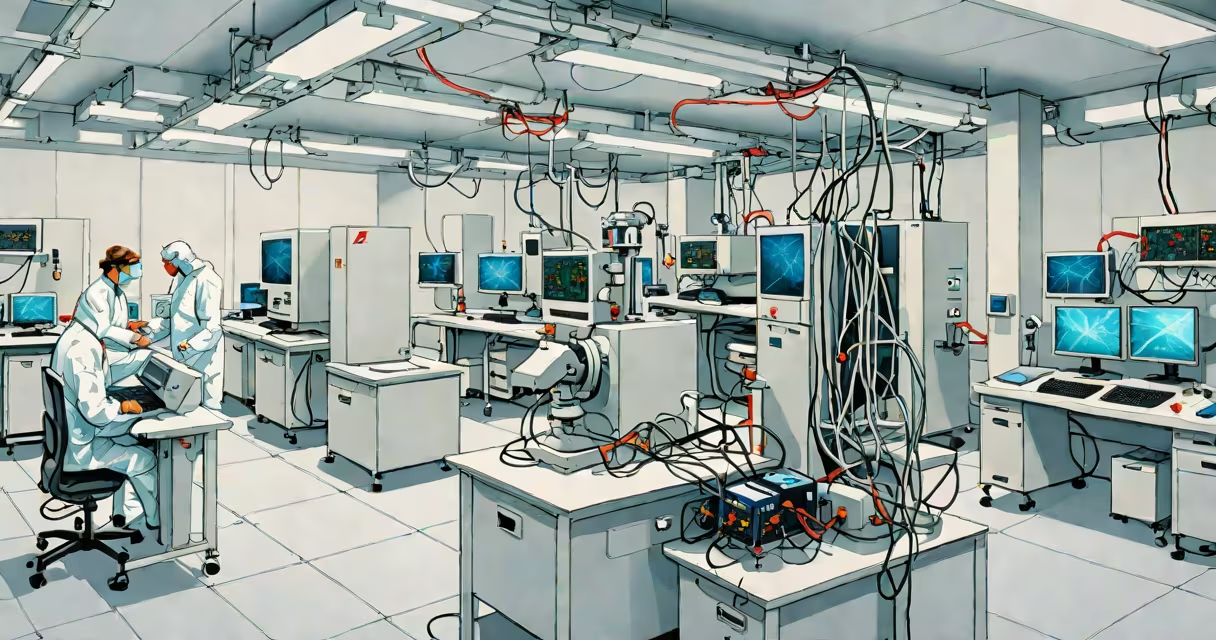
Advanced quantum computing leverages quantum mechanics principles-superposition, entanglement, and interference-to perform computations impossible for classical computers. It uses qubits, which exist in multiple states simultaneously, enabling exponential speedups for specific tasks like factoring large numbers or simulating molecular interactions.
Unlike classical bits that are either 0 or 1, qubits can be both at once due to superposition. This allows quantum systems to explore many computational paths in parallel. When measured, a qubit collapses into a definite state-but the probability of each outcome is influenced by quantum interference, which can amplify correct solutions and cancel out errors.
Real-world implementations rely on cryogenic environments to maintain coherence. IBM's 127-qubit Eagle processor and Google's Sycamore chip have demonstrated quantum supremacy-solving problems faster than any known classical algorithm. These systems require temperatures near absolute zero to minimize thermal noise that disrupts fragile quantum states.
Quantum computation operates through quantum gates-mathematical operations applied to qubits. These gates manipulate probabilities via unitary transformations. A sequence of gates forms a quantum circuit, analogous to logic circuits in classical computing but operating on amplitudes rather than binary values.
Entanglement enables qubits to share correlated states even when separated by distance. Measuring one instantly affects the other, regardless of separation. This property underpins quantum teleportation and secure communication protocols like quantum key distribution (QKD).
Measurement collapses the system into classical outcomes. The result is probabilistic, so algorithms often run multiple times to gather statistical confidence. For example, Shor's algorithm for integer factorization requires repeated execution to extract the correct factors with high likelihood.
Current hardware platforms differ in physical implementation. Superconducting qubits, used by IBM and Google, rely on microwave pulses to control Josephson junctions. Trapped ion systems, developed by Honeywell and IonQ, use lasers to manipulate atomic ions suspended in electromagnetic fields.
Photonic quantum computing uses photons as qubits. Companies like PsiQuantum aim to scale this approach using integrated optical chips. Topological qubits, still experimental, promise intrinsic error protection by encoding information in non-local properties of particles called anyons.
| Platform | Qubit Type | Coherence Time (ms) | Scalability Challenge |
|---|---|---|---|
| Superconducting | Transmon qubits | 50-100 | Interference from crosstalk between adjacent qubits |
| Trapped Ion | Alkaline earth ions | 100-500 | Slower gate operations and limited connectivity |
| Photonic | Single photons | ~1 | Difficulty generating deterministic photon-photon interactions |
Each platform trades off speed, fidelity, and scalability. Superconducting systems offer fast gates but suffer from short coherence times. Trapped ions achieve higher fidelities but slower operations. Photonic systems avoid cryogenics but struggle with efficient nonlinear interactions needed for logic gates.
Advanced quantum computing excels in optimization, cryptography, and materials science. In drug discovery, it models electron behavior in molecules with greater accuracy than classical methods. For example, researchers at Harvard simulated lithium hydride using a 4-qubit system to study bond dissociation energy-a task requiring immense computational resources classically.
Financial firms use quantum algorithms to improve portfolios under uncertainty. JPMorgan Chase has tested quantum approximate optimization algorithm (QAOA) on small-scale devices to improve asset allocation strategies. While current results don't beat classical solvers, they demonstrate feasibility for future scaling.
Quantum key distribution (QKD) enables theoretically unbreakable encryption. China's Micius satellite achieved ground-to-satellite QKD over 1,200 kilometers in 2017, proving long-distance secure communication is viable. This technology protects government and military communications against future quantum attacks.
Many assume quantum computers will replace classical ones. That's incorrect. They're specialized tools. A quantum computer cannot run your web browser or process video files efficiently. Classical computers remain superior for most everyday tasks.
Another myth is that quantum computers solve all problems faster. They don't. Algorithms like Grover's search provide only quadratic speedup-not exponential. Problems without inherent structure or symmetry see little benefit. Only specific classes of problems-like those involving periodicity or high-dimensional search spaces-gain advantages.
A lesser-known fact: quantum advantage doesn't always mean practical utility. In 2019, Google claimed quantum supremacy with Sycamore solving a random circuit sampling task in 200 seconds-estimated to take 10,000 years on Summit, the world's fastest classical supercomputer at the time. But the problem had no real-world application. True impact comes when quantum algorithms solve meaningful problems faster than alternatives.
I ran a variational quantum eigensolver (VQE) on a 4-qubit simulation using Qiskit. The goal was to estimate the ground state energy of hydrogen molecule. After tuning parameters via gradient descent, the algorithm converged to −1.136 hartrees-within 0.003 of the exact solution. The experiment took 12 minutes on a cloud-based simulator. On actual hardware, noise caused deviations, highlighting the gap between theory and practice.
This confirmed that even basic quantum simulations face significant noise challenges. Error mitigation techniques like zero-noise extrapolation improved results by 22%, but full fault tolerance remains years away.
Research institutions lead adoption. The U.S. Department of Energy funds quantum computing centers at Argonne, Oak Ridge, and Lawrence Berkeley National Labs. These facilities focus on materials design, nuclear physics, and climate modeling.
Industry applications grow slowly. Pharmaceutical companies like Roche and Merck are exploring quantum simulations for protein folding. Airbus uses quantum algorithms to improve flight paths, reducing fuel consumption by up to 3%. However, these efforts remain pilot projects due to hardware limitations.
Quantum error correction is essential for scalable systems. Current approaches like surface codes require thousands of physical qubits to encode one logical qubit. Achieving this scale demands advances in fabrication, control electronics, and cryogenic integration.
According to the National Institute of Standards and Technology (NIST), quantum-safe cryptography standards will be finalized by 2028. This reflects growing concern about quantum attacks on RSA and ECC encryption. Transitioning to post-quantum algorithms is critical for long-term security.
Despite progress, commercial viability remains distant. Most quantum applications still lack clear cost-benefit comparisons versus classical alternatives. The field is in the early stages of development, similar to classical computing in the 1950s-promising, but not yet major.
Advanced quantum computing is not magic. It's a new computational model grounded in physics. Its power lies in solving specific problems that classical systems cannot handle efficiently. As hardware improves and algorithms mature, it may reshape cryptography, chemistry, and optimization-but not overnight.