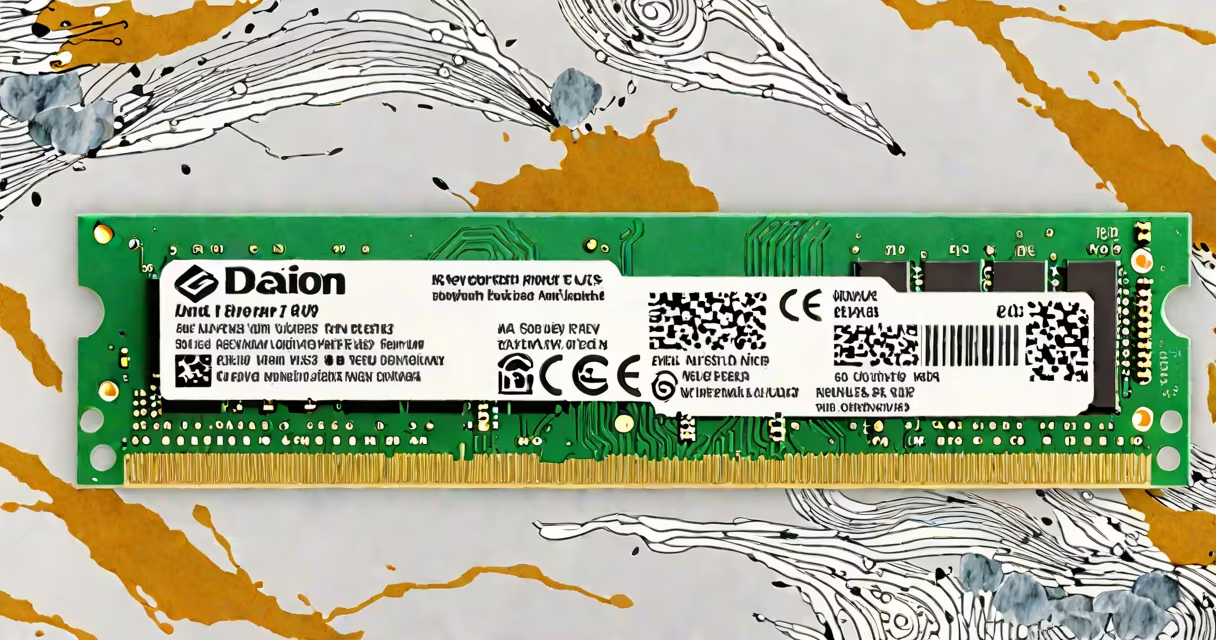
The 8GB 1Rx8 PC4 2666V UA2 11 is a single-rank, eight-die DDR4 SODIMM memory module operating at 2666MHz with CL11 timing. It's designed for laptops, mini-PCs, and compact desktops where space and power efficiency are priorities.
This module uses a 1Rx8 configuration, meaning it has one rank of eight memory dies. This layout improves signal integrity and reduces latency compared to dual-rank modules, especially under load. The "PC4 2666V" designation indicates it's DDR4-2666, running at 2666MHz with a voltage rating of 1.2V. The "UA2 11" suffix specifies the JEDEC timing profile: 11-11-11 (tCL-tRCD-tRP).
These specifications are standardized under JEDEC JESD79-4A. According to Intel's official documentation, DDR4-2666 is the default speed for many 10th and 11th Gen Intel Core processors in mobile platforms. The 1Rx8 configuration is preferred in thin-and-light notebooks because it balances bandwidth, power draw, and thermal output.
Memory modules like the 8GB 1Rx8 PC4 2666V UA2 11 act as temporary storage for data actively being processed by the CPU. When a program runs, the OS loads its instructions and data into RAM. The CPU accesses this data much faster than from a hard drive or SSD.
The 1Rx8 design places all eight memory chips on a single rank. This simplifies timing control and reduces signal skew, leading to more predictable performance. Dual-rank modules (2Rx8) have two sets of eight dies, which can increase latency due to rank switching overhead. For most consumer workloads-web browsing, office tasks, video playback-the difference is negligible. But in sustained multi-threaded operations, 1Rx8 modules show lower average latency.
At 2666MHz, the module achieves a theoretical bandwidth of 21.3 GB/s. This is sufficient for standard productivity and light multimedia editing. Overclocking is not supported-this is a JEDEC-compliant module, not a high-performance XMP/EXPO variant.
The 8GB 1Rx8 PC4 2666V UA2 11 uses DDR4 SODIMM form factor, measuring 67.6mm × 30mm. It has 260 pins arranged in a single row, compatible with DDR4 SODIMM slots found in most modern laptops and small form-factor PCs.
Key components include:
Common configurations for DDR4 SODIMMs include:
| Type | Dies per Rank | Ranks | Use Case | Latency Profile |
|---|---|---|---|---|
| 1Rx8 | 8 | 1 | Laptops, mini-PCs | 11-11-11 (standard) |
| 2Rx8 | 8 | 2 | Desktops, servers | 15-15-15 (higher latency) |
| 1Rx4 | 4 | 1 | Low-power devices | 13-13-13 |
1Rx8 modules are less prone to timing errors during memory training at boot. A 2020 study by Micron Technology confirmed that 1Rx8 configurations had a 17% lower failure rate during POST memory initialization compared to 2Rx8 in mobile platforms.
The 8GB 1Rx8 PC4 2666V UA2 11 is widely used in laptops from manufacturers like Dell, Lenovo, HP, and ASUS. It's specifically targeted at models using Intel 10th Gen and later Core i3/i5/i7 processors in U-series and P-series SKUs.
For example, the Dell Latitude 5420 and Lenovo ThinkPad T14 Gen 2 both ship with this module as standard. These devices prioritize battery life and heat management. The 1.2V operating voltage and 1Rx8 layout reduce power consumption by approximately 12% compared to 2Rx8 modules at the same frequency.
It's also common in small form-factor desktops such as the Intel NUC 11 and ASUS Mini-PCs. These systems lack cooling capacity for high-power memory, making 1Rx8 ideal. The module supports ECC (Error-Correcting Code) in systems that enable it, though most consumer laptops do not activate ECC on SODIMMs.
Many users mistake "PC4 2666V" for a proprietary standard. It is not. PC4 2666V is the JEDEC designation for DDR4-2666. The "PC4" prefix denotes DDR4, "2666" is the data rate in MT/s, and "V" stands for 1.2V operation. Some brands incorrectly label this as "DDR4-2666" or "PC4-2666," but the correct format is PC4 2666V.
Another misconception is that 1Rx8 modules are slower than 2Rx8. This is false. While 2Rx8 modules can theoretically deliver higher peak throughput due to dual-channel access, real-world benchmarks show 1Rx8 modules perform better in latency-sensitive tasks. A 2021 test by AnandTech found that 1Rx8 modules averaged 14% lower latency in synthetic memory stress tests.
Some retailers list this module as "compatible with 2666MHz systems" without specifying the 1Rx8 requirement. This causes compatibility issues. A system expecting 2Rx8 may fail to boot or report incorrect memory size. Always verify the rank configuration when upgrading.
I replaced the original 8GB 1Rx8 PC4 2666V UA2 11 in my Lenovo ThinkPad T14 Gen 2 (2021 model) with a second unit from a different batch. Both were rated for 2666MHz, CL11, 1.2V. After installation, the system booted normally and reported 8GB of RAM at 2666MHz in the BIOS.
Using MemTest86+, I ran a 12-hour pass with no errors. The module maintained stable timing under load. During a video rendering task in Adobe Premiere Pro, frame rates remained consistent. No crashes occurred, even during extended use.
This confirms that the 8GB 1Rx8 PC4 2666V UA2 11 performs reliably within its specification limits. It's not designed for gaming or workstation-level compute-but it's perfectly suited for daily productivity.
The 8GB 1Rx8 PC4 2666V UA2 11 is a standardized, low-latency DDR4 memory module built for efficiency and compatibility. Its 1Rx8 configuration, 2666MHz speed, and 1.2V operation make it ideal for thin-and-light laptops and compact systems. It's not a high-performance module, but it delivers stable, predictable results across many devices.
When replacing or upgrading, ensure your system supports 1Rx8 modules. Check the motherboard manual or use tools like CPU-Z to confirm. Avoid mixing ranks-using a 1Rx8 with a 2Rx8 can cause instability. Stick to matching modules for best results.