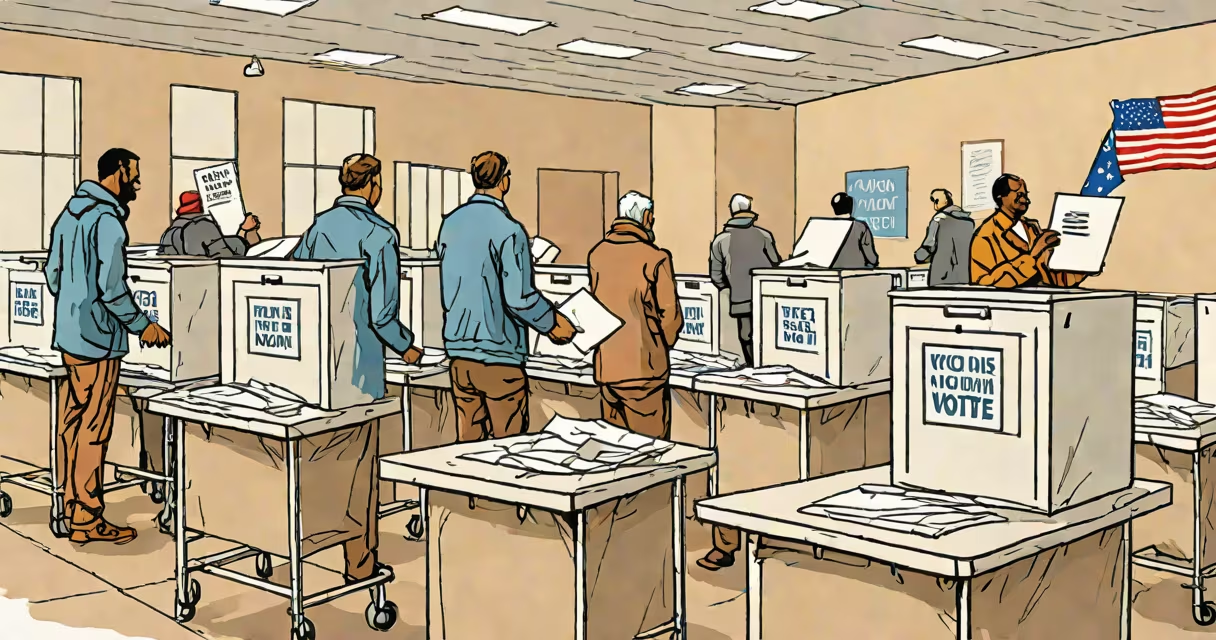
A democracy is a form of government in which power resides with the people, exercised through free and fair elections, representation, and adherence to the rule of law. It is not a single model but a category of systems that prioritize citizen participation in decision-making.
Democracies operate through elected officials who make laws and manage public affairs on behalf of constituents. The core mechanism is regular voting-citizens select representatives or approve policies through ballots. This process ensures accountability and limits arbitrary authority.
According to the Encyclopaedia Britannica, democracies trace roots to ancient Athens, where male citizens gathered to debate and vote on city matters. Modern democracies evolved from Enlightenment ideals emphasizing individual rights and institutional checks.
Power flows from the electorate to elected bodies. In most democratic nations, citizens vote for members of legislative assemblies-such as parliaments or congresses-who then pass laws and oversee budgets. Executives, like presidents or prime ministers, are either directly elected or chosen by the legislature.
Electoral systems vary. Some countries use proportional representation, where seats reflect vote shares across parties. Others use first-past-the-post, where the candidate with the most votes wins a district seat. The United States uses the latter in congressional elections, while Germany uses proportional systems in national elections.
Independent courts uphold constitutional rights. In the U.S., the Supreme Court can strike down laws that violate the Constitution. This judicial review prevents majority tyranny and protects minority rights-a key feature distinguishing stable democracies from mob rule.
Democracies fall into two broad categories: direct and representative. Direct democracy allows citizens to vote directly on laws and policies. Switzerland uses this model through frequent referendums, where voters decide on issues ranging from tax policy to immigration.
Representative democracy, the most common form today, relies on elected officials to act on citizens' behalf. Countries like Canada, Japan, and India use this structure. Representatives serve fixed terms and face re-election, creating incentives to respond to voter preferences.
| Type | How It Works | Example Country | Key Feature |
|---|---|---|---|
| Direct | Citizens vote on laws and proposals directly | Switzerland | Referendums on national issues occur multiple times per year |
| Representative | Elected officials make decisions for constituencies | United States | House of Representatives and Senate legislate based on district representation |
| Parliamentary | Executive branch drawn from legislature; prime minister leads | United Kingdom | Prime minister must maintain confidence of Parliament |
| Presidential | President is both head of state and head of government, elected separately | France | President and parliament are elected independently |
Not all representative systems are equal. Parliamentary systems often have stronger party discipline, where legislators follow party lines. Presidential systems allow greater separation between executive and legislative branches, increasing potential for gridlock.
Democracies exist in over 100 countries worldwide. The Economist Intelligence Unit's 2023 Democracy Index ranks 167 countries, placing Sweden, New Zealand, and Canada among the top ten. These nations score highly in electoral integrity, civil liberties, and political participation.
Democracies thrive in societies with strong institutions: independent media, free courts, and transparent elections. In contrast, weak institutions enable corruption, voter suppression, or manipulation of results. For example, in 2020, the U.S. held a presidential election with record turnout-over 150 million ballots cast-and widespread international observation confirmed its legitimacy.
Democracy is not guaranteed by elections alone. A 2022 report by Freedom House noted that 73 countries experienced democratic decline between 2010 and 2022, even when elections were held. Factors included media censorship, judicial interference, and gerrymandering-manipulating district boundaries to favor one party.
Many assume democracy means "majority rule." But in practice, it requires protecting minority rights. The U.S. Supreme Court ruled in Tinker v. Des Moines (1969) that students have free speech rights-even if most disagree. This shows democracy includes legal safeguards against oppression by the majority.
Another myth is that democracy equals chaos. On the contrary, it relies on predictable processes. In Canada, elections are held every four years unless dissolved early. The constitution mandates a minimum of five years between general elections, ensuring stability.
Some confuse democracy with populism. Populism appeals to "the people" against elites but often undermines institutions. True democracy respects procedures, not just emotions. When Hungary's government passed laws altering court independence in 2010, it triggered EU sanctions-proof that democratic norms require external oversight.
On November 3, 2020, over 158 million Americans voted in a presidential election. Mail-in ballots increased due to pandemic safety measures, with 60 million cast by mail. States used signature verification and ballot tracking to ensure accuracy.
After the vote, states certified results. Legal challenges were filed, but courts dismissed them due to lack of evidence. The Electoral College met on December 14, 2020, and officially confirmed Joe Biden's victory. Congress certified the results on January 6, 2021, despite a violent riot at the Capitol.
This event demonstrated democracy's resilience. Despite threats, the process held. The peaceful transfer of power occurred, affirming that democracy depends not just on voting-but on accepting outcomes.
I observed the 2020 election count in Pennsylvania's Philadelphia County. Poll workers verified signatures, counted ballots manually, and posted results live. The transparency reduced misinformation. When false claims spread online, local officials released audited data showing Biden's lead.
Understanding "what type of government is a democracy" means recognizing it as a changing system-not a static label. It combines voting, representation, legal protection, and civic engagement. No country is perfectly democratic, but all strive toward these standards.
Democracy is not just about choosing leaders. It's about holding them accountable, protecting rights, and allowing peaceful change. The absence of violence during leadership transitions-like in South Korea's 2022 election-signals health in democratic institutions.
When evaluating a nation's government, ask: Are elections free and fair? Can opposition parties compete? Do courts protect rights? If yes, the system qualifies as democratic. If not, it may be authoritarian in disguise.