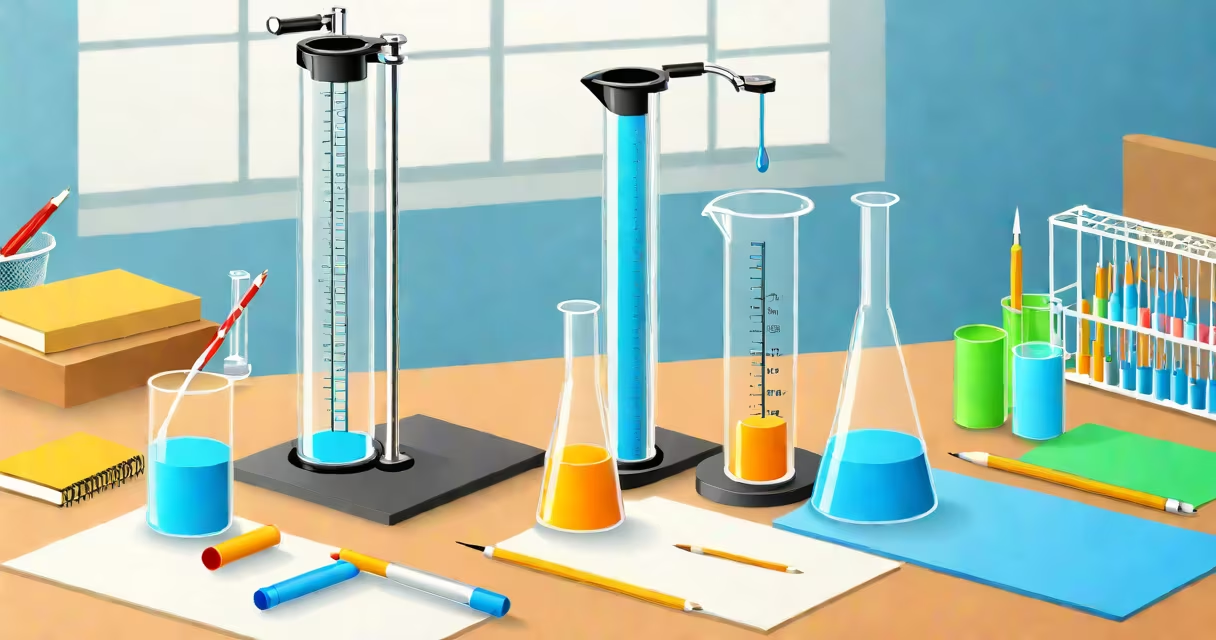
The most common tool used to measure volume is a graduated cylinder. It's a cylindrical container marked with calibrated lines to show precise liquid volume in milliliters (mL). Graduated cylinders come in sizes from 10 mL to 1000 mL and are designed for accuracy in laboratory settings.
Volume measures the amount of space a substance occupies. For liquids, this is typically measured in milliliters or liters. The standard unit in science is the liter, but most lab work uses milliliters due to smaller quantities. A graduated cylinder allows users to read the meniscus-the curved surface of the liquid-to determine volume with ±1% accuracy, depending on size and calibration.
For example, a 100 mL graduated cylinder has markings every 1 mL. When filling it with water, the bottom of the meniscus aligns with the 50 mL mark. This reading is accurate to within ±0.5 mL under proper technique. The meniscus forms due to adhesive forces between the liquid and glass, so eyes must be level with the mark to avoid parallax error.
While the graduated cylinder is the go-to instrument for most lab volume measurements, other tools serve specific purposes based on required precision and sample type.
| Tool | Precision | Best For | Typical Use Case |
|---|---|---|---|
| Graduated cylinder | ±1% | Liquids, moderate precision | Measuring 50 mL of ethanol in a chemistry experiment |
| Pipette | ±0.5% | Small volumes, high accuracy | Transferring 1.0 mL of a DNA solution |
| Buret | ±0.05% | Titrations, variable dispensing | Adding titrant drop-by-drop during acid-base neutralization |
| Beaker | ±10% | Approximate volume, mixing | Preparing a large batch of buffer solution |
Each tool serves a distinct role. Beakers are often used for mixing and rough estimates, while burets are essential in titrations where small changes in volume affect results. Pipettes, especially micropipettes, deliver exact amounts of liquid-critical in biological assays where even a 0.1 mL difference can alter outcomes.
A key distinction many overlook: graduated cylinders measure volume directly, while tools like beakers or flasks rely on estimation. A 500 mL beaker may have markings every 50 mL, making it impossible to accurately read 125 mL. In contrast, a 500 mL graduated cylinder has lines every 10 mL, enabling readings to the nearest 5 mL with confidence.
Measuring volume begins with selecting the correct tool. Choose a graduated cylinder slightly larger than the expected volume. Using a 10 mL cylinder to measure 9 mL of solution is better than using a 1000 mL cylinder, which has wider spacing between marks and higher error potential.
Place the cylinder on a flat surface. Pour liquid slowly until the meniscus reaches the desired mark. Read the volume at eye level-looking straight across the bottom of the curve. If you look from above, the reading appears higher; from below, lower. This is known as parallax error and can introduce up to 2% error in measurement.
For irregular solids, volume is measured indirectly using water displacement. Submerge the object in a graduated cylinder partially filled with water. The rise in water level equals the object's volume. For example, dropping a metal cube into 50 mL of water raises the level to 65 mL. The cube's volume is 15 mL (65 - 50).
I once used this method in a high school physics lab to find the density of a rubber stopper. After measuring its mass on a balance, I submerged it in a 250 mL graduated cylinder containing 100 mL of water. The water rose to 118 mL. The volume was 18 mL. Dividing mass (36 g) by volume (18 mL) gave a density of 2.0 g/mL-consistent with rubber's known range.
Many assume all containers with lines can measure volume precisely. That's false. A beaker labeled "100 mL" doesn't mean it holds exactly 100 mL. Its markings are approximate. The same applies to measuring cups used in kitchens-they're calibrated for cooking, not scientific accuracy.
Another mistake is assuming the cylinder's total capacity determines its accuracy. A 1000 mL cylinder has less precise markings than a 100 mL one. The smallest division on a 1000 mL cylinder is usually 10 mL, so you can only estimate to ±5 mL. A 100 mL cylinder may have 1 mL divisions, allowing readings to ±0.5 mL.
Some think volume measurement is only about liquids. Solids, gases, and even powders require volume tracking. Gases are measured using gas syringes or volumetric flasks in closed systems. Powders are often measured by volume in medicine (e.g., 5 mL of cough syrup), though mass is preferred in research.
For transferring small, precise amounts, a pipette is superior. A 10 mL serological pipette with a bulb can deliver 1.00 mL with ±0.02 mL tolerance. This precision is important in microbiology when preparing bacterial cultures or diluting antibiotics.
Volumetric flasks are used when preparing solutions of exact concentration. They have a single calibration mark. Fill to the mark at eye level, then mix. A 1 L volumetric flask ensures exactly 1.000 L of solution, critical for molarity calculations.
For large-scale industrial use, flow meters measure liquid volume in real time. These devices track the volume of oil through pipelines or water in treatment plants. They use ultrasonic waves or turbine rotation to calculate flow rate over time.
Understanding the right tool prevents errors. In one study published by the National Institute of Standards and Technology (NIST), improper selection of volume-measuring tools led to 14% of experimental failures in university labs. The most common issue was using beakers instead of graduated cylinders for quantitative steps.
Always match the tool to the task. Use a graduated cylinder for routine liquid measurement. Use a pipette for small, accurate transfers. Use a volumetric flask for standardized solutions. And never assume a container's label means accuracy-it's about context and calibration.