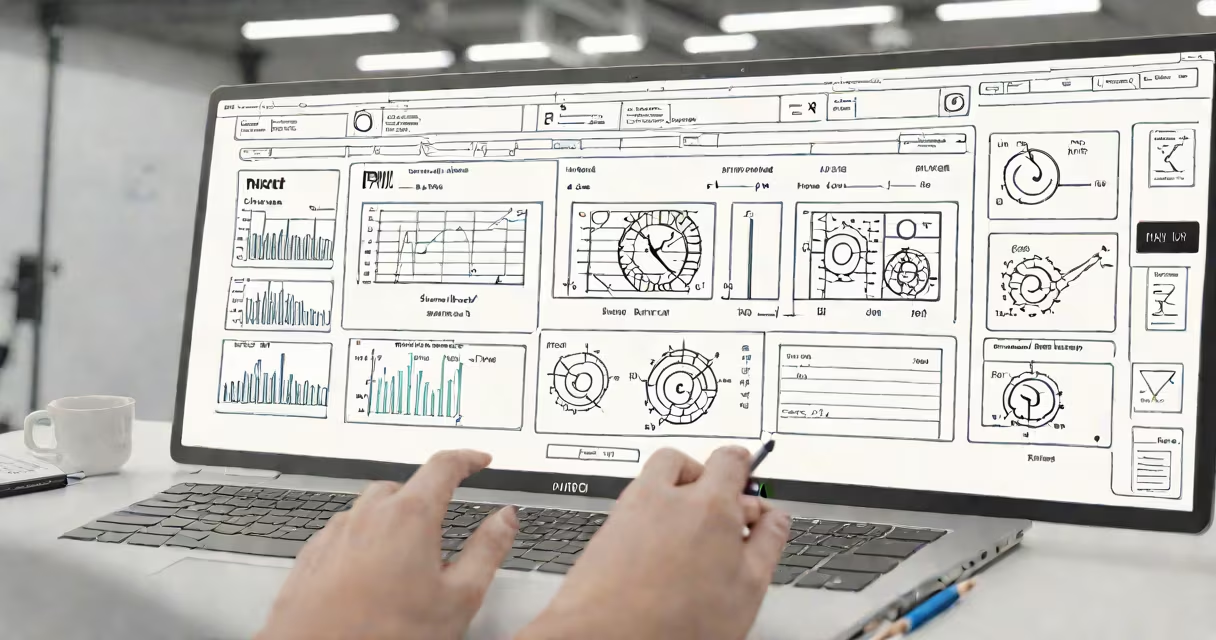
Manufacturing PMI is a real-time performance tracking system that collects, analyzes, and displays key operational data from the shop floor to measure productivity, quality, and equipment effectiveness. It integrates with systems like MES in manufacturing to deliver actionable insights on the production line.
At its core, manufacturing PMI measures how efficiently a factory runs by monitoring output against targets. It uses standardized KPIs such as Equipment Effectiveness (OEE), cycle time, yield rate, and downtime frequency. These metrics are updated continuously, often every minute, allowing supervisors to respond quickly to deviations.
Unlike static reports generated daily or weekly, PMI delivers live visibility into production status. For example, if a CNC machine slows down due to tool wear, PMI flags the drop in cycle time within seconds, triggering alerts before scrap rates rise. This enables immediate corrective action.
PMI operates through a network of sensors, PLCs (Programmable Logic Controllers), and software tools installed on production equipment. Data flows from machines into a central database via industrial protocols like OPC-UA or Modbus. The system then processes this raw input into meaningful performance indicators.
A typical setup includes a real-time dashboard visible on factory monitors or mobile devices. Operators see current output, planned vs. actual production, and machine health scores. When a line falls below target performance, the system highlights the issue with color codes-green for on track, yellow for warning, red for failure.
For instance, a car parts manufacturer using PMI detected a 12% drop in OEE on Line 3 during a night shift. Investigation revealed a misaligned conveyor belt causing part jams. Corrective maintenance was scheduled within 15 minutes of the alert, preventing 37 defective units and saving $2,100 in rework costs.
PMI systems vary based on scale and integration level. They fall into three primary categories: basic, integrated, and advanced.
| Type | Scope | Data Sources | Use Case Example |
|---|---|---|---|
| Basic | Single machine or cell | Sensors, manual entry | Tracking output from a single injection molding press |
| Integrated | Multiple lines, shared data | PLCs, MES in manufacturing, ERP | Monitoring all assembly stations in a plant using unified dashboards |
| Advanced | Enterprise-wide, predictive | IoT devices, AI models, historical databases | Forecasting machine failures using past vibration and temperature data |
Basic PMI systems rely on minimal automation. A worker logs shift output manually and compares it to a daily goal. Integrated systems connect to an MES in manufacturing, syncing work orders, material usage, and labor hours. Advanced systems go further-they apply machine learning to detect patterns that humans miss, such as subtle shifts in spindle vibration indicating early bearing wear.
One key difference is timing. Basic PMI may update hourly; advanced PMI updates every 30 seconds and includes predictive alerts. According to a 2022 study by the Association for Manufacturing Excellence (AME), manufacturers using integrated PMI systems reduced unplanned downtime by 29% compared to those relying on manual reporting.
Manufacturing PMI is often confused with general business intelligence (BI) tools or ERP reports. But PMI focuses specifically on real-time shop floor execution-not financials, inventory levels, or long-term planning.
Another misconception is that PMI replaces human oversight. It doesn't. Instead, it enhances decision-making speed. For example, a supervisor reviewing a PMI dashboard sees that Line 4's yield dropped from 96% to 88% in 20 minutes. Without PMI, this would take hours to notice. With it, the team investigates tool calibration and finds a worn die-corrected before 140 parts were scrapped.
PMI is also not the same as a standard OEE calculation. While OEE is a component of PMI, PMI encompasses multiple metrics and real-time visualization. A standalone OEE report shows historical performance; PMI shows current status and triggers actions.
I once observed a small electronics assembler using a basic PMI setup with Excel sheets and clipboard entries. Output fluctuated wildly. After switching to a cloud-based PMI platform connected to their MES in manufacturing, they cut scrap rates by 34% in six weeks. The difference wasn't technology-it was visibility. They saw problems as they happened, not after the shift ended.
Factories using PMI achieve higher throughput, lower defect rates, and faster response times. The U.S. Department of Commerce's National Institute of Standards and Technology (NIST) identifies PMI as a foundational element of Smart Manufacturing, citing its role in enabling adaptive control and continuous improvement.
One documented case involved a beverage bottling plant that implemented PMI across five filling lines. Over 12 months, they reduced energy consumption per unit by 18% and increased on-time delivery from 82% to 97%. The system identified underutilized compressors and optimized start-up sequences based on real-time demand.
PMI also supports compliance. In regulated industries like pharmaceuticals, PMI provides auditable records of batch performance, machine settings, and operator actions. This ensures adherence to FDA 21 CFR Part 11 requirements for electronic records.
When properly implemented, manufacturing PMI transforms raw production data into strategic insight. It turns reactive troubleshooting into proactive optimization. The system doesn't just show what happened-it predicts what will happen next.
Understanding what is manufacturing PMI means recognizing it as a changing feedback loop between machines, people, and decisions. It's not a report. It's a living system that keeps production moving efficiently, safely, and predictably.