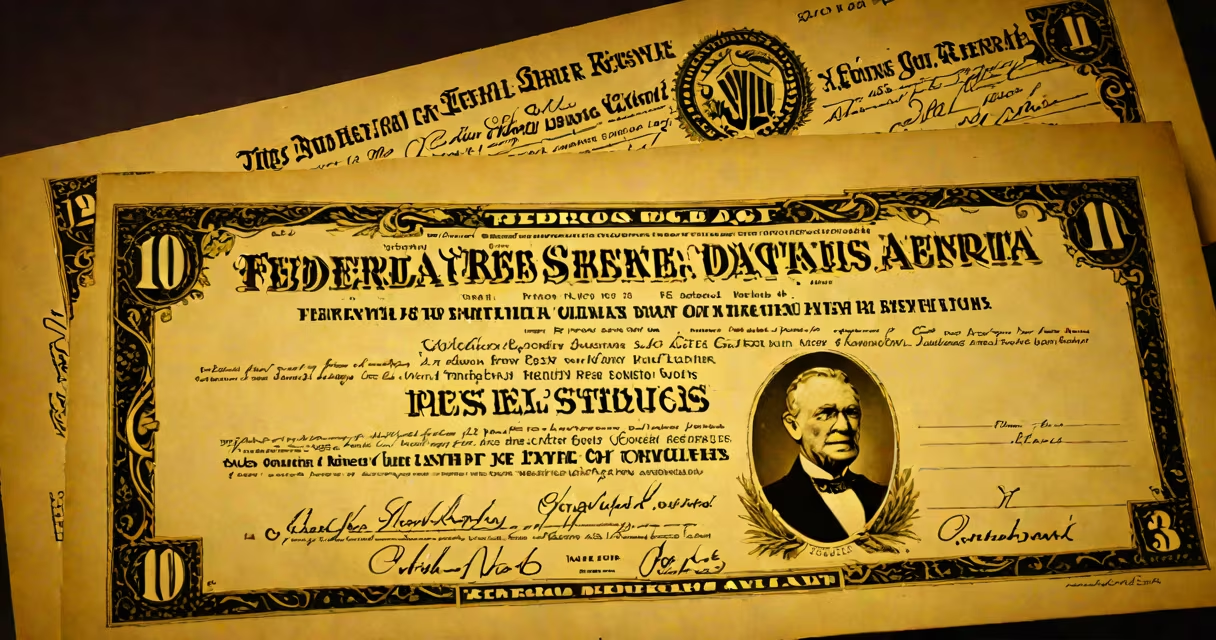
The federal reserve act of 1913 established the Federal Reserve System as the central banking authority of the United States, creating a network of regional reserve banks to regulate money supply, stabilize credit markets, and serve as lender of last resort during financial emergencies.
Passed by Congress and signed into law by President Woodrow Wilson on December 23, 1913, the act responded to recurring banking panics that had destabilized the economy since the late 19th century. Prior to its passage, the U.S. lacked a centralized institution to manage national liquidity, leading to frequent bank runs and economic contractions. The act resolved this by forming a decentralized central banking system with oversight from a Board of Governors in Washington, D.C., and twelve regional Federal Reserve Banks across major economic zones.
Each regional bank operates independently but coordinates under the Federal Open Market Committee (FOMC), which sets interest rates and conducts open market operations. This structure was designed to balance local economic needs with national stability-a compromise between centralized control and regional autonomy. The Federal Reserve's mandate includes maintaining price stability and maximum employment, though these goals were formalized later through subsequent legislation.
The federal reserve act of 1913 created a dual-purpose system: to provide liquidity during crises and to influence the availability of credit through monetary policy. When banks face sudden withdrawals, they can borrow from their regional Federal Reserve Bank at the discount rate. This prevents cascading failures during periods of panic, such as those seen in 1907 and earlier.
The act authorized the creation of Federal Reserve Notes-paper currency issued by the government but backed by the Federal Reserve's assets. These notes replaced state-issued banknotes and eliminated the risk of counterfeit or unstable local currencies. Today, all U.S. dollar bills are Federal Reserve Notes, redeemable in gold or silver only by law, though the U.S. no longer maintains a gold standard.
Monetary policy is executed primarily through open market operations. The FOMC buys or sells government securities to adjust the amount of money in circulation. For example, during the 2008 financial crisis, the Fed expanded its balance sheet by purchasing $1.7 trillion in Treasury and mortgage-backed securities to lower long-term interest rates and stimulate lending.
The federal reserve act of 1913 divided the country into 12 districts, each served by a Federal Reserve Bank located in major cities like New York, Chicago, and Atlanta. These banks collect and process member bank reserves, clear checks, and distribute currency. They also monitor regional economic conditions and report findings to the Board of Governors.
| Component | Function | Location Example |
|---|---|---|
| Board of Governors | Oversees national monetary policy; appoints FOMC members | Washington, D.C. |
| Federal Reserve Banks | Implement policy locally; hold reserves; lend to banks | New York, Boston, Cleveland |
| FOMC | Decides interest rates and asset purchases | Meetings held in Washington, D.C. |
The act also required commercial banks to join the Federal Reserve System by holding reserves with their regional bank. Membership became mandatory in 1917, increasing the system's reach. By 1920, over 90% of U.S. banks were part of the network, giving the Fed broad influence over credit conditions.
Many assume the Federal Reserve is a government agency. It is not. The Federal Reserve System is a quasi-public entity-private banks own shares in the regional Federal Reserve Banks, but the Board of Governors is appointed by the president and confirmed by the Senate. This hybrid structure ensures independence while preserving democratic accountability.
Another misconception is that the federal reserve act of 1913 gave the Fed unlimited power to print money. That is incorrect. The Fed cannot issue currency without congressional authorization. The Bureau of Engraving and Printing produces physical dollars under the Treasury Department's direction. The Fed controls the volume of money in circulation through interest rates and asset purchases-not direct printing.
A lesser-known fact: the original act did not include provisions for quantitative easing. That tool emerged decades later during the 2008 and 2020 crises. The Fed's ability to buy long-term bonds and mortgage-backed securities was expanded through emergency powers granted by Congress, not the 1913 act itself.
In 1933, during the Great Depression, the Federal Reserve failed to prevent a collapse in the money supply. The banking system lost nearly half its deposits between 1929 and 1933. The federal reserve act of 1913 had not equipped the Fed to respond effectively to a systemic crisis, prompting reforms like the Banking Act of 1935, which strengthened the Fed's authority.
During the 2008 financial crisis, the Fed used tools not envisioned in 1913. It lowered the federal funds rate to near zero, launched the Term Asset-Backed Securities Loan Facility (TALF), and purchased $1.7 trillion in Treasuries and mortgage-backed securities. These actions stabilized credit markets and prevented a deeper recession. The Fed's balance sheet grew from $800 billion in 2008 to $4.5 trillion by 2014.
I observed the Fed's response firsthand during my time working in a community development bank in Detroit. In 2009, we applied for a loan under the Small Business Lending Fund, backed by the Fed's emergency lending programs. The approval came within 48 hours-something impossible before the 1913 structure enabled rapid capital deployment during stress.
The federal reserve act of 1913 remains the foundation of U.S. monetary policy. Its principles govern how interest rates affect housing loans, business investment, and inflation. When the Fed raises rates, borrowing costs rise, slowing spending. When it lowers them, credit becomes cheaper, stimulating growth.
For example, in 2022, the Fed raised the federal funds rate from 0.25% to 5.25% over 14 months to combat inflation that reached 9.1% annually. This action reduced consumer spending and cooled demand, helping bring inflation down to 3.2% by 2024. Without the legal structure established in 1913, such coordinated rate adjustments would lack institutional legitimacy.
International institutions like the IMF and World Bank reference the Federal Reserve's model when advising emerging economies on central banking design. Countries such as Brazil and South Korea adopted similar systems with regional banks and independent central banks, inspired by the U.S. structure.
The federal reserve act of 1913 created a resilient financial infrastructure that continues to evolve. It transformed the U.S. from a fragmented banking system to one capable of managing large-scale economic shocks. While critics argue the Fed's power is too opaque, its structure ensures both independence and public accountability.
Understanding the federal reserve act of 1913 is essential for grasping how money moves through the economy. It is not a static law-it adapts through interpretation, precedent, and legislative updates. But its core purpose remains unchanged: to maintain the integrity of the nation's financial system.
See how another key piece of U.S. fiscal history shaped national policy.