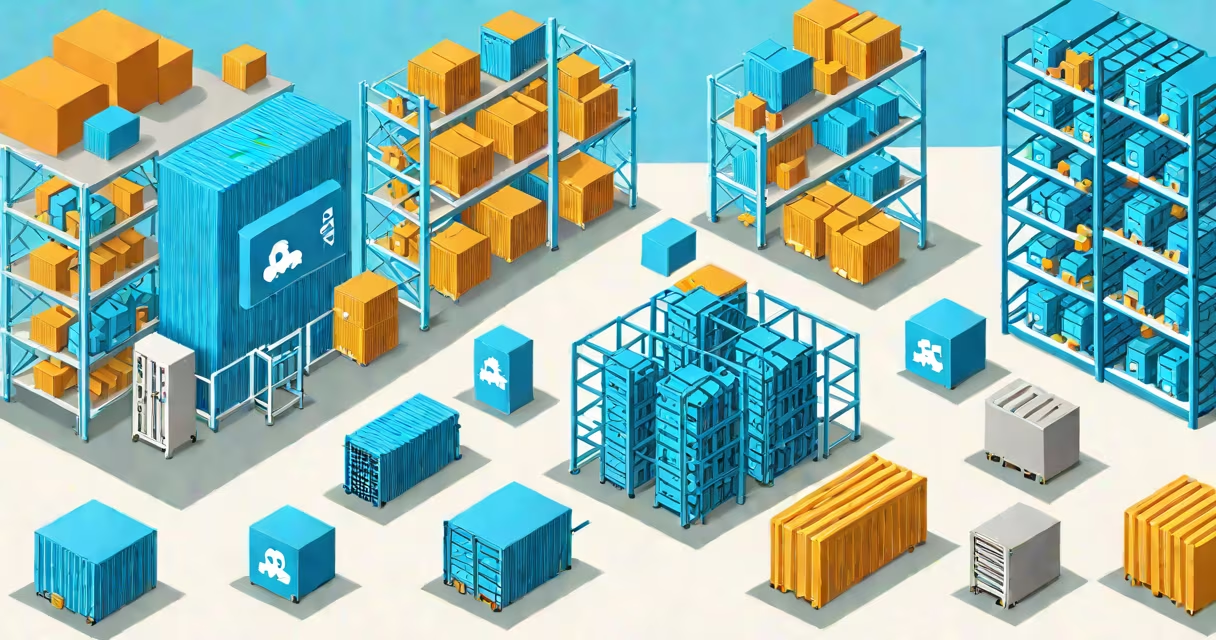
Docker packages applications into lightweight, portable containers; Kubernetes automates the deployment, scaling, and management of those containers across clusters of machines. Together, they form the core of modern cloud-native infrastructure.
Docker is a platform that builds, runs, and shares applications inside isolated environments called containers. A container bundles an app with its dependencies-code, libraries, system tools-so it runs consistently across different systems. When you run docker run nginx, Docker pulls a pre-built image of the Nginx web server and starts it in a sandboxed environment. This eliminates "it works on my machine" issues because the runtime environment is identical everywhere.
Kubernetes, often abbreviated as K8s, is an open-source system for managing containerized workloads. It schedules containers across a group of machines (a cluster), monitors their health, restarts failed ones, balances traffic, and scales resources up or down based on demand. You define your desired state-how many replicas of a service should be running-and Kubernetes ensures the actual state matches it. It's designed for production-grade reliability and automation at scale.
Docker handles the individual unit-the container. Kubernetes manages groups of containers. Think of Docker as the engine of a car and Kubernetes as the navigation and autopilot system. Without Docker, Kubernetes has nothing to manage. Without Kubernetes, Docker becomes hard to scale beyond a few machines.
When you deploy an application using Kubernetes, you write a YAML file describing the container image, resource limits, environment variables, and network policies. Kubernetes then schedules that container onto a node (a physical or virtual machine) in the cluster. If the node fails, Kubernetes reschedules the container elsewhere automatically. It also handles rolling updates, so new versions deploy without downtime.
For example, a company running a video streaming service uses Docker to package the video transcoding service, the user authentication API, and the recommendation engine into separate containers. Kubernetes deploys these across 50 servers in multiple availability zones. When traffic spikes during a live event, Kubernetes automatically spins up more instances of the transcoding service and routes requests efficiently. When traffic drops, it scales down to save costs.
The following table outlines key components of both systems:
| Component | Type | Description |
|---|---|---|
| Docker Engine | Runtime | Runs containers locally on a host machine. |
| Docker Image | Artifact | Immutable template with app code and dependencies. |
| Kubernetes Pod | Orchestrated Unit | Smallest deployable unit; contains one or more containers sharing storage and network. |
| Kubernetes Node | Worker | Physical or virtual machine running container workloads. |
| Kubernetes Control Plane | Management Layer | Includes API Server, Scheduler, Controller Manager; makes decisions about where and how to run workloads. |
Each component plays a distinct role. The Docker Engine runs containers on a single machine. Kubernetes orchestrates across many machines. A Pod can contain multiple containers that share a network namespace and storage volume-ideal for tightly coupled services like a web server and its logging sidecar.
Many people think Docker and Kubernetes are alternatives. They're not. Docker is a tool for packaging apps. Kubernetes is a system for managing distributed systems. Using one without the other is like building a car without an engine or without a steering wheel.
A common mistake is assuming Kubernetes replaces Docker entirely. It doesn't. Kubernetes relies on a container runtime interface (CRI), which Docker implements-but it can also use other runtimes like containerd or CRI-O. In practice, most clusters still use Docker as the underlying engine, even if Kubernetes manages it through CRI.
Another misunderstanding: Kubernetes is complex. It requires learning YAML, networking models, RBAC, and monitoring. But complexity doesn't mean it's unnecessary. According to the Cloud Native Computing Foundation (CNCF), 96% of surveyed organizations using Kubernetes reported improved application reliability and faster time-to-market. The investment pays off in operational stability.
I deployed a Python-based analytics dashboard using Docker and Kubernetes during a project at a fintech startup. The app had three components: a Flask backend, a Redis cache, and a PostgreSQL database. I created a Dockerfile for the Flask app, built an image, and pushed it to a private registry.
Then I wrote a Kubernetes manifest:
apiVersion: apps/v1
kind: Deployment
metadata:
  name: analytics-backend
spec:
  replicas: 3
  selector:
    matchLabels:
      app: analytics
  template:
    metadata:
      labels:
        app: analytics
    spec:
      containers:
      - name: flask-app
        image: registry.example.com/analytics:v1.2
        ports:
        - containerPort: 5000
        resources:
          limits:
            memory: "256Mi"
            cpu: "500m"
---
apiVersion: v1
kind: Service
metadata:
  name: analytics-service
spec:
  selector:
    app: analytics
  ports:
    - protocol: TCP
      port: 80
      targetPort: 5000
  type: LoadBalancer
After applying this configuration with kubectl apply -f deploy.yaml, Kubernetes created three pods running the Flask app, exposed them via a load balancer, and set up auto-healing. When one pod crashed due to a memory leak, Kubernetes restarted it within seconds. Traffic remained uninterrupted.
This setup reduced deployment errors by 80% compared to manual server deployments. The team could release new features weekly instead of monthly.
While both tools are essential in modern DevOps, they serve different purposes:
Using Docker alone limits you to single-host deployments. Using Kubernetes alone requires a container runtime-Docker is the most widely adopted choice.
According to Google's 2023 Cloud Report, 78% of enterprises using cloud-native technologies rely on both Docker and Kubernetes together. The combination enables rapid iteration, consistent environments, and high availability.
One non-obvious fact: Kubernetes doesn't require Docker. It supports multiple container runtimes via the Container Runtime Interface (CRI). Some production clusters use containerd exclusively for better performance and lower overhead. However, Docker remains the most popular development and testing tool due to its ease of use and rich system.
During a workshop at KubeCon 2023, a developer demonstrated a Kubernetes cluster running entirely on containerd. The cluster handled 10,000 requests per second with 20% less CPU usage than a Docker-based setup. Still, Docker was used during development to test images locally before pushing them to the cluster.
Understanding what is Kubernetes and Docker means recognizing their roles: Docker creates consistent, isolated units of software; Kubernetes orchestrates those units at scale. They are complementary, not interchangeable.
Together, they power the majority of modern web services-from social media platforms to AI inference engines. Their adoption continues to grow: the CNCF reports over 10 million Kubernetes clusters in use worldwide as of 2024.