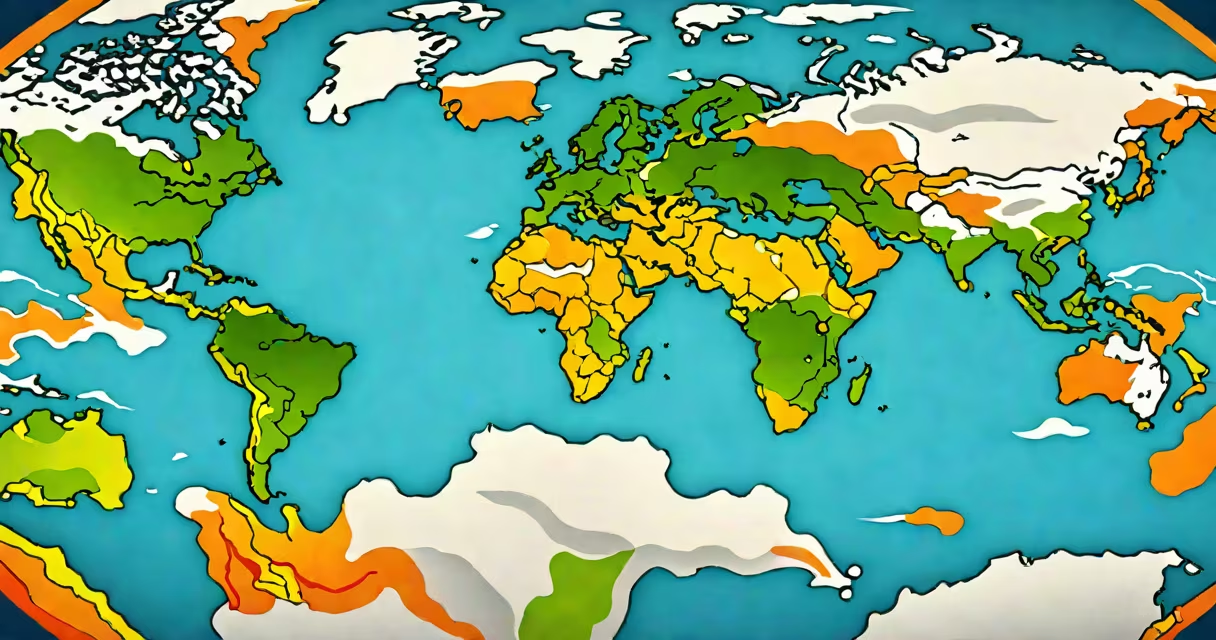
Global warming and climate change describe the long-term rise in Earth's average surface temperature caused by human activities, especially the release of greenhouse gases like carbon dioxide and methane from burning fossil fuels, deforestation, and industrial processes. This warming alters weather patterns, melts glaciers, raises sea levels, and disrupts ecosystems worldwide.
The term "climate change" encompasses broader shifts in weather systems, precipitation, storm frequency, and seasonal patterns, while "global warming" specifically refers to the increase in global average temperatures since the late 19th century. The two are closely linked: global warming is the primary driver of current climate change.
According to NASA and the National Oceanic and Atmospheric Administration (NOAA), Earth's average surface temperature has risen by about 1.2°C (2.2°F) since the late 1800s, with most of the warming occurring since 1970. This rate of change is new in at least the past 2,000 years, based on ice core and tree ring data.
Natural greenhouse gases-carbon dioxide (CO₂), methane (CH₄), nitrous oxide (N₂O), and water vapor-trap heat in Earth's atmosphere. Without them, Earth would be too cold to support life. But human activity has dramatically increased their concentrations.
When sunlight reaches Earth, some is reflected back into space, but most is absorbed and re-emitted as infrared radiation (heat). Greenhouse gases absorb this heat and re-radiate it in all directions, including back toward the surface. More gases mean more heat trapped, leading to higher global temperatures.
Since the Industrial Revolution, CO₂ levels have risen from about 280 parts per million (ppm) to over 420 ppm in 2023. This increase is directly tied to fossil fuel use, cement production, and land-use changes like clearing forests for agriculture. The Intergovernmental Panel on Climate Change (IPCC) confirms that human influence is "unequivocal" in driving recent warming.
Climate change is driven by both natural and human-caused factors. Natural influences include volcanic eruptions, solar cycles, and oceanic oscillations like El Niño. However, scientific consensus identifies human activities as the dominant force behind recent changes.
| Type | Primary Source | Impact on Temperature |
|---|---|---|
| Carbon dioxide (CO₂) | Fossil fuel combustion, deforestation | Major contributor; responsible for ~65% of radiative forcing since 1750 |
| Methane (CH₄) | Cattle farming, landfills, oil/gas extraction | 28 times more potent than CO₂ over 100 years; rising rapidly |
| Nitrous oxide (N₂O) | Fertilizer use, industrial processes | 265 times more potent than CO₂; increasing due to agriculture |
| Halogenated gases | Refrigerants, solvents | Extremely potent; regulated under Montreal Protocol |
Non-greenhouse gas contributors include aerosols from pollution, which can cool the planet temporarily by reflecting sunlight. But their net effect is smaller than greenhouse gas warming, and they don't offset long-term trends.
Impacts of global warming and climate change are already visible across every continent and ocean basin. Glaciers in the Himalayas, Greenland, and Antarctica are retreating at record rates. Sea levels rose about 20 cm (8 inches) globally between 1901 and 2018, with acceleration since 2000.
Extreme weather events have intensified. The 2023 Atlantic hurricane season saw 30 named storms-the highest on record-and Hurricane Ian caused $113 billion in damages in Florida. Heatwaves in Europe and India have exceeded 50°C (122°F) in recent years, with deadly consequences.
Biodiversity loss is accelerating. Coral reefs, which support 25% of marine species, face mass bleaching due to warmer oceans. The Great Barrier Reef lost over half its coral cover since 1995, according to Australian government monitoring.
"Climate change is just a natural cycle." While Earth's climate has shifted over millennia, the current pace of warming exceeds any known natural variation. Ice core records show CO₂ levels haven't been this high in at least 800,000 years. The speed of modern warming-over 1°C in less than 150 years-is unmatched in geological history.
"A single cold winter disproves global warming." Weather is short-term; climate is long-term. A cold snap in one region doesn't negate a 1.2°C global trend. In fact, warming can disrupt atmospheric circulation, leading to more frequent extreme cold events in certain areas.
"The problem is too big to fix." While systemic change is needed, measurable progress is possible. Renewable energy capacity grew 10% annually from 2010 to 2022, according to the International Energy Agency. Countries like Denmark and Costa Rica now generate over 50% of electricity from wind and solar.
In June 2021, a persistent high-pressure system trapped hot air over British Columbia and Washington State. Temperatures reached 49.6°C (121.3°F) in Lytton, Canada-the highest ever recorded in the country. Over 600 people died in the U.S. and Canada during the event.
Climate scientists analyzed the event using attribution studies. They found that such a heatwave was virtually impossible without human-induced climate change. The study, published in *Nature Climate Change*, concluded that global warming made the event at least 150 times more likely.
This case illustrates how climate change doesn't just predict future risks-it alters the likelihood of extreme events already happening.
I visited Anchorage in 2022 and met with local researchers tracking permafrost thaw. In one area near the Chugach Mountains, a road had buckled due to ground collapse. The team showed me satellite images from 1985 and 2022-where forested land had turned into slumping wetlands.
Permafrost stores twice as much carbon as currently exists in the atmosphere. When it thaws, microbes decompose organic matter, releasing CO₂ and CH₄. This creates a feedback loop: warming causes thaw, thaw releases more greenhouse gases, which cause further warming.
Global warming is not synonymous with ozone depletion. Ozone loss occurs in the stratosphere and is caused by chlorofluorocarbons (CFCs), which were banned under the Montreal Protocol. While both are environmental issues, they involve different chemicals, altitudes, and mechanisms.
Also, climate change is not a prediction-it's a documented reality. The World Meteorological Organization reports that the last decade (2013-2022) was the warmest on record. Observational data from satellites, weather stations, and ocean buoys confirm consistent warming trends.
Every year, the IPCC releases updated assessments based on peer-reviewed research. Their 2023 report states that limiting warming to 1.5°C above pre-industrial levels requires immediate, deep cuts in emissions. Failure to act increases risks of irreversible damage to ecosystems and human societies.
Understanding what is global warming climate change begins with recognizing that it is not a distant threat. It is a present condition shaping weather, food systems, infrastructure, and public health. Addressing it requires coordinated action across governments, industries, and individuals.