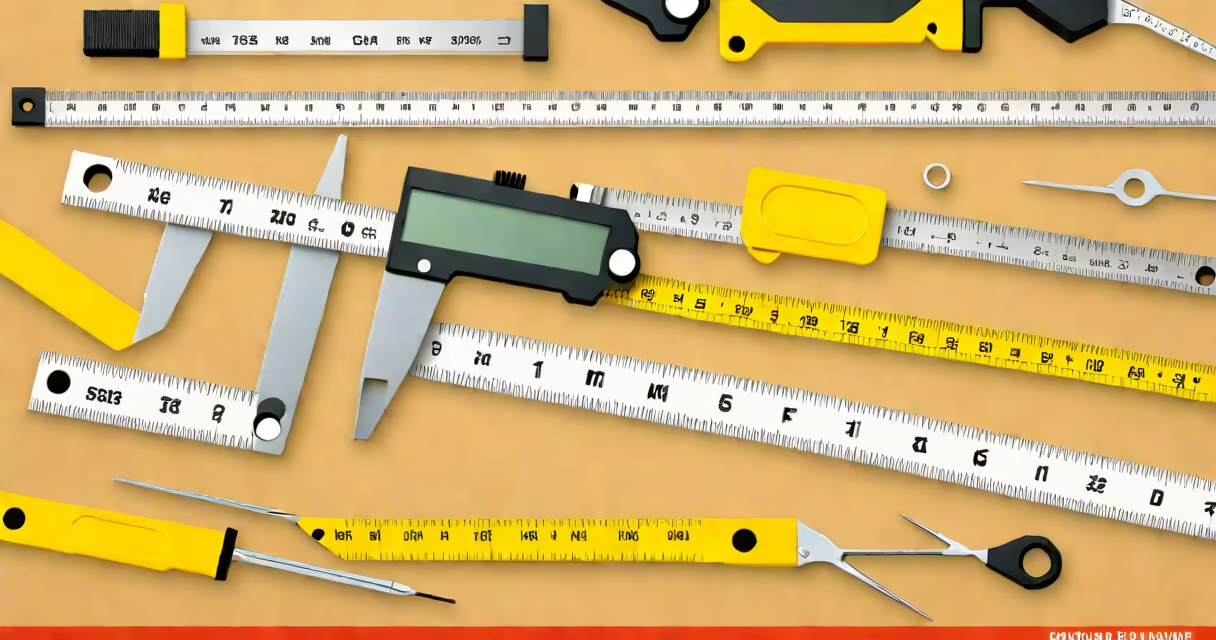
A ruler, tape measure, caliper, or micrometer measures length. These instruments differ in scale, precision, and intended use, ranging from basic household measurements to high-accuracy engineering applications.
Each tool uses physical or digital mechanisms to quantify distance between two points. A ruler relies on marked increments along a straight edge. A tape measure extends a flexible strip with calibrated markings. Calipers use movable jaws to close around an object's dimension, reading the gap via a dial or digital display. Micrometers employ a screw mechanism to translate fine rotations into precise linear movement, often measured in thousandths of an inch or hundredths of a millimeter.
For example, a standard metric ruler divides centimeters into millimeters. When measuring a pencil, align the zero mark with one end and read the value at the other. A tape measure allows curved or extended surfaces to be measured, such as a wall's height. Calipers detect internal or external diameters, like a shaft's width. Micrometers achieve accuracy within ±0.001 mm, essential in manufacturing tolerances.
Modern digital versions integrate sensors and displays. A digital caliper connects to a computer via USB or Bluetooth, transmitting data for quality control systems. This integration reduces human error and supports automated workflows in production lines.
The choice of tool depends on required precision and context. The table below outlines common instruments, their typical use cases, and measurement ranges.
| Instrument | Typical Range | Resolution | Common Use Cases |
|---|---|---|---|
| Ruler | 15-30 cm | 1 mm | Classroom projects, paper cutting, home DIY |
| Tape Measure | 1-5 m | 1 mm | Construction, tailoring, furniture assembly |
| Caliper | 0-150 mm | 0.01 mm | Mechanical parts, machining, quality inspection |
| Micrometer | 0-25 mm | 0.001 mm | Manufacturing, aerospace components, laboratory testing |
Each tool serves distinct environments. A carpenter may use a retractable tape measure to span a room's width. An engineer might select a digital caliper to verify a gear's tooth thickness. A machinist uses a micrometer to check the diameter of a bearing race, ensuring it fits within a 0.005 mm tolerance.
Non-obvious fact: Most rulers are calibrated in both metric and imperial units. A standard 30 cm ruler includes centimeters and inches, allowing dual-unit use. However, conversion errors occur when users misread the smaller tick marks. For example, 1/16 inch equals approximately 1.59 mm-not 1.6 mm-leading to cumulative inaccuracies in detailed work.
People often assume all measuring tools are interchangeable. A tape measure cannot replace a micrometer in precision tasks. While a tape measure may read to 1 mm, a micrometer reads to 0.001 mm. Using a tape measure to assess a piston ring's thickness risks failure due to overspecification.
Another misconception is that digital tools are always more accurate. A digital caliper's accuracy depends on calibration. Without regular verification using gauge blocks, readings drift. According to the National Institute of Standards and Technology (NIST), uncalibrated digital tools can deviate by up to 0.05 mm-outside acceptable limits for critical manufacturing.
I once used a digital caliper during a prototype build. After measuring a bracket's hole diameter, I noticed a 0.02 mm discrepancy between two samples. Rechecking with a mechanical caliper confirmed the digital unit had drifted. Recalibration restored accuracy. This experience underscored that even advanced tools require maintenance.
Understanding the difference prevents misuse. Measuring a wire's length with a force sensor leads to meaningless results. Conversely, applying a ruler to assess tension in a cable yields no useful data. Each instrument targets a specific physical quantity-length, force, pressure, temperature-defined by SI units.
Length measurement remains foundational in science, engineering, and daily life. From building a bookshelf to designing microchips, the correct instrument ensures consistency and reliability. Always match the tool to the task's required precision and environment.
What instrument is used to measure length? Rulers, tape measures, calipers, and micrometers fulfill this role across scales. Choosing the right one avoids errors, saves time, and improves outcomes.