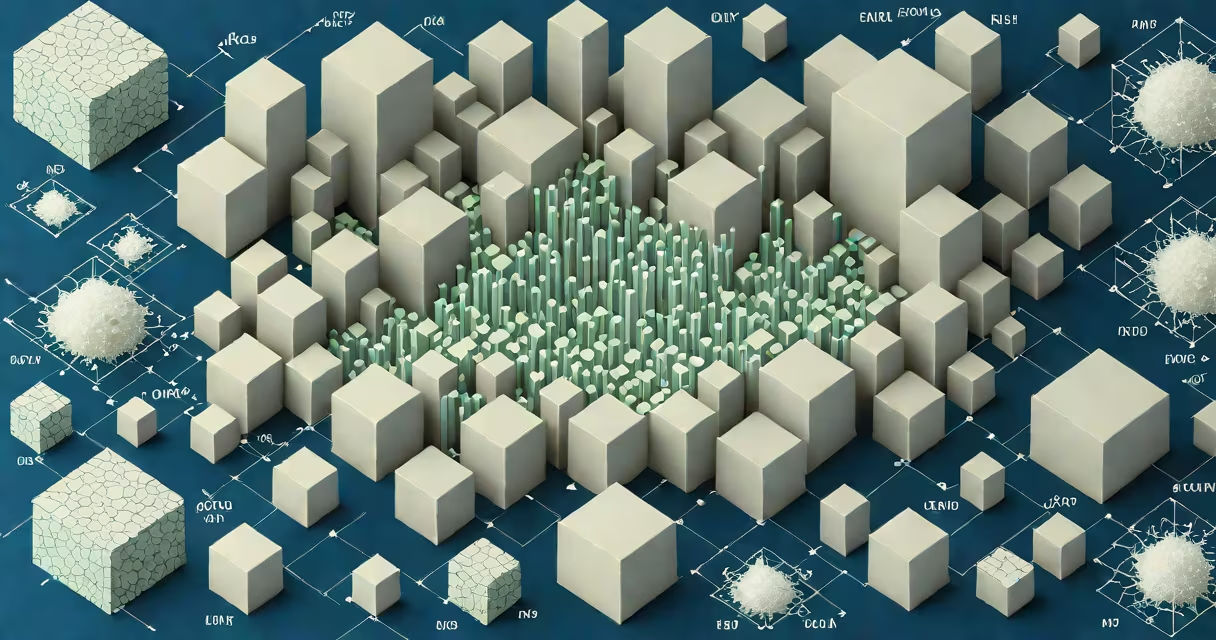
Sodium chloride (NaCl) consists of one sodium ion (Na⁺) and one chloride ion (Cl⁻) bonded through ionic attraction, forming a crystalline lattice with a 1:1 ratio. Its composition is 39.3% sodium and 60.7% chlorine by mass, derived from atomic weights of 22.99 g/mol for sodium and 35.45 g/mol for chlorine.
The structure arises from electron transfer: sodium donates one electron to chlorine, creating positively charged Na⁺ and negatively charged Cl⁻ ions. These oppositely charged particles attract strongly, forming a rigid, repeating three-dimensional lattice. Each sodium ion is surrounded by six chloride ions, and vice versa, maximizing electrostatic stability.
At room temperature, solid sodium chloride dissolves readily in water because polar water molecules disrupt the ionic bonds. The resulting solution conducts electricity due to free-moving ions-a property central to its classification as an electrolyte. This behavior underpins its use in medical IV fluids and nerve signaling.
Natural sodium chloride forms through evaporation of ancient seawater, leaving behind halite deposits. These deposits crystallize into cubes due to the geometry of the ionic lattice. Rock salt mined from underground formations contains trace impurities like magnesium and calcium, which affect color and melting point.
When dissolved, NaCl dissociates completely into Na⁺ and Cl⁻ ions. This complete dissociation distinguishes it from weak electrolytes like acetic acid. In biological systems, the concentration gradient of Na⁺ drives fluid movement across cell membranes via osmosis, regulating blood pressure and hydration.
Industrial production uses vacuum evaporation or solar ponds. For example, the Salar de Uyuni in Bolivia holds over 100 billion tons of salt, mostly NaCl, formed over millions of years from evaporated lakes. Despite vast reserves, purification remains essential for pharmaceutical-grade applications.
While pure NaCl has a consistent composition, variations exist based on processing and additives:
| Type | Composition | Use Case |
|---|---|---|
| Rock salt | NaCl with 1-5% impurities (Ca²⁺, Mg²⁺) | Deicing roads, livestock feed |
| Table salt | NaCl with 0.1-0.3% iodine (as potassium iodide) | Culinary use, nutrient supplementation |
| Pharmaceutical-grade | ≥99.5% pure NaCl, low heavy metal content | IV solutions, sterile rinses |
Trace elements alter physical properties. Magnesium in rock salt lowers melting point to ~500°C, making it effective for deicing below freezing. Iodized table salt prevents goiter; the World Health Organization recommends 150 micrograms of iodine daily for adults.
Some assume sodium chloride is purely "salt" and interchangeable with other salts like potassium chloride. But NaCl differs in ionic charge density and biological impact. Potassium chloride is used in low-sodium diets but affects heart rhythm differently due to K⁺'s role in cardiac repolarization.
Another error is equating NaCl's composition with its health effects. While the molecule itself is stable and non-toxic, excessive intake correlates with hypertension. The American Heart Association advises limiting sodium to less than 2,300 mg per day-about one teaspoon of salt. High intake increases extracellular fluid volume, raising blood pressure.
A key distinction often missed: NaCl is not a compound in the covalent sense. It lacks shared electrons. Instead, it's held together by electrostatic forces. This makes it brittle-crystals fracture along planes rather than bending. When crushed, the lattice breaks into smaller pieces, each still containing equal numbers of Na⁺ and Cl⁻ ions.
Normal saline, used in hospitals, contains 0.9% NaCl by weight. This means 9 grams of NaCl per liter of water. The molarity is approximately 0.154 M, matching human plasma osmolarity. This prevents cellular swelling or shrinkage during intravenous infusion.
To prepare it: dissolve 9 grams of pure NaCl in distilled water, then dilute to 1 liter. The solution dissociates into 0.154 mol/L Na⁺ and 0.154 mol/L Cl⁻. This balance maintains electrolyte homeostasis in patients with dehydration or surgery recovery.
Testing confirms purity using flame tests-sodium produces a persistent yellow-orange flame-and titration with silver nitrate to quantify chloride content. A 10 mL sample of normal saline requires about 0.3 mL of 0.1 M AgNO₃ to reach endpoint, indicating precise chloride concentration.
Understanding the composition of sodium chloride reveals why it behaves as it does. The 1:1 ionic ratio ensures electrical neutrality. The high melting point (801°C) reflects strong ionic bonds. The 60.7% chlorine mass fraction explains why chloride ions dominate in aqueous environments, influencing pH and microbial growth.
For example, in water treatment, NaCl is used in ion exchange resins to remove hardness-causing ions like Ca²⁺ and Mg²⁺. The resin exchanges Na⁺ for those cations, reducing scale formation. After regeneration, brine (high-concentration NaCl solution) flushes out captured minerals.
I once observed a lab technician preparing saline for wound irrigation. She measured 9 grams of NaCl using a calibrated balance, dissolved it in 900 mL of sterile water, then topped off to 1 liter. The final solution was tested with a refractometer-specific gravity matched expected values. This precision matters: even small deviations can cause tissue irritation or infection risk.