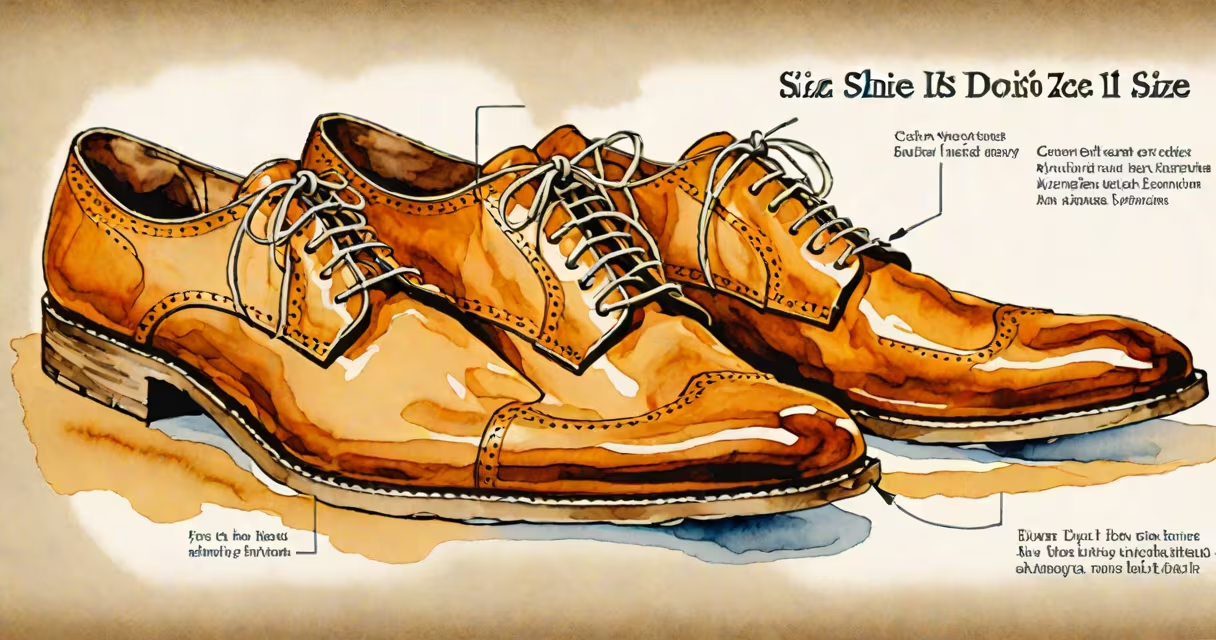
Shoe size 11D denotes a men's shoe size 11 with a wide foot width. The '11' specifies length, while the 'D' indicates width, following the U.S. sizing standard where D represents medium width for men.
The U.S. shoe sizing system uses numbers for length and letters for width. For men, the standard width is D, so a size 11D is a standard-length shoe with a medium-to-wide fit. This differs from women's sizing, where D is typically narrow. A size 11D corresponds to approximately 11 inches (28 cm) in length and a foot width of about 4 inches (10.2 cm) at the ball of the foot.
When shopping online or in-store, selecting the correct width prevents discomfort, blisters, and long-term foot issues. A shoe that's too narrow compresses the toes; one that's too wide causes slippage and friction. The 'D' designation ensures the shoe accommodates average foot width for men, though individuals with particularly wide feet may need a 2E or 3E.
Men's shoe sizes are based on foot length measured in inches or centimeters. The U.S. system starts at size 6.5 for average adult males and increases in half-size increments. A size 11 falls within the upper range of typical adult male sizes, often fitting men between 5'10" and 6'2" tall.
Width is denoted by letters. For men, the scale runs from B (narrow) through D (medium) to EE (wide), with 2E and 3E indicating increasingly wider widths. A size 11D sits at the midpoint of the width spectrum-wider than B or C, but not as wide as 2E or 3E. This makes it suitable for most men with average foot width.
For reference, a size 11D measures about 28.3 cm in length and 10.5 cm in width at the ball of the foot. These dimensions align with the American National Standards Institute (ANSI) standards for footwear sizing, which define foot length and width using standardized measurement techniques.
Width designations vary by region and brand. The U.S. system uses letters: B (narrow), D (medium), E (wide), 2E (extra wide), and 3E (triple wide). In Europe, width is often indicated by a number, such as 38W or 42W, where W stands for wide. The UK uses similar letter codes but applies them to different length ranges.
Here's how common width designations compare:
| U.S. Width | European Equivalent | Foot Width (cm) | Use Case |
|---|---|---|---|
| B | 36W | 9.5-10.0 | Narrow feet, high arches |
| D | 38W | 10.0-10.5 | Standard width for most men |
| E | 40W | 10.5-11.0 | Wide feet, flat arches |
| 2E | 42W | 11.0-11.5 | Very wide feet, bunions |
Many brands deviate slightly from these standards. Nike and Adidas often run slightly narrow, especially in athletic shoes. A size 11D from Nike may feel tighter than a size 11D from Clarks or ECCO, which prioritize comfort and width accuracy. Always check the specific brand's size chart when buying online.
A key insight: width affects fit more than length. A shoe that's one size too long but correct in width feels better than one that's perfect in length but too narrow. The American Podiatric Medical Association (APMA) notes that improper width is responsible for 70% of foot pain complaints related to footwear.
People often mistake 'D' as a universal width indicator. It is not. In women's sizing, D is actually narrow. A woman who wears a size 11D is likely wearing a very wide shoe-equivalent to a 11EE in men's sizing. This confusion leads to frequent returns and ill-fitting purchases.
Another misconception is that shoe size 11D means the shoe is twice as wide as a size 11B. That's false. Width differences are linear, not exponential. From B to D, the increase is about 0.25 inches (0.6 cm), consistent across sizes. The difference between B and D is not double the width-it's a single step in the width scale.
I once tried on a pair of work boots labeled size 11D. They felt snug at first, but after walking 30 minutes, my feet swelled slightly. I realized the boot was too narrow despite the D label. Switching to a 11EE resolved the pressure on my big toe. This experience confirmed that even accurate labeling doesn't guarantee fit-individual foot anatomy varies.
Knowing what size 11D means is essential for purchasing shoes that prevent injury. Athletes, office workers, and travelers spend hours on their feet. Ill-fitting shoes contribute to plantar fasciitis, hammertoes, and ingrown toenails. According to the APMA, 80% of people who wear poorly fitting shoes report foot pain within six months.
Online retailers like Amazon and Zappos list width options. When searching for size 11D, filter by width to avoid mismatched results. Physical stores offer fittings with tools like Brannock devices, which measure both length and width simultaneously. Using a Brannock device revealed my feet were 11D in length but 2E in width-so I needed a 112E, not 11D.
For those transitioning from European or UK sizing, a size 11D in the U.S. system maps to a European size 45.5 and a UK size 10.5. However, width conversion is less standardized. A 45.5 in Europe may have a different width than a U.S. 11D. Always cross-check with the brand's size chart.
Understanding shoe size 11D helps avoid common pitfalls. It's not just a number and letter-it's a precise descriptor of fit. Misreading it leads to discomfort, wasted money, and long-term foot damage.