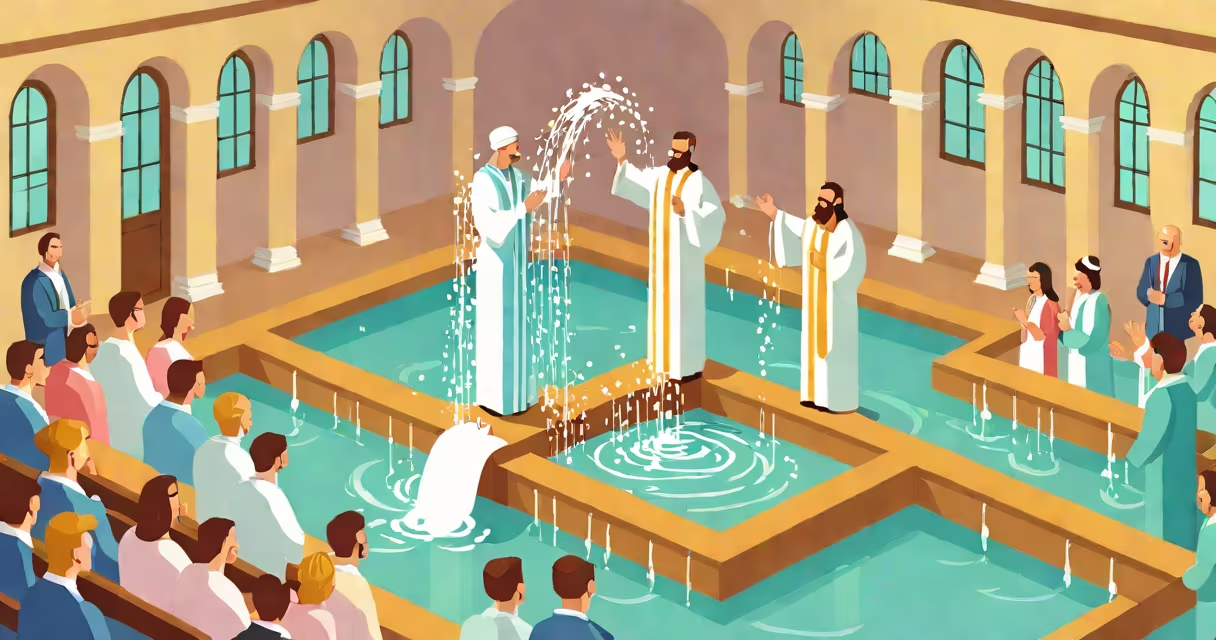
Baptism is a Christian ritual involving immersion or pouring of water that signifies spiritual cleansing, initiation into the faith community, and public declaration of belief in Jesus Christ. It is both a symbolic act and a foundational step in many Christian traditions.
Baptism is not merely a formality-it represents a turning point in a believer's life. The act involves water, spoken words, and often a community witness. It marks the beginning of a new identity in Christ, rooted in the belief that through Jesus' death and resurrection, sin is forgiven and a new life begins.
The earliest recorded baptism occurred when John the Baptist immersed people in the Jordan River as a sign of repentance. Jesus himself was baptized by John, setting a precedent for Christians. After his resurrection, Jesus instructed his disciples to "go and make disciples of all nations, baptizing them in the name of the Father and of the Son and of the Holy Spirit" (Matthew 28:19).
Baptism functions on multiple levels. It is a visible expression of an internal transformation. Water symbolizes purification-washing away sin-and the act of going under and coming up reflects dying to old ways and rising to new life in Christ.
In Catholic and Orthodox traditions, baptism is considered a sacrament-a sacred rite that conveys grace. According to the Catechism of the Catholic Church, "Baptism is the basis of the whole Christian life, the gateway to life in the Spirit, and the door which gives access to the other sacraments." This view holds that baptism imparts sanctifying grace, erases original sin, and makes the person a member of the Church.
Protestant denominations often emphasize baptism as a public profession of faith rather than a vehicle of grace. For Baptists, for example, baptism follows personal conversion and is reserved for those who can consciously affirm their belief. They see it as an act of obedience, not a means of salvation.
Christian traditions differ on how baptism is performed and who may receive it. The main forms are immersion, affusion (pouring), and aspersion (sprinkling).
| Type | Method | Common Traditions | Symbolic Focus |
|---|---|---|---|
| Immersion | Full submersion in water | Baptist, Pentecostal, some evangelical churches | Dying and rising with Christ; complete cleansing |
| Affusion | Pouring water over the head | Catholic, Anglican, Lutheran | Grace received through the word and water |
| Aspersion | Sprinkling water on the head | Some Protestant and historic Christian groups | Symbolic cleansing; practical in certain settings |
Another key difference lies in who is baptized. Infant baptism is practiced in Catholic, Orthodox, and many mainline Protestant churches. These traditions believe baptism incorporates children into God's covenant, even before they can understand. In contrast, believers' baptism-common among Baptists and Anabaptists-requires conscious faith and decision-making.
According to the United States Conference of Catholic Bishops, "The sacrament of Baptism is conferred in the name of the Father, and of the Son, and of the Holy Spirit." This Trinitarian formula is required in most Christian rites. Non-Trinitarian groups such as Jehovah's Witnesses perform baptism in the name of Jesus only, reflecting doctrinal differences.
Baptism remains central in Christian worship calendars. Most churches hold baptism services during Easter, Pentecost, or special family events. In the U.S., about 65% of Christians report being baptized, according to Pew Research Center (2023). The practice varies widely by region and denomination.
For many, baptism is a milestone event. A friend of mine attended a small church in rural Tennessee where families gather annually to baptize children and adults. He described the moment his niece stepped into the river-her hands trembling, her eyes wide-as deeply personal. "She wasn't just getting wet," he said. "She was saying, 'I belong.'"
Baptism also serves as a rite of passage in many cultures. In Nigeria, for example, baptism ceremonies often include extended family, traditional music, and colorful robes. In Japan, where Christianity is a minority faith, baptism is sometimes a quiet act of personal conviction amid societal pressure to conform.
One widespread misunderstanding is that baptism guarantees salvation. While many Christians believe baptism is essential, it is not universally seen as sufficient on its own. The Apostle Paul wrote, "It is by grace you have been saved, through faith-and this is not from yourselves, it is the gift of God" (Ephesians 2:8-9). Faith precedes baptism in most interpretations.
Another confusion arises around infant baptism. Critics argue that babies cannot make a conscious choice, so the act lacks meaning. But defenders point out that baptism is not about the child's understanding-it's about God's promise. As theologian Karl Barth noted, "Baptism is not a human act but a divine action." The church acts on behalf of the child, trusting God's grace to work in them.
A lesser-known fact: baptism is not always permanent. In some cases, individuals who were baptized later leave the faith. The Catholic Church teaches that baptism leaves an indelible mark on the soul, but it doesn't force continued belief. A 2021 study by the Pew Research Center found that 20% of Americans raised Christian no longer identify with any religion-many of whom were baptized as children.
Consider Marcus, a 32-year-old software engineer from Chicago. Raised in a non-religious household, he began attending a local Episcopal church after losing his job. Over several months, he studied scripture, prayed daily, and attended worship services. When he decided to be baptized, he chose a small outdoor pool near Lake Michigan.
The priest poured water over Marcus's head while saying, "I baptize you in the name of the Father, and of the Son, and of the Holy Spirit." Marcus felt cold water run down his neck, then warmth spread through his chest. Afterward, he shared with friends that "it wasn't just a ritual. It was the first time I felt truly seen by God."
This moment illustrates how baptism functions: not as a magical fix, but as a tangible step in a process of faith. It connects personal identity with a larger story-the life, death, and resurrection of Jesus.
Understanding what being baptised does requires recognizing both its symbolic weight and its communal role. It is not simply a religious tradition-it is a lived experience of belonging, renewal, and commitment. Whether performed in a cathedral, a backyard pool, or a riverbank, baptism continues to mark the beginning of a new life in Christ.