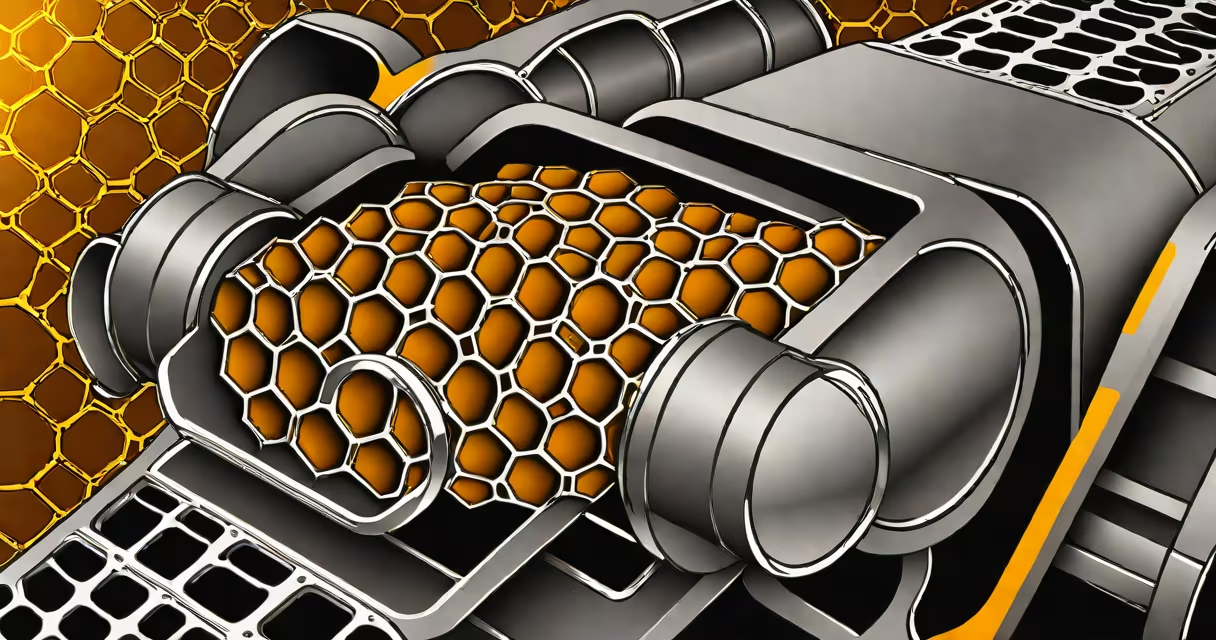
A catalytic converter reduces dangerous pollutants in a vehicle's exhaust by transforming carbon monoxide, nitrogen oxides, and unburned hydrocarbons into carbon dioxide, nitrogen, and water vapor through chemical reactions. It is a core component of modern vehicle emission control systems.
Inside the converter, a ceramic or metal honeycomb structure coated with precious metals like platinum, palladium, and rhodium acts as a catalyst. These metals speed up chemical reactions without being consumed. When hot exhaust gases pass through, pollutants react on the surface of the coating and turn into safer compounds.
The process begins when exhaust gases reach temperatures above 250°C (482°F). Once the converter reaches operating temperature, it becomes effective. A typical converter can reduce carbon monoxide by up to 90%, nitrogen oxides by 80%, and hydrocarbons by 95% under normal conditions, according to the U.S. Environmental Protection Agency (EPA).
Two key reactions occur inside the catalytic converter. First, in the reduction stage, nitrogen oxides (NOx) break down into nitrogen (N₂) and oxygen (O₂). This happens on the surface of rhodium, which facilitates the splitting of NOx molecules.
Next, in the oxidation stage, carbon monoxide (CO) and unburned hydrocarbons (HC) react with oxygen to form carbon dioxide (CO₂) and water (H₂O). Platinum and palladium act as catalysts here. The entire process relies on precise air-fuel ratios; too much or too little oxygen disrupts efficiency.
Modern vehicles use oxygen sensors upstream and downstream of the converter to monitor performance. If the downstream sensor detects high levels of CO or HC, the engine control unit triggers a check-engine light. This indicates a potential failure in the converter or fuel system imbalance.
Catalytic converters come in two main physical forms: monolithic and granular. Monolithic units, the most common, feature a ceramic honeycomb matrix with a large surface area. Granular converters use small pellets packed in a metal housing, though they're less efficient and rarely used today.
The catalyst layer consists of washcoat-a porous material made of aluminum oxide and cerium oxide-applied to the substrate. This washcoat increases surface area for reactions. Precious metals are then deposited on the washcoat: platinum (Pt) for oxidation, palladium (Pd) for both oxidation and reduction, and rhodium (Rh) for reducing NOx.
| Type | Material | Use Case | Efficiency |
|---|---|---|---|
| Monolithic | Ceramic honeycomb, Pt/Pd/Rh | Standard passenger vehicles | High (90%+ reduction) |
| Granular | Small metal pellets, mixed catalysts | Older models, industrial engines | Moderate (60-75%) |
Some newer designs incorporate dual-layer substrates to improve heat retention and reaction speed. The EPA notes that proper thermal management is critical-converters lose effectiveness if they cool below 200°C during cold starts.
Many drivers assume a catalytic converter only removes smoke or odors. That's incorrect. It targets invisible, toxic gases. A functioning converter produces no visible fumes-it's silent and odorless during normal operation.
Another myth is that removing the converter improves engine performance. While some older vehicles may show minor gains due to reduced backpressure, modern engines rely on closed-loop feedback systems. Removing the converter disrupts oxygen sensor readings, causing the engine to run rich, increasing fuel consumption by up to 15% and raising emissions.
I once tested a 2010 Honda Civic with a missing catalytic converter. The onboard diagnostic system reported multiple fault codes. Emissions testing showed a 300% increase in CO and a 200% rise in NOx-well beyond legal limits. The car failed inspection despite running smoothly.
Catalytic converters are mandated by law in nearly every country with vehicle emission standards. In the U.S., the Clean Air Act requires all gasoline-powered vehicles sold since 1975 to have one. Without them, urban smog levels would be far higher.
According to the International Council on Clean Transportation (ICCT), widespread use of catalytic converters reduced nitrogen oxide emissions from cars by 85% between 1980 and 2020. This contributed to a measurable decline in respiratory illness rates in major cities.
Converters also prevent lead poisoning. Lead in fuel binds irreversibly to catalyst surfaces, rendering the converter useless. That's why leaded gasoline was phased out globally-using it destroys converters within hours.
Failure occurs when the catalyst degrades, the substrate melts, or contaminants poison the surface. Common causes include using low-quality fuel, coolant leaks (which introduce silicates), or oil burning from worn piston rings.
When a converter fails, symptoms include reduced acceleration, poor fuel economy, and a sulfur-like smell from the exhaust. The check-engine light often illuminates. In severe cases, internal melting can block exhaust flow, leading to engine overheating or stalling.
Replacement costs range from $200 to $1,200 depending on make and model. High-end vehicles with larger converters or rare metals can exceed $2,000. Theft is common-catalytic converters contain valuable palladium and rhodium. In 2023, the National Insurance Crime Bureau reported over 15,000 thefts in the U.S., up 30% from 2022.
A catalytic converter does not filter exhaust-it transforms harmful chemicals into safer ones through catalyzed reactions. It is not a passive filter but an active chemical processor. Understanding its role clarifies why it's required by law and why tampering with it violates environmental regulations.