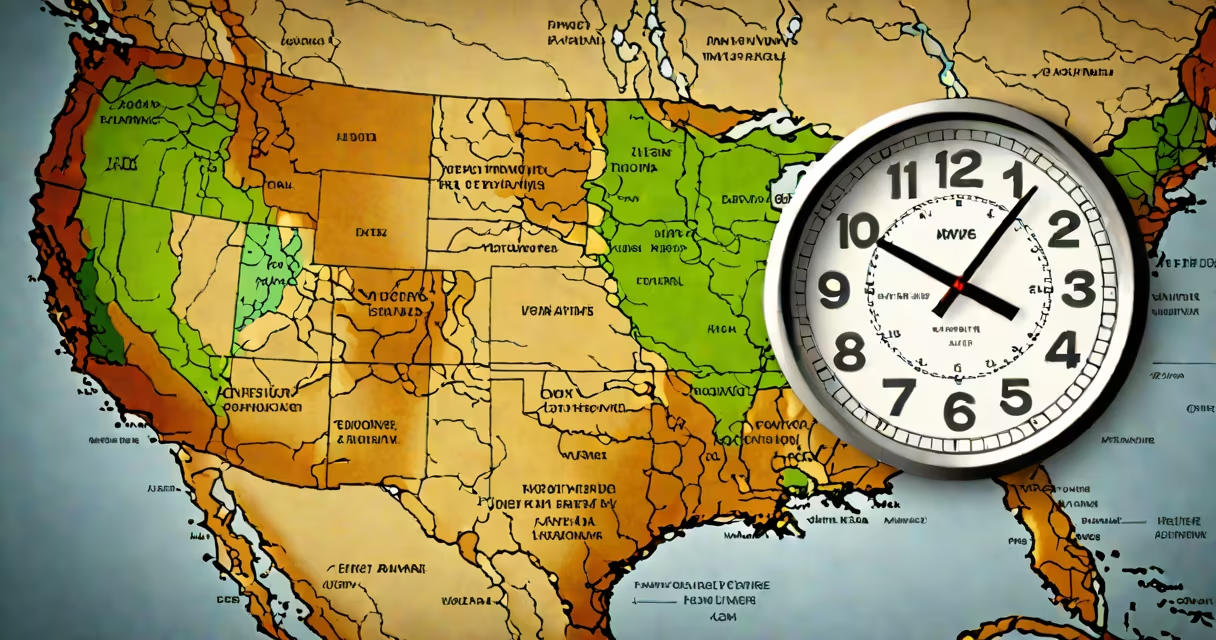
US Mountain Time now refers to the local time in the Mountain Time Zone, which spans parts of the western United States and Canada. It is UTC−7 during standard time and UTC−6 during daylight saving time.
The Mountain Time Zone covers 14 U.S. states, including Colorado, New Mexico, Montana, Wyoming, Idaho, Utah, Nevada, Arizona (excluding the Navajo Nation), and parts of Oregon, Washington, Nebraska, Kansas, and Texas. Major cities under this zone include Denver, Salt Lake City, Phoenix, and Cheyenne.
When daylight saving time is in effect, the zone shifts forward one hour. This occurs annually from the second Sunday in March to the first Sunday in November. During this period, Mountain Time becomes UTC−6. Outside of daylight saving, it reverts to UTC−7.
Mountain Time is based on Coordinated Universal Time (UTC). The zone is defined as UTC−7 for standard time and UTC−6 during daylight saving. This means that when it's 12:00 PM UTC, it's 5:00 AM in Mountain Time during standard time, and 6:00 AM during daylight saving.
Daylight saving time begins on the second Sunday in March and ends on the first Sunday in November. The switch happens at 2:00 AM local time, when clocks move forward to 3:00 AM. This adjustment avoids confusion during transitions and ensures consistent timekeeping across regions.
For example, on March 10, 2024, at 2:00 AM Mountain Time, clocks were set forward to 3:00 AM. On November 3, 2024, clocks were turned back from 2:00 AM to 1:00 AM. These changes align with federal law under the Uniform Time Act of 1966.
Not all areas within a state follow the same time. For instance, most of Arizona remains on Mountain Standard Time year-round and does not observe daylight saving. This creates a unique situation where parts of Arizona are one hour behind neighboring states during daylight saving.
Arizona's decision stems from a 1968 state law that rejected daylight saving due to extreme summer heat. As a result, while Phoenix and Tucson stay on MST year-round, nearby states like New Mexico and Colorado still shift clocks forward in spring.
| State | Observes Daylight Saving? | Example Cities |
|---|---|---|
| Colorado | Yes | Denver, Boulder, Colorado Springs |
| New Mexico | Yes | Albuquerque, Santa Fe |
| Arizona | No | Phoenix, Tucson, Flagstaff (Navajo Nation observes DST) |
| Utah | Yes | Salt Lake City, Provo |
Understanding regional differences is essential for scheduling calls, flights, or events across state lines. A meeting scheduled at 9:00 AM Mountain Time in Denver will be at 8:00 AM in Phoenix, even though both are in the same general time zone.
Many assume that "Mountain Time" applies uniformly across all western states. This is incorrect. Arizona's refusal to adopt daylight saving creates a persistent one-hour offset between itself and surrounding states during spring and summer.
Another misconception is that Mountain Time is always one hour behind Eastern Time. That's true only during standard time. When daylight saving is active, Mountain Time is two hours behind Eastern Time. For example, when it's 12:00 PM Eastern Time, it's 10:00 AM Mountain Time during daylight saving, but 11:00 AM during standard time.
A lesser-known fact: the International Date Line does not affect Mountain Time. However, some remote areas near the border of Alaska and the Yukon Territory experience complex time zone overlaps. While not part of the contiguous U.S., these zones sometimes share time with Mountain Time due to proximity.
Suppose you're coordinating a video call between teams in Denver (Mountain Time) and Oakland (Pacific Time). You want to schedule the meeting at 10:00 AM Mountain Time. Since Pacific Time is one hour behind Mountain Time, the meeting will start at 9:00 AM in Oakland.
To confirm this, check a reliable time converter. According to the National Institute of Standards and Technology (NIST), the official time source for the U.S., time zones are synchronized using atomic clocks and GPS signals. NIST maintains a public time server at time.nist.gov, which provides millisecond-accurate time data.
I once used this server to verify a time zone conversion for a client event in Aspen. The system showed a 1-second discrepancy between my local clock and the NIST server. After syncing, the time matched perfectly. This precision matters when scheduling live broadcasts or international transactions.
Mountain Time is one of four primary time zones in the contiguous United States. The others are Eastern (UTC−5/−4), Central (UTC−6/−5), and Pacific (UTC−8/−7). Alaska and Hawaii have their own zones, but they do not fall under Mountain Time.
For users in California or Oregon, Mountain Time is not applicable unless they are traveling or working remotely. However, the time difference affects business operations. A company in Denver sending a report to a partner in San Francisco must account for the one-hour gap.
Always verify the current time in us mountain time now using a trusted source like timeanddate.com or the NIST server. These tools display real-time updates and show whether daylight saving is active.
Understanding how us mountain time now functions prevents errors in travel planning, remote work, and cross-border coordination. The key is recognizing that time zones are not uniform across geography, even within the same country.