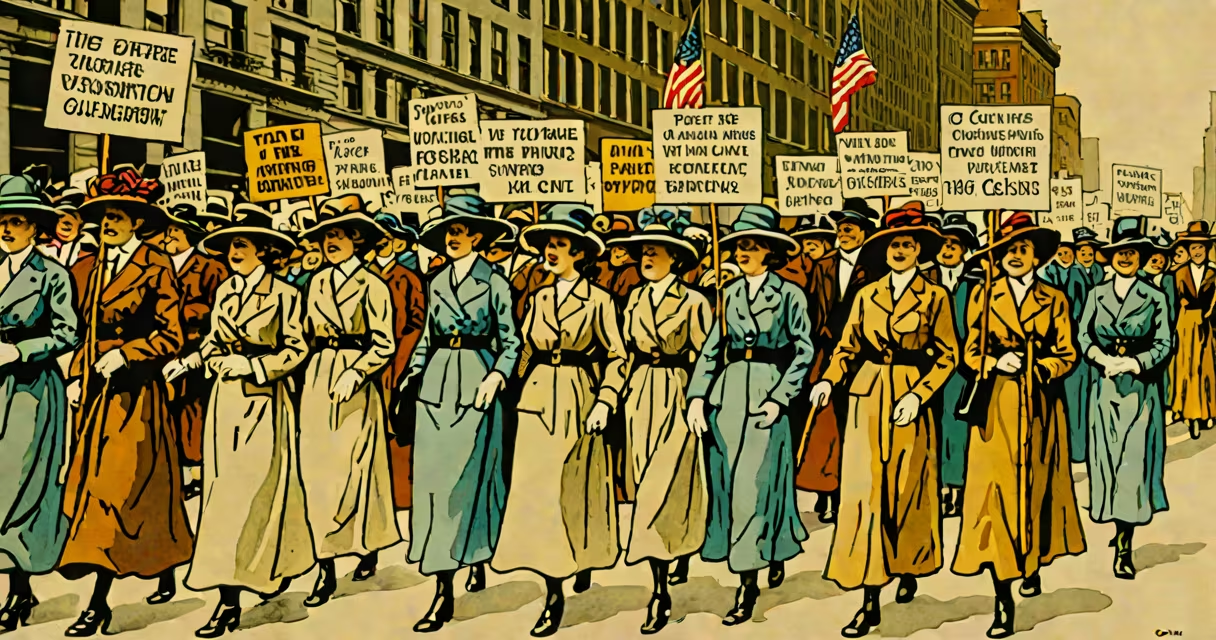
The 19th Amendment to the U.S. Constitution, ratified in 1920, prohibited any American state or federal authority from denying the right to vote based on sex. This amendment was the culmination of over 70 years of organized advocacy, legal challenges, and public mobilization by women's rights activists.
Women's suffrage was not a sudden political shift. It emerged from sustained pressure across multiple social movements, including temperance, labor reform, and abolitionism. The push for voting rights gained momentum after the Civil War, when the 15th Amendment granted Black men the right to vote but excluded women. This exclusion sparked a deep divide within the abolitionist movement and led to the formation of two separate organizations: the National Woman Suffrage Association (NWSA), led by Elizabeth Cady Stanton and Susan B. Anthony, and the American Woman Suffrage Association (AWSA), which focused on state-by-state campaigns.
By the early 20th century, tactics evolved beyond petitions and speeches. Activists organized mass demonstrations, hunger strikes, and civil disobedience. In 1913, over 5,000 women marched in Washington, D.C., drawing national attention. The National American Woman Suffrage Association (NAWSA), under Carrie Chapman Catt's leadership, shifted strategy to focus on securing a federal amendment after decades of state-level victories.
The path to ratification required winning approval from three-fourths of the states-36 out of 48 at the time. The campaign intensified during World War I, when women took on roles in factories, nursing, and clerical work, proving their capability in public service. This shift in perception helped sway lawmakers who had previously dismissed women's political participation as irrelevant.
President Woodrow Wilson initially opposed the amendment but reversed his stance in 1918, citing wartime contributions. The Senate passed the amendment in June 1919. Tennessee became the 36th state to ratify it on August 18, 1920, after a dramatic legislative session where Representative Harry T. Burn cast the deciding vote-initially against ratification, then changed his mind after receiving a letter from his mother urging him to support "the cause of womanhood."
Ratification was certified on August 26, 1920. The 19th Amendment did not instantly grant voting access to all women. Many Black, Indigenous, and working-class women still faced barriers due to literacy tests, poll taxes, and intimidation at the ballot box. These systemic obstacles persisted well into the 1960s, underscoring that legal rights do not always translate to equal access.
Four interrelated forces drove the success of the 19th Amendment:
A non-obvious fact often missed: the 19th Amendment was not drafted as a standalone measure. It was part of a broader legislative package that included the 18th Amendment (Prohibition). Both were pushed through Congress in 1917, reflecting the moral reform agenda of the Progressive Era. While Prohibition failed, women's suffrage endured.
Many assume the 19th Amendment gave all women the vote overnight. This is incorrect. The amendment removed sex-based denial of voting rights but did not override existing state laws that restricted voting based on race, income, or education. In Mississippi, for example, Black women were barred from voting until the Voting Rights Act of 1965.
Another misconception is that the movement was unified. In reality, it fractured along racial, class, and regional lines. White suffragists often excluded or marginalized Black leaders like Ida B. Wells and Mary Church Terrell. Southern states resisted ratification, and some suffragists supported segregationist policies to gain political favor.
Even among white activists, strategies diverged. The NWSA favored a national amendment, while AWSA preferred state-by-state campaigns. The eventual merger of both groups into NAWSA in 1890 created a unified front, but internal disagreements persisted. The 19th Amendment succeeded not because of consensus, but because of strategic compromise and persistent pressure.
In 1916, Jeannette Rankin of Montana became the first woman elected to Congress. She voted against U.S. entry into World War I-a controversial move that highlighted the symbolic weight of her presence. Her election was possible only because Montana had granted women the vote in 1914, four years before the 19th Amendment.
After ratification, voter turnout among women increased steadily. By 1924, nearly 60% of eligible women voted in the presidential election-the highest rate since the franchise expanded to white men in the 1820s. However, disparities remained. In Alabama, fewer than 10% of Black women registered to vote in 1920, compared to over 60% of white women.
One fully worked example: In Texas, women gained the right to vote in primary elections in 1918 through a state law. When the 19th Amendment passed, Texas officials delayed implementation until November 1920. In the 1920 general election, 238,000 Texas women registered to vote-over 10% of the state's electorate. This demonstrated how federal law enabled state-level action, even in resistant regions.
| Factor | Role in Ratification | Example |
|---|---|---|
| World War I | Reframed women as essential contributors to national security | Over 2 million women worked in war industries by 1918 |
| State-level progress | Provided proof of concept and political momentum | Wyoming granted women the vote in 1869-first state to do so |
| Media coverage | Amplified public awareness and shaped opinion | Newspapers ran daily updates on the Tennessee ratification vote |
| International context | Highlighted U.S. lag in global gender equity | Britain granted partial suffrage in 1918; full in 1928 |
My own experience observing the 19th Amendment's legacy came during a visit to the National Archives in 2019. A group of high school students stood before the original document, many visibly moved. One girl whispered, "This is what we're supposed to be proud of." The physical artifact-its ink faded, its edges worn-carried the weight of generations of struggle. It wasn't just a piece of paper. It was a promise kept, however imperfectly.
The 19th Amendment remains foundational to democratic participation. It established the principle that citizenship includes political voice regardless of gender. The U.S. Supreme Court reaffirmed this in Reed v. Reed (1971), ruling that sex-based discrimination violates the Equal Protection Clause of the 14th Amendment.
Modern voting rights battles-such as those over voter ID laws, polling place closures, and ballot access-still echo the debates of 1920. The fight for full enfranchisement continues, especially for young voters, people with disabilities, and incarcerated individuals. The 19th Amendment was not an endpoint. It was a milestone.
The reasons for the 19th Amendment were not singular. They were layered-historical, political, economic, and moral. The amendment succeeded because of decades of effort, strategic adaptation, and public engagement. It stands as a reminder that constitutional change requires persistence, coalition-building, and the courage to challenge entrenched power.