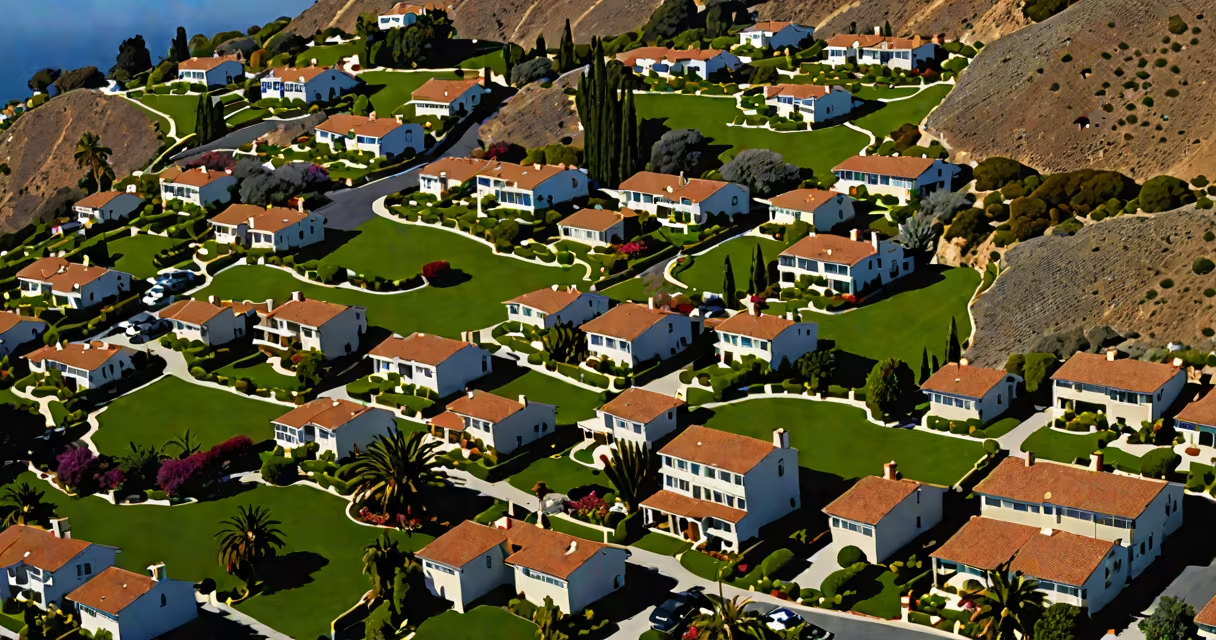
The Palos Verdes Peninsula is a 12-mile-long coastal landform jutting into the Pacific Ocean from southern Los Angeles County, home to affluent residential communities, protected natural preserves, and sweeping ocean vistas. It lies between the cities of Redondo Beach and San Pedro, bordered by the Pacific Coast Highway (State Route 1) and the Santa Monica Mountains.
Geologically, the peninsula formed from uplifted marine sediments and volcanic rock during the Miocene epoch, creating steep cliffs and terraced hillsides ideal for high-end residential development. Its climate features mild temperatures year-round, with average highs near 70°F (21°C) in summer and 60°F (16°C) in winter, thanks to consistent sea breezes.
Three incorporated municipalities make up the core of the peninsula: Palos Verdes Estates, Rolling Hills, and Rolling Hills Estates. These towns maintain strict zoning laws, often requiring minimum lot sizes of 1 acre and architectural review boards to preserve visual harmony. The area is served by the Palos Verdes Unified School District, which consistently ranks among the top in California for academic performance.
Each community operates under its own municipal government, with elected city councils and mayors. Palos Verdes Estates, for example, has a city council composed of five members who set budgets, approve development projects, and manage public services. The city maintains a dedicated police department and fire protection agency, both funded through local property taxes.
Access to the peninsula is limited to a few major roads. State Route 1 runs along the western edge, offering one of the most scenic drives in California. The eastern side connects via Via Verde and Palos Verdes Drive South, both winding through residential zones with restricted speed limits and no commercial signage. Private security patrols monitor gated entrances to neighborhoods such as Aviara and Del Mar Heights.
Despite its exclusivity, the peninsula is accessible to visitors. Public beaches like Point Fermin Park and the Palos Verdes Nature Preserve offer hiking trails, tide pools, and birdwatching opportunities. The area hosts seasonal events such as the annual Palos Verdes Art Walk and the Sunset Festival at the Palos Verdes Performing Arts Center.
The peninsula's terrain consists of sandstone, shale, and basalt formations, shaped by erosion and tectonic uplift. Soil composition varies from sandy loam in lowlands to clay-rich deposits in higher elevations, influencing landscaping choices and foundation design for homes.
Residential construction focuses on single-family estates with custom designs. Most homes feature Mediterranean Revival, Modernist, or Craftsman styles, using materials like stucco, tile roofing, and imported stone. Energy efficiency standards require solar panels on new builds, and many properties include smart-home systems integrated with automated irrigation and security monitoring.
| Community | Median Home Value (2023) | Lot Size Minimum | Notable Feature |
|---|---|---|---|
| Palos Verdes Estates | $4.2 million | 1 acre | Historic 1920s civic center |
| Rolling Hills | $3.8 million | 1.5 acres | Private golf course |
| Rolling Hills Estates | $4.6 million | 2 acres | Gated access with 24/7 patrol |
Data from the U.S. Census Bureau and Zillow Market Report (2023) confirm that median home values exceed $4 million across the peninsula, with price premiums driven by oceanfront lots and historic preservation status. Properties with direct beach access command 15-20% above-market premiums.
The Palos Verdes Peninsula serves as a retreat for professionals in finance, tech, and entertainment. High-net-worth individuals choose the area for privacy, proximity to LAX, and access to elite private schools. Families often cite safety, low crime rates (0.3 incidents per 1,000 residents annually), and strong community networks as key factors.
Investors value the peninsula's stable appreciation trend. Since 2000, home prices have risen at a compound annual growth rate of 4.1%, according to CoreLogic. This outpaces the national average of 2.8%. The stability stems from limited land availability-only 2,800 parcels are zoned for residential use-and strict environmental regulations that prevent large-scale development.
A notable exception is the Aviara neighborhood, where a recent rezoning allowed for mixed-use development. The project includes 120 luxury townhomes and a community center, approved by the Los Angeles County Board of Supervisors in 2022. This expansion reflects a rare shift toward density while preserving the area's character.
Many assume the entire peninsula is a single city. In reality, it spans three distinct municipalities with separate tax jurisdictions, emergency response protocols, and school districts. Residents must file city-specific property tax declarations and attend separate city council meetings.
Another misconception is that all homes face the ocean. Only about 12% of properties have direct ocean views due to topography. Most homes overlook neighboring hills or inland valleys. The most sought-after lots are located on the western ridge, where elevation maximizes visibility and minimizes fog intrusion.
One non-obvious fact: the peninsula's coastline is legally protected under the California Coastal Act of 1976. This law restricts construction within 100 feet of the high-tide line and mandates public access points at regular intervals. As a result, even privately owned oceanfront property cannot block views from adjacent parcels or public pathways.
I visited the Palos Verdes Peninsula in June 2023 to attend a community garden event in Palos Verdes Estates. As I walked along the paved path from the Civic Center to the community greenhouse, I noticed that every yard had a different plant species-native sage, manzanita, and coast live oak-planted in clusters to support pollinators. The city's field ordinance requires 70% native vegetation in front yards, a rule enforced through annual inspections.
At the event, a resident explained that the community's water conservation program reduced outdoor usage by 40% since 2018. Rainwater harvesting systems are mandatory on new homes, and all irrigation uses recycled graywater. These measures align with state mandates under the Sustainable Groundwater Management Act (SGMA).