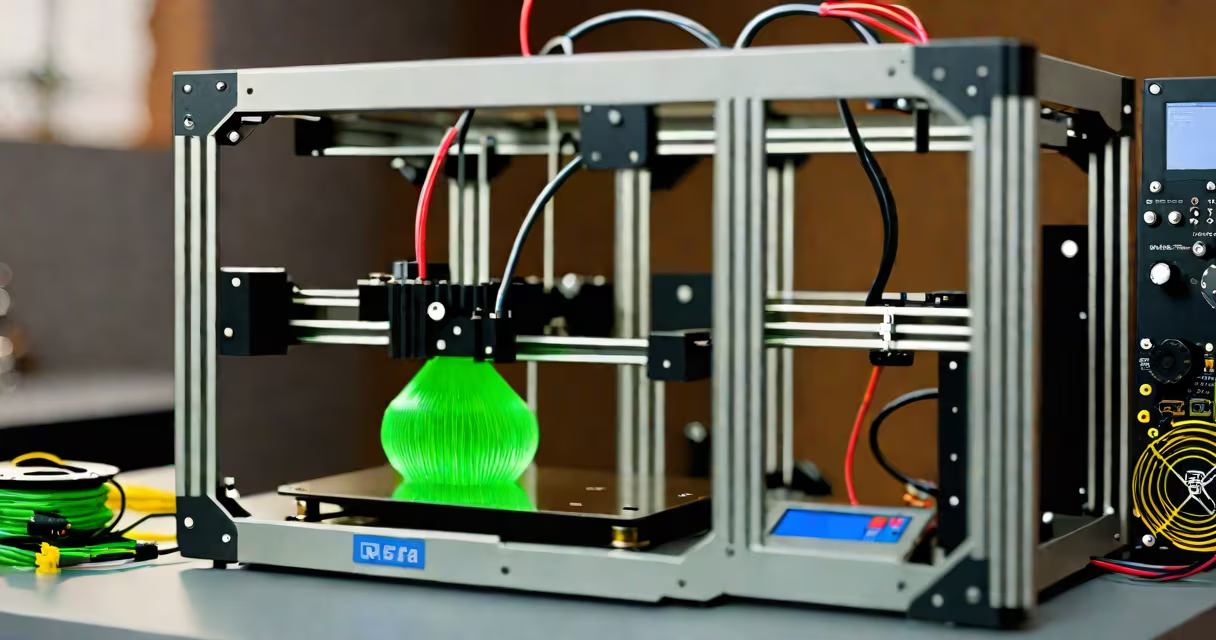
An open source printer is a physical device-most commonly a 3D printer-whose mechanical designs, electronic schematics, firmware code, and control software are publicly available under open licenses. Anyone can view, copy, modify, and redistribute these components without legal restrictions. This model enables rapid iteration, community collaboration, and low-cost access to advanced manufacturing tools.
Unlike proprietary printers sold by companies like HP or Canon, which lock users into closed ecosystems and restrict modifications, open source printers operate under principles of transparency and shared development. The core idea is that hardware, like software, benefits from collective scrutiny and improvement. This applies especially to 3D printers, where open source projects have driven down costs and accelerated innovation since the early 2010s.
For example, the RepRap project-a self-replicating 3D printer-launched in 2005 and released its designs under the GNU General Public License (GPL). Since then, thousands of derivatives have emerged, including models like the Prusa i3, Elegoo Neptune, and Anycubic Kobra. These machines share common architecture: a Cartesian motion system, stepper motors, a heated bed, and a microcontroller running Marlin or Klipper firmware-all based on openly published blueprints.
At its core, an open source printer functions through precise coordination between mechanical parts, electronic drivers, and embedded software. A 3D printer moves a print head along X, Y, and Z axes using stepper motors controlled by a microcontroller such as an Arduino or ESP32. The controller interprets G-code-a standard language for CNC machines-and translates it into electrical pulses that drive the motors.
All components are designed using CAD software like Fusion 360 or FreeCAD. These models are exported as STL files for 3D printing or DXF for laser cutting. The firmware, written in C++ or Python, runs on the microcontroller and manages timing, temperature regulation, and error handling. Because the source code is public, developers worldwide can fix bugs, improve performance, or adapt the software for new materials like flexible filaments or metal-infused resins.
A real-world example: the Prusa i3 MK3S uses open source designs and firmware. Its build volume is 250 x 210 x 200 mm, supports dual-gear extruders, and includes a sensor-based bed leveling system. The entire design-including the bill of materials, assembly instructions, and firmware repository-is hosted on GitHub under a Creative Commons license. Users can clone the project, tweak the frame geometry for stronger materials, or integrate custom sensors.
While most open source printers are 3D printers, the concept extends to other categories. Here's a breakdown of major types:
| Type | Use Case | Key Features | Example Project |
|---|---|---|---|
| 3D Printer | Prototyping, toolmaking, custom parts | Open CAD files, modifiable firmware, community support | Prusa i3 MK3S, Elegoo Neptune 4 Pro |
| Laser Cutter | Engraving, precision cutting of wood/plastic | Open-source control software (LightBurn), modular optics | OpenBeam, Glowforge (early version) |
| CNC Router | Woodworking, signage, mold making | Stepper motor control, G-code compatibility | Shapeoko, X-Carve |
| Desktop CNC Mill | Small-scale metal fabrication | High-torque spindles, closed-loop feedback | OpenBuilds CNC, DIY mill kits |
These systems often rely on shared libraries and standardized interfaces. For instance, many open source printers use the GRBL firmware, which provides consistent behavior across different platforms. This interoperability reduces learning curves and allows hobbyists to swap components between projects.
One non-obvious fact: open source printers aren't always cheaper to build. While the design files are free, sourcing quality components-such as linear rails, high-resolution encoders, or industrial-grade stepper motors-can exceed the cost of a commercial machine. However, the long-term value lies in repairability and upgrade paths. A user can replace a worn belt or upgrade to a higher-torque motor without vendor lock-in.
People often confuse "open source printer" with "open hardware" or "DIY printer." While related, they're not synonymous. Open source implies both availability of design files and permission to redistribute modified versions. Open hardware may lack redistribution rights or require attribution. DIY simply means you assemble it yourself-not necessarily from open designs.
Another misunderstanding: open source printers are not inherently less reliable. The RepRap project has produced machines that run continuously for months with minimal maintenance. According to a 2022 survey by the Open Source Hardware Association, 78% of respondents reported uptime exceeding 90% in production environments. Failures typically stem from poor component selection or improper calibration-not the openness of the design.
I once spent a weekend assembling a Prusa i3 clone from salvaged parts. The frame was bent, the belts stretched, and the nozzle clogged after five prints. But because the firmware was open, I could adjust PID tuning parameters and recalibrate the homing sequence using a serial terminal. Within two hours, the machine printed a functional replacement part for a broken bicycle chain. That experience confirmed a key insight: open source doesn't eliminate complexity-it redistributes expertise.
Open source printers thrive on collaboration. Developers contribute fixes, users report issues on forums like Reddit's r/3Dprinting or the RepRap forum, and designers release new variants monthly. This cycle accelerates progress far beyond what single corporations can achieve.
Research from MIT's Media Lab shows that open source hardware projects grow faster in adoption and feature diversity compared to closed alternatives. Between 2015 and 2020, open source 3D printers accounted for 63% of all new desktop printer designs documented in the Open Hardware Repository. This growth is fueled by educational institutions, makerspaces, and startups that use these platforms to prototype products before investing in injection molding or CNC machining.
For example, a team at Stanford used an open source printer to fabricate custom lab equipment during the pandemic. They printed a low-cost centrifuge housing from recycled PETG filament and integrated it with a DC motor and speed controller. The device achieved 5,000 RPM and was validated against commercial units in a peer-reviewed study. The full design was later shared under a CC-BY-NC license.
When choosing an open source printer, look for active communities, clear documentation, and regular updates to firmware and design files. Avoid projects with outdated repositories or no issue tracking. Tools like GitHub, GitLab, and Hackaday provide visibility into project health.