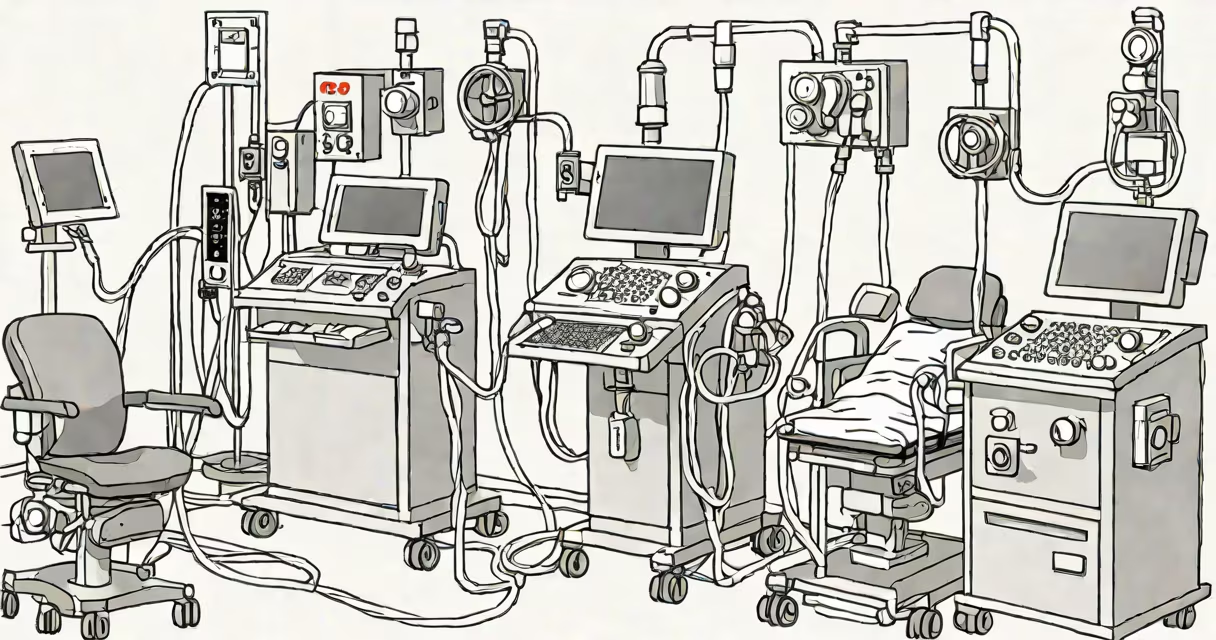
A mechanical ventilation system is a medical device that delivers controlled breaths to a patient who cannot maintain adequate breathing on their own. It ensures oxygen delivery and carbon dioxide removal through positive pressure ventilation, typically used in intensive care units, during surgery, or in emergency resuscitation.
These systems are essential in managing acute respiratory failure caused by conditions such as pneumonia, acute respiratory distress syndrome (ARDS), or severe trauma. They operate by applying pressurized air or oxygen through a tube inserted into the patient's airway-either via endotracheal intubation or a tracheostomy.
The core function is to automate and regulate the process of gas exchange. The ventilator controls tidal volume (amount of air delivered per breath), respiratory rate, and inspiratory pressure. Settings are adjusted based on patient size, lung compliance, and blood gas results. Without this intervention, patients with compromised respiratory function risk hypoxia, hypercapnia, and organ failure.
When a patient cannot sustain effective spontaneous breathing, a mechanical ventilation system takes over. Air is delivered from a compressed gas source-typically a mixture of oxygen and room air-through a circuit of tubing to a patient interface. This interface is usually an endotracheal tube placed through the mouth or nose into the trachea, or a tracheostomy tube in long-term cases.
The ventilator cycles between inspiration and expiration using preset parameters. During inspiration, pressure increases to push air into the lungs. During expiration, the system allows passive deflation. Modern ventilators monitor real-time data such as airway pressure, tidal volume, minute ventilation, and oxygen saturation. Alarms trigger if thresholds are breached-such as high peak pressure indicating obstruction or low oxygen levels signaling disconnection.
For example, a 70 kg adult with ARDS may be set on a volume-controlled mode with a tidal volume of 6 mL/kg (420 mL), a respiratory rate of 16 breaths per minute, and an FiO₂ (fraction of inspired oxygen) of 60%. The ventilator maintains this pattern continuously until the patient recovers enough to breathe independently.
There are several modes of ventilation, each suited to different clinical scenarios. The most common are:
| Mode | Use Case | Key Feature |
|---|---|---|
| Volume-Controlled (VCV) | Acute respiratory failure, ARDS | Delivers a fixed tidal volume; pressure varies with lung compliance |
| Pressure-Controlled (PCV) | Pulmonary edema, high airway resistance | Applies constant pressure; tidal volume adjusts based on lung mechanics |
| Pressure Support Ventilation (PSV) | Weaning from ventilator | Assists spontaneous breaths; reduces work of breathing |
| Synchronized Intermittent Mandatory Ventilation (SIMV) | Transition from full support to spontaneous breathing | Combines mandatory breaths with spontaneous efforts; allows patient-triggered breaths |
Each mode influences patient comfort, lung injury risk, and weaning success. For instance, VCV is widely used in ARDS due to its predictable tidal volume delivery, which reduces volutrauma-the risk of alveolar overdistension. However, it can increase peak airway pressures, potentially causing barotrauma if not monitored.
Modern ventilators integrate adaptive support ventilation (ASV), which automatically adjusts settings based on patient effort and respiratory mechanics. This reduces clinician workload and improves synchronization between patient and machine.
Many people assume a mechanical ventilation system is a single device. In reality, it's a complete system comprising the ventilator unit, tubing, humidifier, filters, and patient interface. The ventilator itself is just the control center; the entire circuit must be maintained to prevent infection and ensure accurate delivery.
Another misconception is that mechanical ventilation always means "life support." While it sustains important functions, it does not treat underlying causes. A patient on a mechanical ventilation system may still be dying from sepsis, multi-organ failure, or irreversible brain injury. Withdrawal of ventilation is ethically permissible when it serves no therapeutic purpose and aligns with advance directives.
Mechanical ventilation is not synonymous with intubation. Intubation is the procedure of inserting a tube into the airway. A patient can be intubated but not ventilated-such as during sedation for a procedure-or ventilated via non-invasive methods like bilevel positive airway pressure (BiPAP) without intubation.
One non-obvious fact: prolonged mechanical ventilation increases the risk of ventilator-associated pneumonia (VAP). Studies show VAP incidence rises to 10-20% in patients ventilated beyond 48 hours. Preventive measures include elevating the head of the bed to 30 degrees, daily sedation interruption, and oral care with chlorhexidine.
In my time working in a surgical ICU, I managed a 58-year-old man with severe COPD exacerbation requiring intubation. His initial settings were: assist-control mode, tidal volume 450 mL, respiratory rate 14, PEEP 8 cm H₂O, FiO₂ 70%. Within 12 hours, his PaO₂ improved from 58 mmHg to 92 mmHg, and his pH normalized from 7.22 to 7.36.
However, after 72 hours, he developed worsening hypoxemia. A chest X-ray showed bilateral infiltrates. Blood cultures grew Pseudomonas aeruginosa. He was diagnosed with VAP. We reduced FiO₂ to 50%, added antibiotics, and initiated spontaneous breathing trials. After five days of weaning, he was extubated successfully.
This case illustrates that mechanical ventilation is not a static solution-it requires continuous assessment, adjustment, and monitoring. Outcomes depend on timely interventions, not just the machine itself.
According to the American Association for Respiratory Care (AARC), proper ventilator management reduces mortality by 15% compared to unmonitored or poorly adjusted settings. The Surviving Sepsis Campaign guidelines emphasize lung-protective ventilation strategies-limiting plateau pressures below 30 cm H₂O and tidal volumes to 6 mL/kg-to reduce ventilator-induced lung injury.
Understanding the role of a mechanical ventilation system is important for both clinicians and patients' families. It is not a cure, but a bridge to recovery. When used correctly, it buys time for treatment of the root cause-whether infection, trauma, or chronic disease.