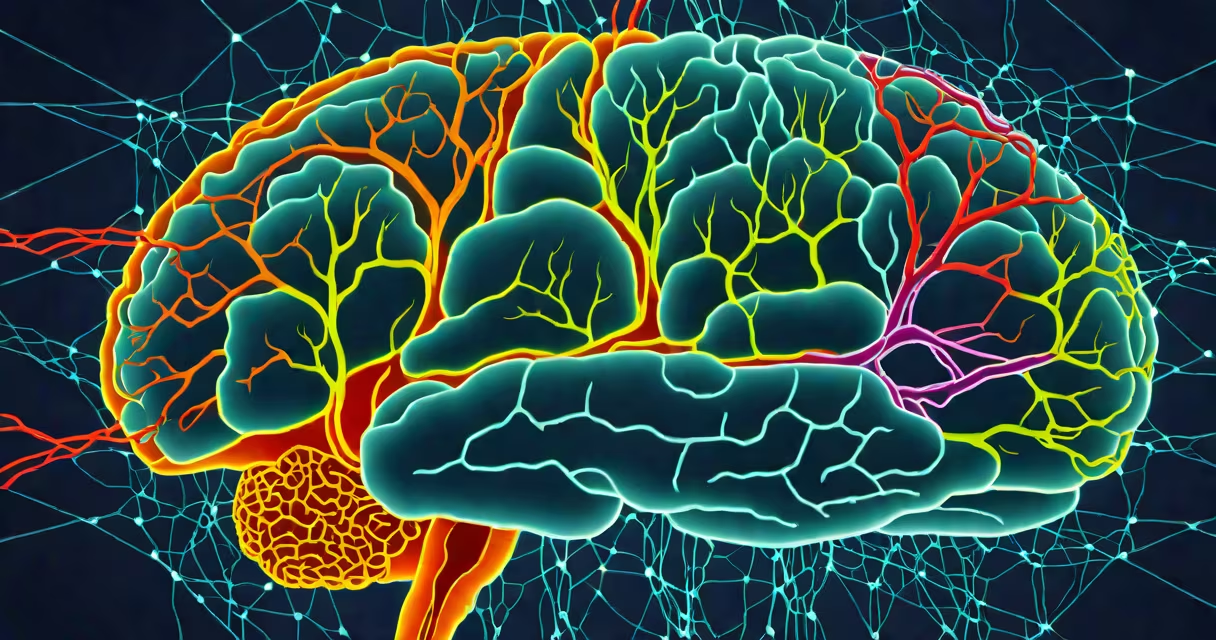
matter and consciousness refers to the unresolved scientific and philosophical challenge of explaining how physical processes in the brain give rise to subjective experience. This includes sensations, thoughts, emotions, and self-awareness-all phenomena that feel immediate and personal, yet emerge from measurable neurons firing in the skull.
The core issue lies in bridging the gap between objective data-like electrical signals, chemical reactions, and brain scans-and the internal, qualitative nature of experience. For example, when you taste chocolate, your brain registers specific patterns of activity, but no known measurement captures the actual sensation of sweetness.
Neuroscience identifies neural correlates of consciousness (NCCs)-specific brain regions and activity patterns linked to conscious states. The prefrontal cortex, thalamus, and posterior cortical areas show consistent activation during wakefulness and attention. Yet even with advanced fMRI and EEG, researchers cannot predict what a person feels based solely on brain activity patterns.
Consciousness arises from complex interactions among billions of neurons. These cells communicate via synapses using neurotransmitters like dopamine and glutamate. When stimulated, neurons fire action potentials-electrical pulses that travel along axons and trigger chemical release at junctions.
These processes form networks that process sensory input, regulate behavior, and maintain memory. Damage to certain areas disrupts conscious function: stroke in the parietal lobe may cause unawareness of limbs, while coma results from widespread neural suppression.
Despite this, no single neuron or circuit generates subjective awareness. Instead, consciousness appears to emerge from large-scale integration of information. The Integrated Information Theory (IIT), proposed by neuroscientist Giulio Tononi, suggests that consciousness corresponds to the amount of integrated information a system can generate. A system with high Φ (phi) values-measuring information integration-is more likely to be conscious.
Scientists and philosophers have developed several frameworks to explain how matter gives rise to consciousness. These differ in assumptions about whether consciousness is fundamental or emergent.
| Model | Core Idea | Key Proponent | Limitation |
|---|---|---|---|
| Physicalism | Consciousness is entirely produced by brain processes. No non-physical elements exist. | David Chalmers (as a position he challenges) | Fails to explain why specific neural activity feels like anything at all. |
| Dualism | Mind and matter are separate substances. Consciousness exists independently of the brain. | René Descartes | No mechanism explains how mind and body interact; contradicts known physics. |
| Panpsychism | Consciousness is a fundamental property of matter, present even at subatomic levels. | Galen Strawson | Lacks empirical evidence; difficult to test or falsify. |
| Emergentism | Consciousness emerges from complex systems, like water emerging from H₂O molecules. | John Searle | Doesn't specify how or when emergence occurs; vague on threshold conditions. |
Each model attempts to resolve the "hard problem" of consciousness-the difficulty of explaining why and how subjective experience arises from physical processes. Physicalism dominates neuroscience but struggles to account for qualia (subjective qualities like redness or pain).
Many assume that because we can measure brain activity during conscious tasks, we've solved the mystery of matter and consciousness. That's incorrect. Correlation is not causation. Just because the brain lights up during decision-making doesn't mean the activity causes the decision-or the feeling of making it.
Another misconception is that artificial intelligence (AI) can achieve consciousness. Current AI systems simulate responses based on data patterns. They lack subjective experience, introspection, or emotional valence. A chatbot may describe sadness but does not feel it. The absence of phenomenology in AI confirms that processing complexity does not imply consciousness.
A lesser-known but critical point: consciousness is not uniform across species. Humans report rich inner lives, but evidence from animals remains indirect. Studies on crows show tool use and problem-solving, but we cannot verify whether they experience intentionality or self-awareness. Similarly, patients in persistent vegetative states show brain activity but no behavioral signs of awareness. These cases show that brain function and conscious presence are not always aligned.
In 2014, a man named B.B. suffered a stroke affecting his left temporal lobe. He lost the ability to recognize faces-a condition called prosopagnosia-but retained normal vision and memory. Functional MRI showed reduced activity in the fusiform face area (FFA), a region specialized for facial recognition.
B.B. could describe facial features accurately and match photos to names, but failed to identify familiar people-even his wife. His brain processed visual data, but the integration necessary for recognition failed. This illustrates that matter and consciousness are not simply about signal transmission. It's about meaningful synthesis: the brain must bind features into a coherent whole.
When asked why he couldn't recognize his wife, B.B. said, "I see her, but I don't know who she is." That statement captures the essence of the matter and consciousness problem: the brain functions, but the self-the "I"-is absent. The neural machinery is intact, but the subjective experience of identity is missing.
I once attended a neuroscience conference where researchers displayed real-time fMRI scans of subjects watching emotionally charged videos. One participant, a woman in her 30s, showed intense activation in the amygdala and insula-regions tied to fear and bodily awareness-while viewing a scene of a child falling.
Afterward, she reported feeling nothing. She said, "I knew it was sad, but I didn't feel it." Her brain lit up, but her subjective response did not follow. This mismatch demonstrated that neural activity alone does not guarantee conscious experience. The same scan pattern can occur with or without emotion, depending on context and individual differences.
Understanding this relationship impacts medicine, ethics, and technology. In clinical settings, distinguishing between brain activity and awareness helps diagnose disorders of consciousness. Patients with locked-in syndrome, for example, are fully aware but unable to move or speak. Without tools to detect their inner state, care becomes misaligned.
As AI advances, debates around machine sentience grow urgent. If machines mimic human behavior perfectly, do they deserve rights? The answer hinges on whether matter and consciousness are truly linked-or if behavior alone suffices.
Research continues through projects like the Human Brain Project and the BRAIN Initiative. These aim to map neural circuits and simulate brain function. But even with complete wiring diagrams,: will we understand consciousness, or merely reproduce its appearance?
Matter and consciousness represents one of the deepest unsolved problems in science. We can locate where awareness begins in the brain, but not why it feels like something to be aware. This gap persists despite decades of progress in neuroscience and philosophy.