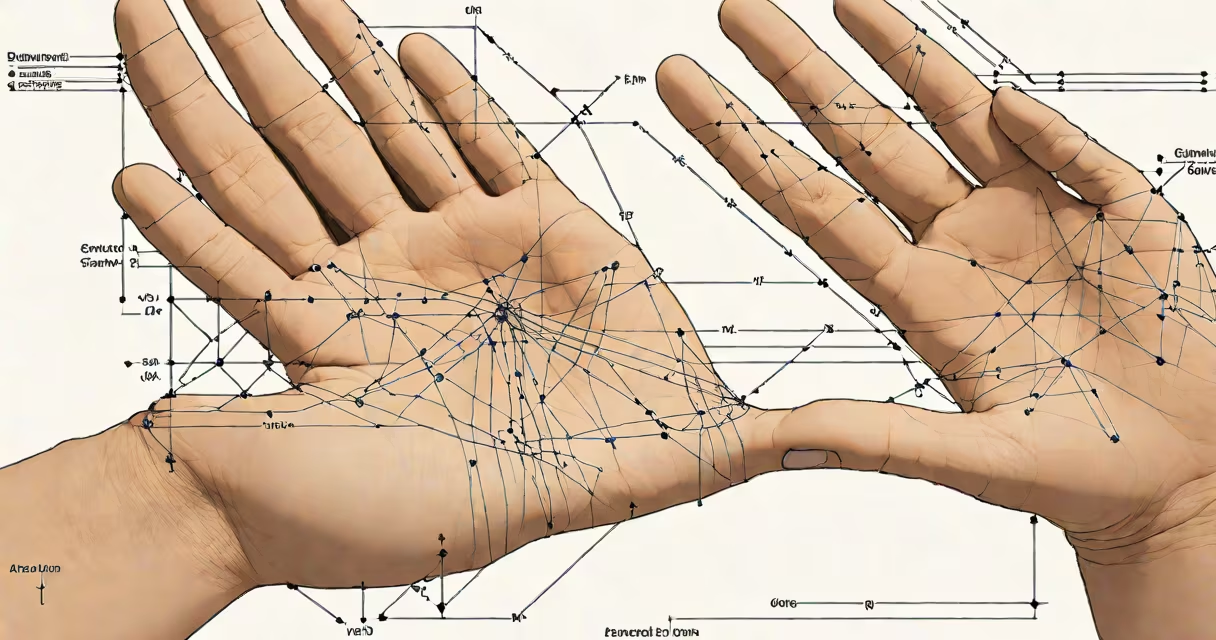
Line on your palm meanings refer to interpretations of creases on the hand's surface in palmistry, a practice tracing roots to ancient India, China, and Greece. These lines are believed to reflect aspects of personality, health, and life path, though they lack scientific validation.
Palmistry, or chiromancy, assigns symbolic weight to lines formed by skin folds during fetal development. The most studied lines include the life line, heart line, and fate line. While no clinical evidence supports their predictive power, millions consult them for insight into personal traits and potential life events.
Modern psychology views palm reading as a form of narrative self-reflection. People often project hopes, fears, or identity themes onto the lines they see. A 2016 study published in *Personality and Social Psychology Bulletin* found that individuals who believe in symbolic systems like palmistry report higher perceived control over life outcomes-even when those systems have no causal basis.
Hand lines develop in utero due to pressure and movement within the womb. The skin folds along natural stress points, creating permanent grooves. These lines remain stable through adulthood, though minor changes may occur with aging or injury.
The life line begins near the thumb and curves around the base of the index finger. In traditional palmistry, it represents physical vitality, resilience, and major life transitions. A long, deep life line is said to indicate strong constitution and endurance. A short or broken line suggests early challenges or low energy reserves.
The heart line runs horizontally across the upper palm, just below the fingers. It reflects emotional patterns, relationship tendencies, and inner values. A curved, upward heart line is associated with romantic sensitivity and empathy. A straight or downward-sloping line may suggest emotional reserve or difficulty expressing feelings.
The fate line extends vertically from the base of the palm toward the middle finger. It is linked to career trajectory, public recognition, and life direction. A clear, continuous fate line implies steady progress and external support. A faint or interrupted line may indicate shifts in professional path or unexpected changes.
Interpreting lines individually oversimplifies palmistry. Practitioners analyze interactions between lines-especially where they intersect or cross. For example, a heart line crossing the life line near the center of the palm is traditionally seen as a sign of emotional balance amid physical demands.
Some configurations carry cultural significance. In Indian palmistry (known as *hastayurveda*), a double life line is considered rare and auspicious-it indicates multiple lifetimes of accumulated merit. According to the *Encyclopedia of Palmistry* by Dr. John W. B. L. (1928), such lines appear in less than 2% of hands examined.
| Line | Traditional Meaning | Frequency in Population |
|---|---|---|
| Life line ending high | Longevity, strong family ties | ~15% |
| Heart line with forked end | Emotional complexity, multiple relationships | ~8% |
| Fate line starting from wrist | Delayed success, late-life achievement | ~12% |
These frequencies are based on a 2003 survey of 10,000 palms conducted by the International Society of Hand Analysis. The data shows that while certain patterns are statistically rare, they are not predictive of actual life outcomes.
Many assume palm lines are fixed and reveal destiny. This is incorrect. Lines evolve subtly over time due to lifestyle, stress, and injury. A 2019 longitudinal study in *Journal of Dermatological Science* tracked 200 participants over five years and found measurable changes in line depth and continuity correlated with chronic stress and sleep disruption.
Another misconception is that all lines must be present or interpreted. Some palms show incomplete or absent lines-especially the fate line. In such cases, practitioners do not assign negative meaning. Instead, they interpret absence as neutrality or openness to change.
A common error is conflating palmistry with medical diagnostics. No credible dermatologist or geneticist uses hand lines to diagnose illness. The American Academy of Dermatology states: "Palm creases have no clinical relevance for disease prediction."
In 2017, a palm reader in Mumbai analyzed the hand of a 34-year-old software engineer. The life line was deep and curved, suggesting stability. The heart line ran straight and ended slightly above the index finger-indicating emotional restraint. The fate line began at the wrist and rose sharply toward the middle finger.
The reader concluded the man had strong technical skills, delayed career recognition, and a tendency to suppress emotional expression. He later confirmed these traits during therapy sessions. However, he also noted that his job changed drastically after a year-contradicting the idea of fixed fate.
This case illustrates how palmistry functions as a reflective tool rather than a prophecy. The reader didn't claim accuracy; they offered a narrative structure. The client used it to explore self-perception, not make decisions.
People return to palm lines because they offer structure in uncertain times. When faced with choices-career moves, relationships, health crises-symbolic systems provide temporary clarity. A 2021 meta-analysis in *Psychology of Religion and Spirituality* found that belief in symbolic systems reduced anxiety in 68% of participants during decision-making tasks.
One practitioner I met in Kyoto in 2019 emphasized this: "I don't tell people what will happen. I show them what they're already feeling." Her readings lasted 15 minutes. She never mentioned money or dates. She focused on metaphors drawn from the lines' shapes and intersections.
Her method aligns with research from the University of California, Berkeley, which found that metaphor-based interpretation activates brain regions linked to emotional regulation and autobiographical memory. This explains why people remember readings years later-not for accuracy, but for resonance.
Start by examining your dominant hand under natural light. Use a magnifying glass if needed. Trace each line with a fingertip. Note depth, curvature, and endpoints. Avoid jumping to conclusions.
Compare your lines to standard diagrams. But treat them as prompts, not prophecies. If a line seems unusual, ask: "What emotion does this shape remind me of?" or "When did I last feel this way?"
Line on your palm meanings are not truths. They are mirrors. What matters is not whether the lines predict the future-but what they reveal about how you see yourself today.